
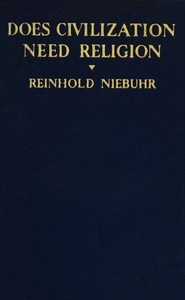
Does civilization need religion? : A study in the social resources and…
Reinhold Niebuhr's Does Civilization Need Religion? isn't a story in the traditional sense. Think of it as a deep, urgent conversation with one of the 20th century's sharpest minds. Published in 1927, it was written in the shadow of World War I, a time when people were deeply disillusioned and questioning everything they thought they knew about progress and human nature.
The Story
Niebuhr sets up a simple but powerful problem. Civilization, he says, is built on ideals like justice, compassion, and sacrifice. But humans are naturally self-interested and tribal. Our selfish instincts constantly work against these high-minded goals. So, what force can possibly motivate us to consistently choose the harder, more ethical path? His argument is that secular systems—like reason, education, or social pressure—aren't strong enough. They create rules, but they don't create the deep, personal conviction needed to follow those rules when it really costs us. Religion, for Niebuhr, provides that missing piece. It roots our moral demands in a sacred, unchanging reality, giving them a power and authority that purely human ideas lack. The 'plot' of the book is his journey through this argument, examining history, psychology, and politics to see what happens when a society tries to build itself on sand instead of stone.
Why You Should Read It
You should read this not to agree with it, but to be challenged by it. Even if you're not religious, Niebuhr's diagnosis of society's ills is startlingly relevant. When you see political polarization, or corporations putting profit over people, or our struggle to make sacrifices for the environment, you can hear echoes of his warning about 'un-grounded' ideals. His writing is direct and lacks the technical jargon that plagues a lot of philosophy. He's a pastor talking to his community, not a professor lecturing a class. Reading him feels like having a tough, honest friend point out the flaws in your best-laid plans.
Final Verdict
This book is perfect for anyone feeling uneasy about the state of the world and looking for a historical perspective that goes deeper than the daily news cycle. It's for the thoughtful reader, the skeptic, and the seeker. Whether you're a person of faith wondering about religion's role in public life, or a secular person curious about why moral frameworks seem to be crumbling, Niebuhr provides a compelling, serious argument you'll be turning over in your mind for weeks. It's not an easy answer, but it's an essential question, asked with brilliant clarity.
Margaret Perez
7 months agoFive stars!
Donald Taylor
1 year agoTo be perfectly clear, the atmosphere created is totally immersive. Exceeded all my expectations.
Mark Clark
2 months agoHigh quality edition, very readable.


Barbara White
1 year agoAs someone who reads a lot, the clarity of the writing makes this accessible. Exceeded all my expectations.