
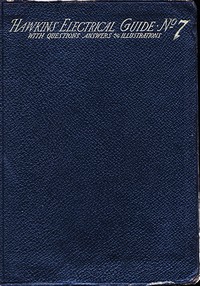
Hawkins Electrical Guide v. 07 (of 10) by N. Hawkins
Let's be clear from the start: this is not a novel. Hawkins Electrical Guide Number Seven is a technical manual, part of a ten-volume set first published in 1914. There's no protagonist, unless you count electricity itself. The ‘plot’ is the logical progression of electrical engineering concepts as understood in the early 20th century. This volume focuses heavily on measurement and control. It meticulously explains how to use instruments like galvanometers and voltmeters, dives into the principles behind various types of motors (like shunt and series motors), and details complex control systems for these machines.
The Story
There isn't a narrative story in the traditional sense. Instead, the book follows the ‘story’ of an idea: mastering electrical power. It starts with the fundamental challenge of measuring electrical current and voltage accurately—without these tools, you're working blind. From there, it builds on that knowledge to explain how to construct and, most importantly, control electric motors. It walks you through wiring diagrams, explains the purpose of each component like resistors and field windings, and discusses the practical problems engineers faced, like how to start a motor without burning it out or how to reverse its direction. The ‘climax’ is the application of all these principles into functional, reliable systems that could run factories or streetcars.
Why You Should Read It
I picked this up out of historical curiosity and was completely drawn in by the voice. Nehemiah Hawkins writes with a palpable sense of wonder and absolute confidence. He’s not just listing facts; he’s a guide, excited to show you how it all fits together. Reading this today is a stark reminder of how much we take for granted. Our smartphones are black boxes of mystery, but Hawkins’s world is one of open panels, visible brushes on commutators, and hands-on understanding. It’s a masterclass in foundational knowledge, written in a way that assumes intelligence but not prior expertise. You get a real sense of the ingenuity of the era—solving big problems with clever mechanics and early electronics.
Final Verdict
This book is perfect for tinkerers, history of science enthusiasts, and anyone with a patient curiosity about how things work. It’s not a light read, but it’s a profoundly satisfying one. If you enjoy old technical diagrams, primary source material from the Industrial Age, or just want to understand the literal mechanics behind our modern world, this volume is a treasure. It’s not for someone looking for a quick narrative fix, but for the right reader, it’s like sitting in a workshop with a brilliant, enthusiastic teacher from 1914.
Steven Thompson
7 months agoLoved it.
Kimberly Wilson
2 years agoSimply put, the character development leaves a lasting impact. I would gladly recommend this title.
Richard Lewis
9 months agoThis is one of those stories where the content flows smoothly from one chapter to the next. I couldn't put it down.
Joshua Perez
1 year agoA must-have for anyone studying this subject.





George Hill
11 months agoSolid story.