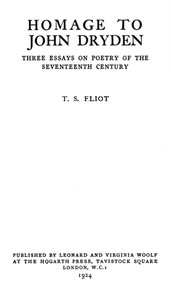
Homage to John Dryden: Three Essays on Poetry of the Seventeenth Century by Eliot
Let's be clear: this isn't a novel with a plot. It's a series of three connected essays where T.S. Eliot, the poet who gave us 'The Waste Land,' turns his sharp eye on three 17th-century poets: John Dryden, John Milton, and the Metaphysical poets like John Donne. He's not just listing facts; he's building a case.
The Story
Eliot's 'story' is an argument about change. He starts by looking at the Metaphysical poets (Donne, Marvell, etc.), praising their ability to fuse thought and feeling into surprising images. Then, he examines John Milton, who he sees as a magnificent but isolating influence—a poet who used language in a way that was hard for others to follow. Finally, he gets to his main point: John Dryden. Eliot presents Dryden as the hero who rescued English poetry. Dryden, he argues, created a new, clear, and flexible language fit for public discourse and reason—the language that would shape the next great age of poetry. The 'plot' is this intellectual journey from private complexity to public clarity.
Why You Should Read It
You should read it because Eliot makes old poetry feel urgent. He writes as a practicing poet, not just a scholar. When he talks about Dryden's 'prose' style in verse, you feel him wrestling with the same problems in his own work. His famous idea of the 'dissociation of sensibility'—the notion that thought and feeling split apart after the 17th century—is presented here in its raw, early form. It's thrilling to watch a major literary mind form its big ideas. Even when you disagree with him (and many do, especially on Milton), the force of his opinion is captivating. He treats these centuries-dead writers like contemporaries he admires or argues with.
Final Verdict
This book is perfect for curious readers who enjoyed poets like Donne or Auden and want to understand the bridges between eras. It's also great for anyone who thinks literary criticism has to be dull; Eliot's voice is too strong and personal for that. It's a short, dense read, so take it slow. Don't pick it up for a simple history lesson. Pick it up to spend time inside the mind of T.S. Eliot as he reshapes how we see the entire landscape of English poetry. You'll come away looking at the 17th and 18th centuries—and maybe even modern poetry—with completely new eyes.