1

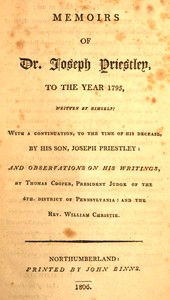
Memoirs of Dr. Joseph Priestley — Reading Companion
(0 User reviews)
147
Project Gutenberg
2025
Not confirmed
Priestley, Joseph, 1733-1804; Chemists -- Great Britain -- Biography
Readers of public-domain and historical texts
Project Gutenberg digital edition
en
Edition facts
Words
74,856
Reading time
326 min
Text sections
18
The source record for Memoirs of Dr. Joseph Priestley — Reading Companion measures this digital text at 74,856 words, 5 hr 26 min estimated reading time, and 18 detected text sections.
The text analysis averages about 26.7 words per sentence, while the detected sections provide another way to judge how the source is divided.
Project Gutenberg metadata also associates the work with “Priestley, Joseph, 1733-1804,” connecting these edition facts with the source record’s subject description.
Source:
Project Gutenberg record #75111
This edition combines Priestley's own memoir to 1795 with his son's continuation and critical appraisals by Thomas Cooper and William Christie, offering a multi-voiced account of his life, scientific work, and religious thought.
Editorial Edition Score
4.8/5
★★★★★
★★★★★
Calculated from edition completeness, EPUB availability, text structure and catalogue metadata. Not a user rating.
How this score is calculated
- Description quality20 pts
- Title & short description10 pts
- Source metadata20 pts
- Text length15 pts
- Chapters / structure15 pts
- EPUB file integrity20 pts
Total of 100 points, scaled to a 2.5-5.0 range. Editions with an empty description or a missing EPUB file are not scored.
Edition quality
Public-domain source text
Read the source text
The source text is kept in the dedicated reader, separate from this catalogue record and its commentary.
The Memoirs of Dr. Joseph Priestley is a composite work, structured in three distinct parts: Priestley's own autobiographical narrative to 1795, a continuation by his son Joseph Priestley covering the final years, and two critical appendices by Thomas Cooper and William Christie assessing his scientific and metaphysical writings. This layered arrangement creates a dialogue between the subject's self-presentation and external evaluation, inviting readers to compare firsthand testimony with later analysis.
The son's preface signals the editorial approach: the original memoir is presented with only "one or two trifling alterations," preserving what he calls the "simple unaffected manner" of the writing. This fidelity to Priestley's own voice sets the tone for a work that values directness over embellishment.
A Life in Three Acts
The book's tripartite structure mirrors Priestley's own division of his life into phases: his early years and education, his scientific career in England, and his final decade in America after the Birmingham riots. The son's continuation picks up the narrative seamlessly, noting that Priestley abandoned even the idea of a temporary return to England due to the political climate there. The appendices then step back to evaluate the whole career, with Cooper focusing on chemistry and natural philosophy, and Christie on metaphysics and theology.
This arrangement allows the reader to trace how Priestley himself shaped his story, then see how his son reframed it for a posthumous audience, and finally encounter two contemporary critics who assess his legacy from different disciplinary angles. The result is a polyphonic biography that resists a single authoritative interpretation.
Recurring Images: The Diary and the Plan
One of the most striking details in the son's continuation is the description of Priestley's lifelong practice of keeping a diary. From his time at the academy until within three or four days of his death, he recorded daily occurrences, reading (with exact page counts), and any hints suggested by his studies. He also began each year by arranging a plan of study and ended it by reviewing his progress. The son notes that this practice was "a source of great satisfaction" and was initially adopted to regulate his studies, then continued from pleasure.
This image of systematic self-accounting recurs throughout the memoir: Priestley is portrayed as a man who apportioned his time strictly, adhered to a regular plan of alternate study and relaxation, and never materially deviated from it. The diaries themselves, mostly destroyed in the Birmingham riots, become a symbol of both the orderliness of his mind and the violence that disrupted his life.
Movement Between Scenes: England and America
The narrative moves between two geographical poles: England, where Priestley achieved his scientific reputation and suffered the destruction of his library and apparatus, and America, where he found "peace" and "ease in his circumstances" at Northumberland. The son's account explicitly contrasts the two: in England, Priestley's discoveries added to the credit of the nation; in America, he was not obliged to withdraw his name from the Philosophical Society, and he was "suffered to live in peace."
This spatial contrast is not merely descriptive but evaluative. The son argues that the American system, placing all religious sects on the same footing, "effectually secured the peace of the community" and promoted truth and virtue. The movement from Birmingham to Northumberland thus becomes a movement from persecution to tolerance, from disruption to productivity. The text notes that Priestley did little at Hackney compared to what he achieved in Birmingham or America, because his time was "very much broken in upon by company"—a telling detail about the social pressures of his English life.
The Critical Appendices: Cooper and Christie
The final sections of the volume shift from narrative to analysis. Thomas Cooper's appendix provides an account of Priestley's discoveries in chemistry and his writings on scientific subjects, while William Christie's covers his metaphysical writings. These are not mere summaries but evaluative essays that engage with Priestley's ideas and their reception. Cooper, a judge and political figure, brings a legal precision to his assessment of Priestley's scientific method; Christie, a clergyman, examines the theological implications of his materialism.
Together, these appendices serve as a contemporary critical response, offering readers of the 1806 edition a framework for understanding Priestley's intellectual legacy. They also reflect the collaborative nature of the volume: the memoir is not a single author's work but a collective project involving family and friends, each contributing from their own expertise.
Readers approaching this edition should be aware that it offers not one but several portraits of Priestley: his own, his son's, and those of two sympathetic but critical contemporaries. The shifts in voice and perspective reward careful attention, as do the recurring motifs of order, diary-keeping, and geographical movement. The appendices, often overlooked, provide essential context for understanding how Priestley's work was received in the early nineteenth century and how his reputation was shaped by those closest to him.
Reading Priestley’s quiet account of his own life, I thought of old letters my grandfather kept—half-finished sentences, voices layering on top of each other. That same feeling came once from The Memoirs of Jacques Casanova de Seingalt, 1725-1798. Volume 03: Military Career — A Reader’s Guide, where a man’s self-description wobbles between truth and self-forgiveness, just as Priestley’s does. Both books felt less like history, more like eavesdropping on a private apology.
There are no reviews for this eBook.
There are no comments for this eBook.
Reader reflection
What was your reading experience?
Capture what you thought, learned, and would like to remember.
Your progress
0
/
10
2
Was reading this book enjoyable?
3
How likely are you to recommend this book?
4
Did the language feel accessible?
5
Was the book what you thought it would be?
6
Which element worked best for you?
7
Did anything about the book feel genuinely new?
8
What was its emotional impact?
9
What is the main idea you are taking away?
10