1

Memoirs of John R. Young, Utah Pioneer, 1847 — Context and Discussion
(0 User reviews)
1109
Project Gutenberg
2014
Not confirmed
Young, John R., 1837-; Latter Day Saint pioneers -- Utah -- Biography
Readers of public-domain and historical texts
Project Gutenberg digital edition
en
Edition facts
Words
86,894
Reading time
378 min
Text sections
10
This digital edition of Memoirs of John R. Young, Utah Pioneer, 1847 — Context and Discussion is described by source-level measurements including 86,894 words, 6 hr 18 min estimated reading time, and 10 detected text sections.
The text analysis averages about 18.5 words per sentence, while the detected sections provide another way to judge how the source is divided.
Project Gutenberg metadata also associates the work with “Young, John R., 1837-,” connecting these edition facts with the source record’s subject description.
Source:
Project Gutenberg record #46391
John R. Young's 1920 memoir recounts his 1847 pioneer trek to Utah, missionary service in Hawaii and England, and close association with Brigham Young, using plainspoken diction, verse interludes, and vivid sensory details.
Editorial Edition Score
4.8/5
★★★★★
★★★★★
Calculated from edition completeness, EPUB availability, text structure and catalogue metadata. Not a user rating.
How this score is calculated
- Description quality20 pts
- Title & short description10 pts
- Source metadata20 pts
- Text length15 pts
- Chapters / structure15 pts
- EPUB file integrity20 pts
Total of 100 points, scaled to a 2.5-5.0 range. Editions with an empty description or a missing EPUB file are not scored.
Edition quality
Public-domain source text
Read the source text
The source text is kept in the dedicated reader, separate from this catalogue record and its commentary.
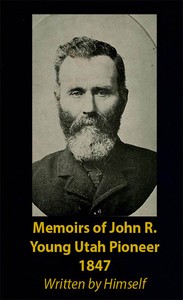
John R. Young opens his 1920 memoir not with his birth but with a poem on the power of words, calling them “the soul’s ambassadors.” This choice signals a narrator who values direct expression and moral reflection. The memoir, written when Young was in his eighties, covers his 1847 pioneer journey to Utah as a child, his missions to Hawaii and England, and his decades of church service. Young’s prose is plain and unadorned, but he frequently breaks into verse—often to praise fellow church leaders like Joseph F. Smith—and includes letters, journal entries, and financial reports. The result is a hybrid text that blends personal recollection with documentary evidence, offering a firsthand view of Mormon institutional life in the nineteenth century.
Diction and the Plain Style
Young’s sentences are short and declarative, with little ornament. He writes, “I had bread and herrings for breakfast, dinner, and supper” to describe a day of fasting. When he records a letter from a sister in the gospel, he lets her words stand without commentary: “I can truly say that from the time you were here, a great weight of sorrow has been lifted off my heart.” This restraint gives the memoir a documentary feel. Young rarely editorializes; instead, he presents events and lets the reader infer. His vocabulary is concrete—rawhide soup, thistles, crickets, sea gulls—and he favors action verbs: “walked,” “preached,” “visited.” The plain style suits a man who describes himself as more comfortable with labor than with rhetoric.
Verse as Personal Tribute
Young inserts original poems at key moments, often to honor church leaders. His lines on Joseph F. Smith—“I knew Joseph F. Smith, in life’s rosy morn. / When herding cows, and plowing corn”—are metrically rough but affectionate. The poems function as eulogies, not literary exercises. They reveal Young’s emotional register: he admires physical endurance, humility, and loyalty. The verse on Smith’s Hawaiian mission—“Poi, paakai, poverty and shame, / Were all endured, for the blessed Savior’s name”—uses Hawaiian words (poi, paakai) to ground the tribute in specific experience. These poems are the memoir’s most personal feature, offering a counterpoint to the otherwise factual prose.
Dialogue and Reported Speech
Young rarely reproduces extended dialogue, but he includes letters and quoted statements that serve as indirect speech. A letter from Jane Roach, for instance, is given in full: “I can truly say that from the time you were here, a great weight of sorrow has been lifted off my heart.” Young’s response—“It is always a comfort to me to know that I have been a comfort to others”—is the closest he comes to self-reflection. He also reports public exchanges, such as an open-air discussion with a city postmaster and a Methodist revival where he was invited to pray. At the revival, he “thanked the Lord for having raised up the Prophet Joseph Smith,” which he notes “advertised my coming meeting better than my hand bills had done.” These episodes show Young’s strategic use of speech to advance his missionary work.
Sensory Details of Place and Hardship
Young’s descriptions are spare but vivid. In Plymouth, he lodges in a garret “four stories high” with a window overlooking “the Plymouth Starch Works’ back yard, a filthy, stinking hole; and the room literally swarmed with rats and mice.” He admits, “like any woman, I am in mortal terror” of rodents—a rare personal disclosure. In contrast, he notes the beauty of a park with “a large herd of fallow deer” and writes, “How beautiful they looked!” His eye for detail extends to weather: “Out-door wall flowers are in bloom, while fruit buds are swelling, as if spring were at hand.” These sensory observations ground the narrative in physical reality, whether the squalor of a Plymouth garret or the mild January of Bristol.
Young’s memoir rewards readers who attend to small details: a line of verse, a quoted letter, a mention of rawhide soup. The author’s voice emerges not through grand statements but through the accumulation of precise, unadorned observations. Readers should approach the text as a mosaic of primary sources—journal entries, poems, correspondence—rather than a continuous narrative. The gaps between episodes are as telling as the episodes themselves, revealing what Young chose to record and what he left unsaid.
That rainy afternoon, John Young’s plainspoken voice followed me into the dusk, his Hawaii missionary days lingering like wet earth. Later, idly, I picked up The Gallery of Portraits: with Memoirs. Volume 5 (of 7) — Edition Insights and found the same quiet gravity—faces and lives, each a small, sensed presence. One book simply handed me to the other, no hurry at all.
There are no reviews for this eBook.
There are no comments for this eBook.
Reader reflection
How will you remember this book?
Save your reaction, strongest insight, and memorable passage.
Your progress
0
/
10
2
How did the book work for you overall?
3
Is this a title you would suggest to others?
4
How easy was the book to follow?
5
Did any part of the book stay with you emotionally?
6
Did the book deliver what you hoped for?
7
Would you like to discuss this book with someone?
8
Could you apply anything you learned?
9
What changed or sharpened your thinking?
10