1

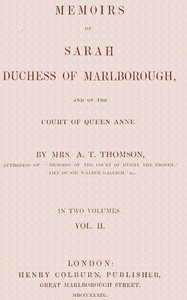
Memoirs of Sarah, Duchess of Marlborough, and of the Court of Queen Anne Vol. 2 (of 2) — Key Ideas to Explore
(0 User reviews)
224
Project Gutenberg
2021
Not confirmed
Great Britain -- Court and courtiers -- Biography; Marlborough, Sarah Jennings Churchill, Duchess of, 1660-1744
Readers of public-domain and historical texts
Project Gutenberg digital edition
en
Edition facts
Words
130,859
Reading time
569 min
Text sections
27
The catalog record for Memoirs of Sarah, Duchess of Marlborough, and of the Court of Queen Anne Vol. 2 (of 2) — Key Ideas to Explore provides practical reading context through 130,859 words, 9 hr 29 min estimated reading time, and 27 detected text sections.
The text analysis averages about 29.6 words per sentence, while the detected sections provide another way to judge how the source is divided.
Project Gutenberg metadata also associates the work with “Great Britain -- Court and courtiers -- Biography,” connecting these edition facts with the source record’s subject description.
Source:
Project Gutenberg record #65781
This editorial note examines Mrs. A. T. Thomson's narrative choices in volume two of her memoirs of Sarah, Duchess of Marlborough, focusing on her use of direct speech, comparative character sketches, and the interplay between public events and private emotion.
Editorial Edition Score
4.9/5
★★★★★
★★★★★
Calculated from edition completeness, EPUB availability, text structure and catalogue metadata. Not a user rating.
How this score is calculated
- Description quality20 pts
- Title & short description10 pts
- Source metadata20 pts
- Text length15 pts
- Chapters / structure15 pts
- EPUB file integrity20 pts
Total of 100 points, scaled to a 2.5-5.0 range. Editions with an empty description or a missing EPUB file are not scored.
Edition quality
Public-domain source text
Read the source text
The source text is kept in the dedicated reader, separate from this catalogue record and its commentary.
Mrs. A. T. Thomson opens this volume with a series of character sketches that serve as both introduction and judgment. The chapter headings themselves—'Character of Lord Peterborough—Of Lord Montague'—signal a methodical approach to portraiture. Thomson does not simply narrate events; she pauses to assess, often using contrasting pairs to sharpen her subjects. This technique, evident throughout the excerpts, gives the memoir a deliberative, almost judicial tone.
Direct Speech as Evidence
Thomson frequently incorporates direct quotations from her subjects, lending immediacy to her narrative. In the excerpt concerning the Duke of Marlborough's declining years, she reports his poignant exclamation upon viewing his own portrait: 'That was a man!' This single line, set off by quotation marks, carries more emotional weight than pages of description. Similarly, she reproduces the Duchess's sharp remark about saving sixpence, attributing it to 'his contemporary' but using it to illustrate character. Thomson's choice to include such speech acts suggests she values the authentic voice over paraphrase, even when the source is unnamed or anecdotal.
Comparative Portraiture
A distinctive feature of Thomson's style is her use of extended comparison to define her subjects. The most striking example in the excerpts is her parallel between Marlborough and Swift. She juxtaposes their fates in old age, noting that both suffered from the same 'mortal and humiliating disease,' but insists on their differences: Marlborough retained his reason and domestic comforts, while Swift descended into 'insanity' and isolation. Thomson marshals evidence—Marlborough's attendance in the House of Lords, his family's presence—to counter the popular notion of his 'imbecility.' This comparative method allows her to correct received opinion while also delivering a moral judgment on Swift's character.
The Interplay of Public and Private
Thomson consistently links political events to personal relationships. The chapter list reveals a pattern: 'Decline of the Duchess’s influence' is followed by 'Singular Letter from Anne in explanation.' The excerpts show Thomson weaving together court intrigues, such as Harley's maneuvers, with domestic scenes like the Duchess's 'affectionate attentions' to the Queen after Prince George's death. She presents the Duchess's political actions as extensions of her personal loyalties and grievances. This approach humanizes the historical narrative, but it also risks conflating motive with explanation—a choice Thomson makes explicit when she describes the Duchess's 'disappointment' at the Queen's coldness.
Narrative Voice and Moral Framing
Thomson's authorial voice is never neutral. She uses adjectives like 'kindly,' 'humane,' 'pure,' and 'religious' for Marlborough, while Swift is 'coarse, selfish, and profane.' These evaluative terms are woven into the syntax, not set apart as opinion. Thomson also employs rhetorical questions—'would he have been so careful to save a sixpence for the sake of his heir?'—to engage the reader in moral reflection. Her closing comparison of the two men's deaths is framed as a lesson in 'retributive justice.' This overt moralizing is a deliberate stylistic choice, aligning the memoir with the tradition of exemplary biography rather than dispassionate history.
Readers attentive to Thomson's diction will notice how she uses small details—a quoted phrase, a contrasting pair, a moral epithet—to shape interpretation. Her narrative is not a transparent window onto the past but a carefully constructed argument. To read these memoirs is to watch a Victorian biographer at work, selecting, comparing, and judging. The pleasure lies not only in the story of Sarah and Anne but in observing how Thomson builds her case.
There’s something moving in how Thomson captures Sarah’s public fury while hinting at the private loneliness beneath it, that old ache of being seen but not understood. It reminds me of the quiet determination in Annie Besant: An Autobiography, where a woman’s convictions cost her so dearly, yet she kept walking. Annie Besant: An Autobiography — Context and Discussion lingers there, too—between what we show and what we carry alone.
There are no reviews for this eBook.
There are no comments for this eBook.
Reader reflection
Take a moment to reflect on this book
Create a short personal record of your experience with this book.
Your progress
0
/
10
2
Did this book hold your interest?
3
Is this a title you would suggest to others?
4
How much effort did this book require?
5
Would you start a conversation about this book?
6
How well did it match your expectations?
7
Did anything about the book feel genuinely new?
8
Do you expect to return to this book?
9
What changed or sharpened your thinking?
10