1

Memoirs of the life of David Rittenhouse, LLD. F.R.S., late president of the American Philosophical Society, &c. — Key Ideas to Explore
(0 User reviews)
2145
Project Gutenberg
2023
Not confirmed
Rittenhouse, David, 1732-1796; Astronomers -- Pennsylvania -- Biography
Readers of public-domain and historical texts
Project Gutenberg digital edition
en
Edition facts
Words
182,349
Reading time
793 min
Text sections
31
This digital edition of Memoirs of the life of David Rittenhouse, LLD. F.R.S., late president of the American Philosophical Society, &c. — Key Ideas to Explore is described by source-level measurements including 182,349 words, 13 hr 13 min estimated reading time, and 31 detected text sections.
The text analysis averages about 27.7 words per sentence, while the detected sections provide another way to judge how the source is divided.
Project Gutenberg metadata also associates the work with “Rittenhouse, David, 1732-1796,” connecting these edition facts with the source record’s subject description.
Source:
Project Gutenberg record #72283
William Barton's 1813 memoir of astronomer David Rittenhouse, drawing on personal acquaintance and archival papers, traces Rittenhouse's scientific career, his role as Director of the Mint, and his presidency of the American Philosophical Society, with an appendix of previously unpublished writings.
Editorial Edition Score
4.9/5
★★★★★
★★★★★
Calculated from edition completeness, EPUB availability, text structure and catalogue metadata. Not a user rating.
How this score is calculated
- Description quality20 pts
- Title & short description10 pts
- Source metadata20 pts
- Text length15 pts
- Chapters / structure15 pts
- EPUB file integrity20 pts
Total of 100 points, scaled to a 2.5-5.0 range. Editions with an empty description or a missing EPUB file are not scored.
Edition quality
Read the Text
the end of the fourteenth century, continues the learned Baron, this absurd system arrived to a great height. It became a mere jargon, a confused heap of unintelligible ideas.
The celebrated Mr. Boyle, the great successor of Lord Verulam (St. Albans) in experimental philosophy, is said to have declared against the Philosophy of Aristotle, as having in it more of words than things; promising much and performing little; and giving the Inventions of Men for indubitable proofs, instead of building upon observation and experiment. He was so zealous for, and so scrupulous about, this true method of learning by experiment, that, though the _Cartesian_ philosophy then made a great noise in the world, yet he would never be persuaded to read the works of _Descartes_; for fear he should be amused, and led away, by plausible accounts of things founded on conjecture, and merely hypothetical. (See Art. _Boyle_, in the New and General Biography.)—This great and excellent man was born the same year in which Bacon, Viscount St. Albans, died.
Epicurus, the disciple of Democritus, and follower of the Philosophy of Aristotle, was engaged, although unsuccessfully enough, in the labyrinth of Metaphysics, as well as in Physics. He adopted the system of _Atoms_, which Democritus first propagated; and hence appears to be derived Descartes’s equally preposterous doctrine of the _Plenum_ and of _Vortices_.
To this cause, then, may be fairly attributed the half-enlightened notions of the Deity,[7] and of a future state, entertained by these pagan searchers after truth. To the same cause may be traced the sentiment that dictated the reply made by Anaxagoras,—when, in consequence of his incessant contemplation of the stars, he was asked, “_if he had no concern for his country?_”—“_I incessantly regard my country_,” said he, pointing to Heaven.
“Nulla gens tam fera, quæ non sciat Deum habendum esse, quamvis ignoret qualem habere deceat.”
CIC. de Naturâ Deorum.
Plato’s attention to the same celestial science unquestionably enlarged his notions of the Deity, and enabled him to think the more justly of the moral attributes of human nature. According to Plato—whose morality, on the whole, corresponds with the system maintained by Socrates,[8]—the human soul is a ray from the Divinity. He believed, that this minute portion of infinite Wisdom, Goodness and Power, was omniscient, while united with the Parent stock from which it emanated; but, when combined with the body, that it contracted ignorance and impurity from that union. He did not, like his master Socrates, neglect natural philosophy; but investigated many principles which relate to that branch of knowledge:—and, according to this philosopher, all things consisted of two principles,—_God_ and _matter_.
While Plato followed the morals of Socrates, he cultivated the metaphysical opinions of Pythagoras. He is said to have founded his physics on the notions of Heraclitus: it may be presumed, nevertheless, that he derived that branch of his system from a better source.
It is evident that Plato believed in the immortality of the soul of man; but he had, at the same time, very inadequate conceptions of the mode or state of its existence, when separated from the body. It seems to have been reserved for the Christian dispensation, to elucidate this great _arcanum_, hidden from the most sagacious of the heathen philosophers.[9] It was the difficulty that arose on this subject, the incapability of knowing how to dispose of the soul, or intellectual principle in the constitution of our species, after its disentanglement from the body; a difficulty by which all the philosophers, antecedent to the promulgation of Christianity, were subjected to unsurmountable perplexities;—it was this, that rendered even the expansive genius of Anaxagoras utterly incompetent to conceive of the possibility that the soul should exist, independent of some union with matter. He therefore invented the doctrine of the _Metempsychosis_; in order to provide some receptacle of organised matter for that imperishable intellectual principle attached to our nature here, after its departure from the human frame; and to which new vehicle of the vital spirit of its original but abandoned abode, the extinguished corporeal man, its union with it should impart the powers and faculties of animal life.
“_Reason_, tho’ taught by sense to range on high, To trace the stars and measure all the sky; Tho’ fancy, memory, foresight fill her train, And o’er the beast he lifts the pride of man; Yet, still to _matter_, _form_ and _space_ confin’d, Or moral truths or laws that rule mankind, Could ne’er, _unaided_, pierce the mental gloom, Explore _new_ scenes _beyond the closing tomb_, Reach with _immortal_ hope the blest abode, Or raise one thought of _spirit_ or of GOD.” _Vision of Columbus_, book VIII.
William Barton, a lawyer and member of the American Philosophical Society, wrote this memoir of David Rittenhouse in 1813, seventeen years after the astronomer's death. The work is explicitly based on Barton's personal knowledge of Rittenhouse—he notes the 'personal regard' between Rittenhouse and President Washington—and on papers supplied by Rittenhouse's family. The book's full title promises 'sundry philosophical and other papers, most of which have not hitherto been published,' and the appendix delivers on that claim. Barton's narrative voice is formal and occasionally defensive, especially when addressing Rittenhouse's involvement with the Democratic Society of Philadelphia.
Barton's Dual Role as Biographer and Defender
Barton does not present himself as a neutral chronicler. He writes as a friend of Rittenhouse and as a participant in the same intellectual circles. This proximity gives the memoir an insider's texture but also a defensive tone. The most striking example is Barton's lengthy justification of Rittenhouse's election as president of the Democratic Society in 1793. He argues that Rittenhouse was chosen because he was 'a man of unimpeachable patriotism and integrity,' and that his acceptance of the role did not diminish President Washington's esteem for him. Barton goes so far as to assert that Washington's reluctance to accept Rittenhouse's resignation from the Mint 'yielded only to the Doctor's urgent solicitation.' These passages reveal Barton's anxiety about how Rittenhouse's political associations might be judged by posterity.
The Democratic Society Episode as a Test Case
The extended discussion of the Democratic Society occupies a significant portion of the excerpts. Barton traces the society's origins to the Jacobin Club of Paris, quoting Chief Justice Marshall's Life of Washington to establish the connection. He then carefully distinguishes between the society's founders—whose 'secret designs' he implies were 'inimical to the true interest of the country'—and its members, many of whom were 'highly estimable and meritorious citizens' who joined without knowing the society's real aims. This distinction allows Barton to defend Rittenhouse without defending the society itself. The passage is notable for its legalistic structure: Barton presents evidence, anticipates objections, and builds a case. It is the most argumentative section of the excerpts and suggests that the memoir as a whole may be as much a political apologia as a scientific biography.
The Appendix as a Window into Rittenhouse's Papers
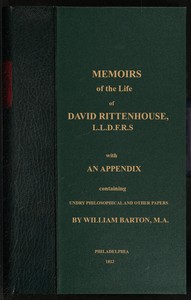
The title page announces an appendix containing 'sundry philosophical and other papers, most of which have not hitherto been published.' This appendix is a key feature of the book, offering readers access to primary sources that Barton used in composing the memoir. The excerpts do not include the appendix itself, but its existence shapes the reader's experience of the main text. Barton frequently refers to documents and letters, and the appendix presumably provides the evidence for his claims. For a reader interested in Rittenhouse's scientific work, the appendix may be the most valuable part of the volume. Barton's role as editor of these papers is itself a subject worth noting: he selects, arranges, and presumably annotates them, making his editorial choices part of the historical record.
The Texture of Early American Intellectual Life
Beyond the defense of Rittenhouse, the excerpts offer glimpses into the networks of early American science and politics. Barton mentions Rittenhouse's correspondence with 'many distinguished men,' and the catalog subjects list 'astronomers' and 'physics' as primary topics. The memoir is set against the backdrop of the American Revolution and the early republic, and Barton's language reflects the period's formal, Latinate prose style. Phrases like 'the shock given to the humane feelings of the American people, by the murder of Louis XVI' reveal the emotional temperature of the era. Readers should expect a work that is as much about the intellectual and political culture of the early United States as it is about Rittenhouse himself.
Barton's memoir rewards readers who approach it as a layered historical document rather than a straightforward biography. The defensive passages about the Democratic Society, the reliance on unpublished papers, and the formal prose all invite scrutiny of Barton's motives and methods. Readers interested in the politics of early American science will find this a rich, if partisan, source. The appendix, though not excerpted here, is likely the book's most enduring contribution.
There are no reviews for this eBook.
There are no comments for this eBook.
Reader reflection
Take a moment to reflect on this book
Create a short personal record of your experience with this book.
Your progress
0
/
10
2
What was your overall reaction to the book?
3
Would you encourage someone else to read it?
4
What was the reading difficulty like?
5
Could you follow the author’s main argument?
6
Would you start a conversation about this book?
7
Is this a title worth rereading?
8
What did you think about the pace?
9
What did this book teach you most?
10