1

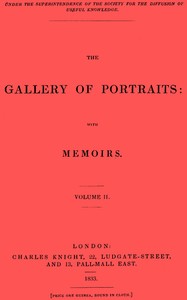
The Gallery of Portraits: with Memoirs. Volume 2 (of 7) — Reading Notes
(0 User reviews)
704
Project Gutenberg
2017
Not confirmed
Biography
Readers of public-domain and historical texts
Project Gutenberg digital edition
en
Edition facts
Words
84,232
Reading time
367 min
Text sections
26
For The Gallery of Portraits: with Memoirs. Volume 2 (of 7) — Reading Notes, the stored edition analysis reports 84,232 words, 6 hr 7 min estimated reading time, and 26 detected text sections.
The text analysis averages about 26.5 words per sentence, while the detected sections provide another way to judge how the source is divided.
Project Gutenberg metadata also associates the work with “Biography,” connecting these edition facts with the source record’s subject description.
Source:
Project Gutenberg record #55092
This volume presents 24 biographical memoirs paired with engraved portraits, from Lord Somers to Peter the Great. Malkin's structure moves from birth to legacy, weaving political, scientific, and artistic lives into a coherent sequence. Recurring motifs include patronage, travel, and the interplay of genius and circumstance.
Editorial Edition Score
4.9/5
★★★★★
★★★★★
Calculated from edition completeness, EPUB availability, text structure and catalogue metadata. Not a user rating.
How this score is calculated
- Description quality20 pts
- Title & short description10 pts
- Source metadata20 pts
- Text length15 pts
- Chapters / structure15 pts
- EPUB file integrity20 pts
Total of 100 points, scaled to a 2.5-5.0 range. Editions with an empty description or a missing EPUB file are not scored.
Edition quality
Public-domain source text
Read the source text
The source text is kept in the dedicated reader, separate from this catalogue record and its commentary.
Arthur Thomas Malkin's second volume of The Gallery of Portraits pairs engraved likenesses with biographical memoirs of twenty-four notable figures, from Lord Chancellor Somers to Peter the Great. The work's structure is deliberately sequential: each entry opens with the subject's birth and early circumstances, then traces education, career milestones, and final legacy. Across these lives, recurring images of travel, patronage, and the tension between inherited tradition and personal innovation create a cohesive pattern. Malkin frequently notes how a figure's formative environment—whether a Worcester clothier's house or the court of Mantua—shaped their later achievements.
From Birth to Legacy: A Repeating Arc
Each memoir follows a consistent trajectory: birth and parentage, early education (often described as 'meagre' or 'unsatisfactory'), rise to prominence, key works or actions, and final years. For Somers, the loss of parish registers during the civil wars is noted; for Rubens, the death of his mother prompts a decisive return to Antwerp. This structural repetition allows Malkin to highlight turning points—such as the Duke of Mantua selecting Rubens as an envoy—while maintaining a uniform biographical framework. The pattern reinforces the idea that great lives, however varied, share common stages of development.
Patronage and Mobility Across Europe
Movement between courts and countries is a persistent motif. Rubens travels from Mantua to Spain, then Rome, Genoa, and finally Antwerp; his diplomatic mission to Spain is described as an 'extraordinary' use of an artist's talents. Somers's family is linked to Admiral Sir George Somers, shipwrecked on the Bermudas. Malkin emphasizes how patronage—whether from a duke, a king, or a learned society—enables or redirects a career. The memoirs repeatedly show subjects crossing borders, carrying skills and reputations with them, and adapting to new cultural contexts.
The Interplay of Genius and Method
Malkin often dissects how a subject's working methods relate to their reputation. Rubens's practice of making small sketches for students to enlarge is described as a system that 'gave his own labour only to invention and finishing.' The text notes that his style 'with all its admirable qualities, was one in which the delicacies of form and expression were never allowed to stand in the way of despatch.' Such observations ground the portraits in concrete professional habits rather than abstract praise. Similarly, the memoir of Somers notes the difficulty of verifying his birth date due to lost records, foregrounding the historian's own methodological limits.
Recurring Images: Animals, Objects, and the Studio
Certain images recur across entries. Rubens keeps a collection of wild beasts as 'living models' for hunting scenes; his house is described as a 'princely museum' filled with pictures, statues, and vases. These details evoke a material world where objects and animals are integral to creative work. The memoirs also frequently mention portraits—Rubens executes a portrait of the King of Spain, and the volume itself is built around engraved portraits. This self-referential thread ties the biographies to the gallery format, reminding readers that each life is being visually as well as textually preserved.
Readers approaching this volume will find that its value lies less in exhaustive biography than in the cumulative effect of juxtaposed lives. Malkin's consistent structure invites comparison across entries: how does a painter's patronage differ from a statesman's? What role does travel play for a scientist versus a diplomat? The recurring motifs of mobility, method, and material culture offer a lens through which to view the entire gallery, making each portrait part of a larger conversation about achievement and circumstance.
There’s something about the way those old portraits linger, each life framed by what came before and after. Reading the gallery, I kept thinking of a different sort of memoir, one where the sea itself becomes the thread. It felt like stumbling upon a familiar room in an unexpected house. I set the volume down and picked up The Memoirs of Admiral Lord Beresford — A Closer Reading, and the afternoon slipped away quietly.
There are no reviews for this eBook.
There are no comments for this eBook.
Reader reflection
Before you leave, reflect on the book
Use these questions to collect your thoughts before moving on.
Your progress
0
/
10
2
Did this book hold your interest?
3
Would you recommend this book to another reader?
4
How much effort did this book require?
5
How useful were the ideas in this book?
6
How strong was your personal connection to the text?
7
How clearly were the main ideas presented?
8
How well did it match your expectations?
9
What changed or sharpened your thinking?
10