1

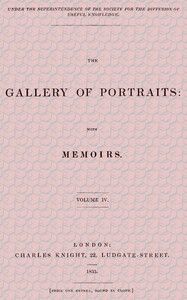
The Gallery of Portraits: with Memoirs. Volume 4 (of 7) — Background and Themes
(0 User reviews)
1897
Project Gutenberg
2017
Not confirmed
Biography
Readers of public-domain and historical texts
Project Gutenberg digital edition
en
Edition facts
Words
94,006
Reading time
409 min
Text sections
26
The catalog record for The Gallery of Portraits: with Memoirs. Volume 4 (of 7) — Background and Themes provides practical reading context through 94,006 words, 6 hr 49 min estimated reading time, and 26 detected text sections.
The text analysis averages about 26.4 words per sentence, while the detected sections provide another way to judge how the source is divided.
Project Gutenberg metadata also associates the work with “Biography,” connecting these edition facts with the source record’s subject description.
Source:
Project Gutenberg record #55688
Arthur Thomas Malkin's fourth volume of biographical sketches combines engraved portraits with concise memoirs, focusing on figures like Daguesseau, Cromwell, and Marlborough. The prose is marked by precise diction, evaluative judgments, and a narrative voice that balances factual summary with moral commentary.
Editorial Edition Score
4.9/5
★★★★★
★★★★★
Calculated from edition completeness, EPUB availability, text structure and catalogue metadata. Not a user rating.
How this score is calculated
- Description quality20 pts
- Title & short description10 pts
- Source metadata20 pts
- Text length15 pts
- Chapters / structure15 pts
- EPUB file integrity20 pts
Total of 100 points, scaled to a 2.5-5.0 range. Editions with an empty description or a missing EPUB file are not scored.
Edition quality
Public-domain source text
Read the source text
The source text is kept in the dedicated reader, separate from this catalogue record and its commentary.
Arthur Thomas Malkin's The Gallery of Portraits: with Memoirs, Volume 4, presents twenty-six biographical sketches of historical figures, each accompanied by an engraved portrait. The work, published under the superintendence of the Society for the Diffusion of Useful Knowledge, aims to instruct a broad readership through concise, morally-inflected narratives. Malkin's authorial choices are evident in his diction and sentence structure: he frequently employs evaluative adjectives such as 'signal overthrow' and 'gallant resistance,' and he integrates direct quotations from sources like Coxe's Life of Marlborough to lend authority. The memoirs are not neutral summaries; they carry implicit judgments, as when Malkin notes that Daguesseau's father 'was distinguished by mildness' during the persecution of Protestants, adding 'to his honour be it remembered.' This blend of factual reporting and moral commentary shapes the reader's perception of each subject.
Evaluative Diction and Moral Framing
Malkin's word choices consistently convey approval or disapproval. In the memoir of Daguesseau, he writes that the father 'was distinguished by mildness' and that 'one person only perished under his jurisdiction'—a pointed contrast to the surrounding persecution. The phrase 'to his honour be it remembered' explicitly invites moral judgment. Similarly, in the account of Marlborough's campaigns, Malkin describes the French defeat at Ramillies as a 'signal overthrow' and Lille's resistance as 'gallant.' These adjectives are not merely descriptive; they shape the narrative's moral landscape. The author also uses verbs that imply agency and character: Daguesseau 'resigned his Intendancy' out of disgust, while Marlborough 'manœuvred so ably' that the enemy never dared battle. Such choices reveal a consistent authorial stance that evaluates historical actors by their conduct, not just their achievements.
Narrative Structure and the Use of Sources
Each memoir follows a chronological arc from birth to death, but Malkin varies the pace by expanding on key episodes. The Daguesseau entry, for instance, devotes considerable space to the father's career before turning to the son, establishing a familial context. In contrast, the Marlborough section moves swiftly through a series of battles, punctuated by a lengthy quotation from Coxe. This quotation—nearly eighty words—is the only extended borrowing in the excerpts, and it serves as a climax, summarizing the 'extraordinary campaign' with the historian's own rhetorical flourish. Malkin's reliance on a single source for this passage suggests a selective approach to evidence: he prioritizes vivid, authoritative testimony over multiple perspectives. The result is a narrative that feels both factual and crafted, with the author acting as a curator of memorable details rather than an impartial chronicler.
Recurring Patterns in Description and Setting
Across the excerpts, Malkin repeatedly emphasizes geographical and political settings. In the Daguesseau memoir, places like Limoges, Bordeaux, and Languedoc anchor the narrative, while the Canal of Languedoc is described as 'that mighty work.' The Marlborough account is dense with place names—Ramillies, Brussels, Antwerp, Ghent, Lille—each tied to a military outcome. This geographical specificity grounds the memoirs in tangible landscapes, but it also serves a rhetorical purpose: the reader is invited to visualize the scale of events. Malkin also notes the emotional responses of populations, as when 'the other chief towns of the province opened their gates, and with expressions of joy acknowledged Charles of Austria.' Such details humanize the political shifts, though they remain brief and subordinate to the main narrative. The author's eye for setting is consistent, but he never lingers on description for its own sake; every location is functional to the story.
Voice and the Implied Reader
Malkin's authorial voice is that of an informed educator addressing a curious but non-specialist audience. He avoids technical jargon, explains terms like 'dragonnades' in passing, and assumes no prior knowledge of the Canal of Languedoc or the intricacies of the War of the Spanish Succession. His sentences are generally straightforward, though occasionally complex when summarizing military maneuvers. The tone is measured but not dry; moments of praise or criticism are delivered with restraint. For example, the comment that Daguesseau 'was careless of his privileges' for not using a comma indicative of noble birth is a subtle dig at aristocratic pretension. The implied reader is expected to appreciate such moral nuances and to share the author's values of moderation, competence, and honor. This consistent voice unifies the diverse subjects, making the volume cohere as a gallery of exemplary—and cautionary—lives.
Readers approaching this volume should attend to the interplay between engraved portrait and written memoir: the image precedes the text, setting a visual expectation that the prose then fills with character and event. Malkin's choices in diction, structure, and emphasis reward close reading, as they reveal the moral framework through which he presents history. The memoirs are not neutral records but crafted narratives that invite reflection on leadership, integrity, and the uses of power.
There’s something steady about reading Malkin’s portraits, the way he weighs a life without rushing to judgment. It reminded me of an old, quieter pleasure: turning to The Memoirs of Count Carlo Gozzi; Volume the First — Text and Context, where a voice likewise lingers on character rather than mere event. Both feel like conversations held across centuries, unhurried and gently wise.
There are no reviews for this eBook.
There are no comments for this eBook.
Reader reflection
Take a moment to reflect on this book
Create a short personal record of your experience with this book.
Your progress
0
/
10
2
How much did you enjoy the reading experience?
3
Would you pass this book on to a friend?
4
Did the language feel accessible?
5
How strongly did the book affect you emotionally?
6
Did the book give you something worth debating?
7
Was the book easy to understand?
8
How would you describe its reading pace?
9
What is the main idea you are taking away?
10