1

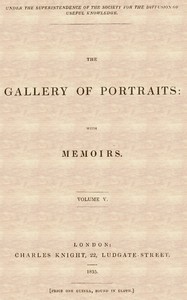
The Gallery of Portraits: with Memoirs. Volume 5 (of 7) — Edition Insights
(0 User reviews)
1178
Project Gutenberg
2017
Not confirmed
Biography
Readers of public-domain and historical texts
Project Gutenberg digital edition
en
Edition facts
Words
87,256
Reading time
380 min
Text sections
26
This digital edition of The Gallery of Portraits: with Memoirs. Volume 5 (of 7) — Edition Insights is described by source-level measurements including 87,256 words, 6 hr 20 min estimated reading time, and 26 detected text sections.
The text analysis averages about 26.7 words per sentence, while the detected sections provide another way to judge how the source is divided.
Project Gutenberg metadata also associates the work with “Biography,” connecting these edition facts with the source record’s subject description.
Source:
Project Gutenberg record #55358
This volume of biographical sketches, published under the Society for the Diffusion of Useful Knowledge, profiles twenty-four figures including Jeremy Taylor, Mrs. Siddons, and Shakespeare. Malkin's prose balances factual precision with evaluative commentary, often noting gaps in historical records and offering candid assessments of his subjects' achievements and shortcomings.
Editorial Edition Score
4.9/5
★★★★★
★★★★★
Calculated from edition completeness, EPUB availability, text structure and catalogue metadata. Not a user rating.
How this score is calculated
- Description quality20 pts
- Title & short description10 pts
- Source metadata20 pts
- Text length15 pts
- Chapters / structure15 pts
- EPUB file integrity20 pts
Total of 100 points, scaled to a 2.5-5.0 range. Editions with an empty description or a missing EPUB file are not scored.
Edition quality
Read the Text
t confidential advisers, and was soon afterwards knighted and made Chancellor of the Exchequer. In this capacity he negotiated with the parliamentary commissioners sent to Oxford in 1643; and in 1645 he acted as one of the King’s commissioners at the treaty of Uxbridge. After the breaking off of that treaty it was thought expedient to send the Prince of Wales into the west of England, both to secure his person from the dangers with which his father was environed, and to give encouragement to the Royalists in that part of the country. Sir Edward Hyde accompanied him as one of his council. The parliamentary successes in the west compelled the Prince to migrate, first to Scilly, thence to Jersey, from which place he departed into France in July, 1646. Hyde remained in Jersey for the space of two years, devoting himself wholly to his History of the Rebellion, which he had commenced in the Scilly Islands, and of which he completed the four first books at that time. While engaged in this manner, he received several letters from the King, expressive of his approbation of his undertaking, and supplying him with a particular relation of the occurrences which had taken place from the departure of the Prince until the period of his joining the Scotch army.
In May, 1648, Hyde received the King’s commands to join the Prince of Wales at Paris. On the way thither, he met Lord Cottington and others at Rouen, where he learned that the Prince was gone to Holland, and was ordered to follow him. After many difficulties and dangers, Cottington and Hyde met their young master at the Hague in the month of August, and were soon afterwards joined by several other members of the King’s council.
On the announcement of the execution of his father, Charles despatched Sir Edward Hyde and Lord Cottington as his ambassadors to Spain. After a fruitless negotiation of fifteen months, they received a message from court shortly after the arrival of the news of Cromwell’s victory at Dunbar, desiring them to quit the Spanish dominions. Hyde then repaired to Antwerp, where he resided with his wife and family, until, at the end of 1651, he was summoned to Paris, to meet Charles II., after his memorable escape from the battle of Worcester. He resided at Paris with the exiled court for nearly three years, and during this period enjoyed the unlimited confidence of his master, who left the arduous and difficult task of corresponding and negotiating with the English royalists entirely to his management. At this period the exiled royalists were frequently reduced to great pecuniary distress. The miserable dissensions and petty jealousies which prevailed among them are fully described in the History of the Rebellion. At length Charles, wearied and disgusted by the intrigues and broils which perpetually disturbed his council, while subject to the interference of the Queen Mother, determined to leave Paris; and accordingly he quitted that city in June, 1654, and went to reside at Cologne, Sir Edward Hyde and the rest of his court still following his humble fortunes. Upon the execution of the treaty with Spain, Charles removed from Cologne to Bruges in 1657, and in the course of that year bestowed upon Sir Edward Hyde the then empty dignity of Lord High Chancellor of England. Soon after this event the prospects of the Royalists began to brighten. The government of Cromwell had been for some time growing infirm, in consequence of domestic dissensions, the exhausted state of the revenue, and the distrust entertained towards the Protector, who had successively deceived and disappointed all parties. These seeds of discord were sedulously cultivated by the English royalists; and at last the death of that extraordinary man led to a series of events which introduced the restoration of Charles II.
Arthur Thomas Malkin's fifth volume of The Gallery of Portraits opens with Jeremy Taylor, and the very first sentence signals the author's method: he notes that Taylor 'did not boast of an exalted lineage' before immediately qualifying that one forefather, Dr. Rowland Taylor, was 'distinguished among the divines of the Reformation for his abilities, learning, and piety.' This pattern of measured praise, often followed by a caveat or a confession of ignorance, recurs throughout the volume. Malkin is as willing to admit what is unknown—'we have no certain knowledge' of Taylor's academical honours—as he is to assert what is documented. The result is a series of memoirs that feel more like judicious historical assessments than hagiography.
Diction of Candid Assessment
Malkin's word choices consistently convey a tone of sober evaluation. When discussing Mrs. Siddons, he writes that 'the reader will be surprised to find how many of [her performed plays] are in plays all but forgotten, and utterly unworthy of her talents.' The phrase 'all but forgotten' and 'utterly unworthy' are blunt, yet they are grounded in the evidence of the play list he provides. Similarly, of Taylor's early career, Malkin reports that Archbishop Laud 'approved of his performance, but thought him too young'—a detail that humanises both figures without sentimentality. The author's diction often carries a moral weight: he notes that Mrs. Siddons 'made it her boast that she had never wilfully disappointed either a manager or the public,' using 'boast' in a positive sense that underscores her professional integrity.
Dialogue and Reported Speech
Malkin occasionally incorporates direct speech, but he does so sparingly and with clear attribution. The most striking instance is Taylor's response to Laud: 'Taylor begged his Grace's pardon for that fault, and promised that, if he lived, he would mend it.' This reported exchange is compact yet revealing of Taylor's wit and deference. Malkin does not embellish; he lets the words stand as a record. In the Siddons memoir, direct speech is absent, but the author paraphrases her self-assessment—'she had always been an honest actress'—in a way that feels like a quotation without being one. This technique allows Malkin to convey his subject's voice while maintaining his own narrative control.
Structure and the Use of Lists
A notable structural feature in the Siddons entry is the extensive table of her London performances from 1782 to 1802, listing plays, characters, and years. Malkin introduces it with the remark that 'the reader will be surprised to find how many of them are in plays all but forgotten,' turning a dry catalogue into evidence for a critical point. This list is not merely ornamental; it serves as a primary source within the memoir, allowing readers to verify the author's claim. Elsewhere, Malkin uses shorter lists—such as the table of contents for the volume—to orient the reader. His prose paragraphs are typically dense with facts, but he breaks them with such tabular material to vary the pace and to let data speak for itself.
Recurring Details and Authorial Presence
Throughout the volume, Malkin repeatedly signals the limits of his knowledge. Of Taylor's fellowship, he writes: 'it is at least doubtful, for no record of the fact exists in the registers of the college.' This scrupulousness appears again in the Siddons memoir, where he notes that 'of Mrs. Siddons's private life it is not necessary for us to speak at length'—a deliberate boundary that respects both the subject and the reader. The author also inserts evaluative asides, such as calling Taylor 'this great ornament of our church,' which reveal his own perspective without overwhelming the factual narrative. These recurring gestures—acknowledging uncertainty, setting limits, offering measured praise—create a consistent authorial persona: that of a learned but cautious biographer.
Readers approaching this volume should attend to the interplay between Malkin's factual reporting and his quiet judgments. The memoirs reward those who read the lists and tables as carefully as the prose, for they often contain the evidence for the author's claims. Malkin's willingness to admit ignorance is as instructive as his assertions; it reminds us that biography, even in the nineteenth century, was an exercise in sifting what could be known from what could not. This volume offers not just portraits but a portrait of the biographer at work.
In that old Gallery, Malkin’s hand paused over gaps in a portrait, noting what time had quietly taken. There is a similar hush within A Belle of the Fifties Memoirs of Mrs. Clay of Alabama, covering social and political life in Washington and the South, 1853-1866. Put into narrative form by Ada — Story, Setting & Ideas — a witness’s gentle honesty about what history forgets to record. Some pages simply hold a life, softly, without need for correction.
There are no reviews for this eBook.
There are no comments for this eBook.
Reader reflection
Record your reading impressions
A brief reflection can help important ideas stay with you longer.
Your progress
0
/
10
2
How much did you enjoy the reading experience?
3
Would you pass this book on to a friend?
4
How demanding did the text feel?
5
Did the book meet your expectations?
6
Did this book create an emotional response?
7
Did you relate to its people, ideas, or situations?
8
What was the strongest part of the book?
9
In one sentence, what did you learn?
10