
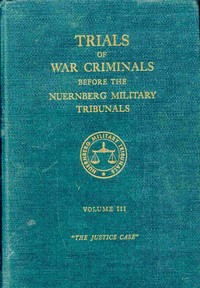
Trials of war criminals before the Nuernberg military tribunals under control…
This isn't a single story with a plot in the traditional sense. Instead, it's the official record of a dozen separate trials held in Nuremberg after the main trial of the top Nazi leaders. The U.S. military prosecuted doctors who performed horrific experiments, judges who twisted the law to condemn innocent people, and business executives who used slave labor to fuel the Nazi war machine.
The Story
The book presents the courtroom arguments themselves. You hear the prosecutors laying out chilling evidence of crimes that had no legal name before 1945—'crimes against humanity.' You read the defenses, which often boiled down to 'I was just following orders' or 'I was just doing my job.' The tension comes from watching new legal principles, like the idea that individuals are responsible for their actions even during war, clash with old notions of national sovereignty and military obedience. It's the dramatic birth of modern international law, played out case by case.
Why You Should Read It
What gripped me wasn't just the historical facts, which are devastating, but the human drama in the arguments. You see smart, educated people—doctors, lawyers, engineers—trying to justify the unjustifiable. It forces you to ask uncomfortable questions: Where is the line? How do ordinary professions become tools for atrocity? It’s easy to condemn cartoonish villains, but this book shows how evil can be bureaucratic, clinical, and dressed in a suit. It’s profoundly sobering, but also weirdly hopeful. In the rubble of a broken world, people fought to establish that some actions are so wrong, they are crimes against all of us, everywhere.
Final Verdict
This is for the reader who likes to get as close to primary sources as possible. It's perfect for history buffs who want to move beyond summaries and hear the actual voices from the courtroom. It's also great for anyone interested in law, ethics, or psychology. Be warned: it's dense and the subject matter is heavy. It's not a breezy read, but it is a profoundly important one. Think of it as the foundational document for how the world tries to deal with mass atrocity. It’s a challenging, essential piece of our collective history.
Daniel Johnson
4 months agoI came across this while browsing and the pacing is just right, keeping you engaged. Highly recommended.
Thomas Garcia
8 months agoHelped me clear up some confusion on the topic.
Nancy Thompson
1 year agoAs someone who reads a lot, it creates a vivid world that you simply do not want to leave. A valuable addition to my collection.