1

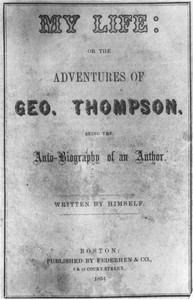
My Life: or the Adventures of Geo. Thompson Being the Auto-Biography of an Author. Written by Himself. — Reading Companion
(0 User reviews)
64
Project Gutenberg
2009
Not confirmed
Authors, American -- 19th century -- Biography; Thompson, George, 1823-
Readers of public-domain and historical texts
Project Gutenberg digital edition
en
Edition facts
Words
40,023
Reading time
175 min
Text sections
4
My Life: or the Adventures of Geo. Thompson Being the Auto-Biography of an Author. Written by Himself. — Reading Companion can be approached with a clearer sense of reading commitment from its source measurements: 40,023 words, 2 hr 55 min estimated reading time, and 4 detected text sections.
The text analysis averages about 20.6 words per sentence, while the detected sections provide another way to judge how the source is divided.
Project Gutenberg metadata also associates the work with “Authors, American -- 19th century -- Biography,” connecting these edition facts with the source record’s subject description.
Source:
Project Gutenberg record #28635
George Thompson's 1854 autobiography blends self-promotion with sensational fiction, offering a first-person account of a struggling author's life that oscillates between theatrical melodrama and candid self-deprecation.
Editorial Edition Score
4.6/5
★★★★★
★★★★★
Calculated from edition completeness, EPUB availability, text structure and catalogue metadata. Not a user rating.
How this score is calculated
- Description quality20 pts
- Title & short description10 pts
- Source metadata20 pts
- Text length15 pts
- Chapters / structure15 pts
- EPUB file integrity20 pts
Total of 100 points, scaled to a 2.5-5.0 range. Editions with an empty description or a missing EPUB file are not scored.
Edition quality
Public-domain source text
Read the source text
The source text is kept in the dedicated reader, separate from this catalogue record and its commentary.
George Thompson opens his 1854 autobiography with a bold comparison to Alexandre Dumas and Charles Dickens, framing his life story as both a fashionable literary exercise and a defiant act of self-assertion. The introductory poem sets a tone of restless truth-seeking, declaring that 'Truth's domain' offers wonders more 'wild and true' than fiction. Yet the narrative that follows immediately undercuts this claim, as Thompson's prose veers between high-flown melodrama and wry, colloquial asides. The excerpt featuring Mrs. Raymond's plight—complete with a villainous landlady, a threatened dagger, and a vow of vengeance—reads like a sensation novel, only to be punctured by Thompson's parenthetical admission that his youthful rhetoric was 'theatrical and romantic,' and that he would now simply advise her to 'put on the tea-kettle.' This self-aware oscillation between genres is the book's most distinctive feature.
Self-Portrait of an Author as a Young Man
Thompson introduces himself as a writer of 'no talent at all' compared to his famous contemporaries, yet he simultaneously boasts of his 'total independence' from public opinion. This paradoxical self-presentation recurs throughout the excerpts. He claims to be 'unobtrusive, unambitious, retiring,' while writing an autobiography that explicitly aims to 'blow his own trumpet.' The tension is not resolved but performed: Thompson wants credit for candor about his faults, yet he also insists that his lack of 'cheek' has held him back. The reader is left to decide whether this is genuine humility, ironic posturing, or a calculated bid for sympathy. The catalog subject 'Authors, American – 19th century – Biography' suggests a straightforward life story, but Thompson's narrative voice is anything but straightforward.
Melodrama and Its Discontents
The extended scene with Mrs. Raymond showcases Thompson's reliance on sensational plot devices: a virtuous woman threatened with prostitution, a hidden dagger, a villain named Livingston, and a vow of bloody revenge. The language is deliberately overwrought—'her bosom heaved like the waves of a stormy sea'—and the situation is a staple of the penny-dreadful fiction Thompson presumably wrote for a living. Yet the author undercuts the drama with a parenthetical remark that contrasts his nineteen-year-old self with his older, more pragmatic narrator. This double-voiced technique invites the reader to enjoy the melodrama while also recognizing its artificiality. The excerpt does not reveal whether Mrs. Raymond's story is true or invented, but Thompson's willingness to blur the line between autobiography and fiction is itself a central subject of the book.
Poverty, Labor, and the Writer's Lot
Thompson's account of his early struggles is grounded in concrete details: he 'lived frugally, almost on bread and water,' and could not earn enough to pay rent despite 'utmost industry.' The Mrs. Raymond episode similarly emphasizes economic vulnerability—she has 'not tasted food since the day before yesterday' and faces eviction. These passages align with the catalog subject of Thompson's biography as a record of an author's life, but they also reveal the precariousness of the literary marketplace in mid-nineteenth-century America. Thompson presents himself as a witness to hardship, yet his narrative frame—the autobiography of a writer who has survived to tell the tale—implies a measure of success. The excerpts do not clarify how Thompson eventually escaped poverty, but they establish that his self-portrait is inseparable from the material conditions of his trade.
Readers approaching My Life should be prepared for a work that resists easy classification. Thompson's autobiography is neither a reliable memoir nor a pure fiction, but a hybrid that uses the conventions of both genres to construct a public persona. The catalog subjects—'Authors, American – 19th century – Biography'—only partially capture what the text actually does. Pay attention to the shifts in tone, the parenthetical asides, and the way Thompson frames his own story as both exemplary and exceptional. The book rewards those who read with an eye for its strategic inconsistencies.
There’s something touching about George Thompson, who wrote his own noisy, unreliable life story and still couldn’t quite hide the loneliness underneath. I found myself lately thinking of Elizabeth, endlessly negotiating a marriage she never truly wanted. Both knew the strange fatigue of performing desire for public consumption. The Courtships of Queen Elizabeth A history of the various negotiations for her marriage — A Reader’s Guide captures that quiet, weary dance beautifully.
There are no reviews for this eBook.
There are no comments for this eBook.
Reader reflection
Before you leave, reflect on the book
Use these questions to collect your thoughts before moving on.
Your progress
0
/
10
2
Was reading this book enjoyable?
3
Is this a title you would suggest to others?
4
How much effort did this book require?
5
Did anything about the book feel genuinely new?
6
How closely did the book connect with your experience?
7
Could you see yourself revisiting this book?
8
How valuable was this book for your own interests?
9
In one sentence, what did you learn?
10