1

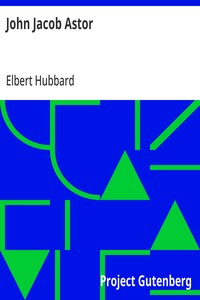
John Jacob Astor — Story, Setting & Ideas
(0 User reviews)
1070
Project Gutenberg
1996
Not confirmed
Astor, John Jacob, 1763-1848; Businessmen -- United States -- Biography
Readers of public-domain and historical texts
Project Gutenberg digital edition
en
Edition facts
Words
9,647
Reading time
42 min
Text sections
1
The catalog record for John Jacob Astor — Story, Setting & Ideas provides practical reading context through 9,647 words, 42 min estimated reading time, and 1 detected text section.
The text analysis averages about 18.8 words per sentence, while the detected sections provide another way to judge how the source is divided.
Project Gutenberg metadata also associates the work with “Astor, John Jacob, 1763-1848,” connecting these edition facts with the source record’s subject description.
Source:
Project Gutenberg record #412
Elbert Hubbard's biography of John Jacob Astor, part of his 'Little Journeys' series, blends moral aphorisms with a portrait of Astor's business foresight, using the subject to argue that wealth is a result of habit and efficiency.
Editorial Edition Score
4.3/5
★★★★★
★★★★★
Calculated from edition completeness, EPUB availability, text structure and catalogue metadata. Not a user rating.
How this score is calculated
- Description quality20 pts
- Title & short description10 pts
- Source metadata20 pts
- Text length15 pts
- Chapters / structure15 pts
- EPUB file integrity20 pts
Total of 100 points, scaled to a 2.5-5.0 range. Editions with an empty description or a missing EPUB file are not scored.
Edition quality
Public-domain source text
Read the source text
The source text is kept in the dedicated reader, separate from this catalogue record and its commentary.
Elbert Hubbard opens his biography of John Jacob Astor not with a birth date but with a maxim attributed to Astor: 'The man who makes it the habit of his life to go to bed at nine o'clock, usually gets rich and is always reliable.' This epigram sets the tone for a work that treats business success as a moral outcome of disciplined habits. Hubbard, writing in his 'Little Journeys' series, frames the biography as a lesson in efficiency, weaving Astor's story into a broader argument about self-reliance and productive labor. The opening pages digress into a discussion of Victor Hugo and the purpose of education, suggesting that Hubbard's interest lies less in strict chronology than in using Astor as a case study for his own philosophy.
Habit as the Engine of Wealth
Hubbard's portrait of Astor is built on the premise that 'wealth is a result of habit.' The opening epigram is not merely decorative; it introduces a recurring theme that Astor's success stemmed from regular, industrious routines. Hubbard contrasts this with 'rogues' who 'do their work at night,' implying that moral character and daily discipline are the true foundations of fortune. The biography does not provide a detailed account of Astor's early life or specific business deals; instead, it uses his example to advocate for a life of purposeful work. Readers should note that Hubbard's evidence for this claim is largely anecdotal and philosophical rather than drawn from Astor's own records. The text treats habit as both cause and justification of wealth, a perspective that colors every subsequent anecdote.
Efficiency as a Moral Imperative
Hubbard devotes significant space to a digression on education, arguing that the only worthwhile schooling 'increases human efficiency.' He quotes Victor Hugo—'When you open a school, you close a prison'—and reinterprets it to mean that education must produce self-reliant, productive individuals. A pointed anecdote about a man buying a razor 'for social purposes' illustrates Hubbard's disdain for learning that does not lead to practical output. This section, though seemingly tangential, establishes the lens through which Astor's achievements are viewed: Astor is presented as a model of efficiency, a man whose foresight and industry exemplify the kind of education that 'sets the captives free.' The biography thus becomes a moral treatise as much as a life story.
Prophetic Vision of a Continental Empire
The middle excerpts shift to Astor's role as a visionary who foresaw the growth of cities across North America. Hubbard recounts Astor's predictions—Duluth, Chicago, Minneapolis—and his meetings with Thomas Jefferson, who initially saw the Rocky Mountains as a 'natural separation of peoples.' Astor, by contrast, 'closed his eyes and saw pack-trains, mules laden with skins, winding across these mountains.' The text emphasizes Astor's prescience, noting that his plans for a chain of forts from Lake Superior to the Pacific were dismissed by contemporaries but later vindicated. Hubbard uses this to argue that Astor's success was not merely financial but rooted in a superior understanding of geography and commerce. The biography presents these predictions as evidence of Astor's 'prophetic brain,' a phrase that underscores Hubbard's admiration.
The Perils of Divided Authority
Hubbard attributes the limited success of Astor's Pacific venture, Astoria, to a failure of leadership: 'power at Astoria was subdivided among several little men, who wore themselves out in a struggle for honors.' This observation, drawn from the later excerpts, reveals Hubbard's belief that centralized, decisive control is essential for business achievement. He suggests that had Astor been present personally, 'a city like Seattle would have bloomed and blossomed on the Pacific, fifty years ago.' The biography does not provide details of the internal conflicts, but the critique aligns with Hubbard's broader theme that efficiency and unity of purpose are paramount. Readers should note that this section relies on Hubbard's interpretation rather than documented events, and it serves to reinforce the moral about the dangers of divided command.
Hubbard's biography of John Jacob Astor is less a factual chronicle than a moral essay wrapped in a biographical frame. Readers will find no exhaustive account of Astor's fur trade or real estate dealings; instead, the text uses selected episodes to argue that wealth flows from habit, efficiency, and foresight. The digressions—on education, on the nature of prisons, on the folly of social climbing—are integral to Hubbard's purpose. To read this work is to encounter a Progressive-era sermon on business virtue, where Astor serves as both exemplar and proof text. Approach it as a period piece that reveals more about its author's values than about its subject's inner life.
Some books sit with you quietly, the way John Jacob Astor did—how habits build character, not just fortunes. I found myself thinking about that while reading Colored girls and boys' inspiring United States history and a heart to heart talk about white folks — Background and Themes. There, too, people shaped by daily dignity, not destiny. Both left me softer, somehow, toward effort.
There are no reviews for this eBook.
There are no comments for this eBook.
Reader reflection
What did you think of this book?
Answer a few questions and save a private reflection on this device.
Your progress
0
/
10
2
What was your overall reaction to the book?
3
Would you encourage someone else to read it?
4
How demanding did the text feel?
5
How clear did the writing feel?
6
What did you think about the pace?
7
Did any part of the book stay with you emotionally?
8
What did you appreciate most?
9
What is the main idea you are taking away?
10