1

Thackerayana: Notes and Anecdotes — Context and Discussion
(0 User reviews)
558
Project Gutenberg
2014
Not confirmed
Novelists, English -- 19th century -- Biography; Thackeray, William Makepeace, 1811-1863; Thackeray, William Makepeace, 1811-1863 -- Library; Thackeray, William Makepeace, 1811-1863 -- Books and reading
Readers of public-domain and historical texts
Project Gutenberg digital edition
en
Edition facts
Words
139,915
Reading time
609 min
Text sections
21
The source record for Thackerayana: Notes and Anecdotes — Context and Discussion measures this digital text at 139,915 words, 10 hr 9 min estimated reading time, and 21 detected text sections.
The text analysis averages about 27.8 words per sentence, while the detected sections provide another way to judge how the source is divided.
Project Gutenberg metadata also associates the work with “Novelists, English -- 19th century -- Biography,” connecting these edition facts with the source record’s subject description.
Source:
Project Gutenberg record #44563
Joseph Grego's 1875 compilation pairs Thackeray's own sketches with excerpts from his reading, revealing how the novelist's visual humor and literary tastes intersected. The book's structure—juxtaposing Thackeray's school-life drawings against passages from the Tatler and other sources—offers a unique window into his creative process, though the excerpts are too fragmentary to confirm broader biographical claims.
Editorial Edition Score
4.9/5
★★★★★
★★★★★
Calculated from edition completeness, EPUB availability, text structure and catalogue metadata. Not a user rating.
How this score is calculated
- Description quality20 pts
- Title & short description10 pts
- Source metadata20 pts
- Text length15 pts
- Chapters / structure15 pts
- EPUB file integrity20 pts
Total of 100 points, scaled to a 2.5-5.0 range. Editions with an empty description or a missing EPUB file are not scored.
Edition quality
Public-domain source text
Read the source text
The source text is kept in the dedicated reader, separate from this catalogue record and its commentary.
Joseph Grego's Thackerayana: Notes and Anecdotes is not a biography in the conventional sense. Instead, it assembles hundreds of sketches by William Makepeace Thackeray alongside excerpts from books he read, creating a mosaic of the novelist's visual and literary imagination. The volume's subtitle promises depictions of 'humorous incidents in his School Life, and Favourite Scenes and Characters in the Books of his Every-day Reading,' and the surviving excerpts bear this out—but only partially. Grego's introduction dwells on the shock of Thackeray's death in 1863 and the financial anxieties faced by his daughters, a framing that feels more like a Victorian memorial than a critical apparatus. The catalog subjects list Thackeray's library and reading habits, yet the text offers only scattered glimpses of those habits, leaving the reader to infer connections between the sketches and the quoted passages.
The Compiler's Frame and Its Limits
Grego's introduction sets a mournful tone, recounting how Thackeray's death 'left, in the hour of their trial, his two young daughters deprived of the fatherly active mind.' This personal angle colors the entire volume, positioning the sketches and notes as a kind of posthumous tribute. Yet the excerpts that follow do not consistently support the biographical narrative. For instance, the introduction mentions Thackeray's 'costly and handsome mansion' and his standing as 'one who really represented literature in the great world,' but the subsequent pages leap abruptly into a series of quotations from the Tatler, with no explanation of how these relate to Thackeray's life. The compiler's voice recedes after the opening, leaving the reader to navigate a collage of primary sources without clear guidance. This structural choice suggests that Thackerayana is more an archive than an argument, a repository of materials that Grego deemed relevant but did not fully integrate.
Thackeray's Sketches as Evidence
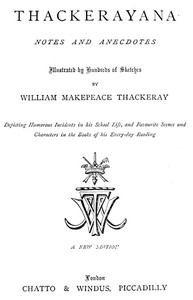
The volume's title page boasts that it is 'Illustrated by Hundreds of Sketches BY WILLIAM MAKEPEACE THACKERAY,' and the excerpts hint at the range of his visual output. The introduction refers to 'humorous incidents in his School Life,' but the text itself offers no sustained description of those drawings. Instead, the reader encounters a long passage from the Tatler (No. 111) describing a 'fine lady' who visits Mr. Bickerstaff, complete with a 'pretty hesitation' and a fan held to her face. Thackeray's sketches, if they accompany such passages, are not described in the excerpts; the reader must imagine how his line drawings might have visualized the scene. This gap between the promise of visual evidence and its actual presentation is a notable feature of the text. The catalog subject 'Thackeray, William Makepeace, 1811-1863 — Books and reading' finds partial confirmation in the quoted Tatler essays, but the excerpts do not reveal whether Thackeray himself annotated or responded to these readings.
The Tatler Excerpts and Their Function
The most substantial excerpts in the provided text are from Joseph Addison's Tatler papers, specifically numbers 111 and 116. These passages showcase the periodical's blend of social satire and moral reflection: one describes a lady's visit to Mr. Bickerstaff, complete with a ledger of visits 'received' and 'paid'; another offers a meditation on 'mental infirmities' and the dangers of 'covetous' old age. Grego includes these without explicit commentary, leaving the reader to wonder why they were chosen. The Tatler was a staple of eighteenth-century literature that Thackeray admired, but the excerpts alone do not demonstrate how he used or transformed such material. The catalog subject 'Novelists, English -- 19th century -- Biography' is only weakly supported, as the text provides more of Thackeray's reading than his life. The excerpts end abruptly with a discussion of hooped petticoats, a fittingly trivial note that underscores the volume's miscellaneous character.
Thackerayana rewards readers who approach it as a cabinet of curiosities rather than a coherent biography. The sketches and excerpts invite comparison, but the connections must be drawn by the reader. Grego's editorial hand is light, and the volume's value lies in the raw materials it preserves—Thackeray's visual humor and the literary culture he inhabited. Those seeking a narrative of his life will need to look elsewhere; those interested in the texture of his imagination will find much to explore.
Thackeray’s scattered margins, his doodles beside borrowed lines, always felt like a quiet conversation across centuries. And in that same spirit, I often set beside it a king who collected wisdom rather than wit—Alfred, gathering his own fragments of learning for darker times. Both books whisper of how a mind shapes itself from the shelf. There’s a gentle kinship in that, The Life and Times of Alfred the Great Being the Ford lectures for 1901 — Themes and Context resting alongside Grego’s old curiosity.
There are no reviews for this eBook.
There are no comments for this eBook.
Reader reflection
Your personal reading reflection
Build a private reading journal entry for this title.
Your progress
0
/
10
2
Did this book hold your interest?
3
Would you encourage someone else to read it?
4
How demanding did the text feel?
5
Did anything about the book feel genuinely new?
6
What was its emotional impact?
7
How useful did the reading feel?
8
Did any part of the book feel personally relevant?
9
What is the main idea you are taking away?
10