1

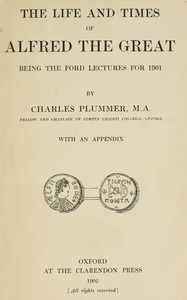
The Life and Times of Alfred the Great Being the Ford lectures for 1901 — Themes and Context
(0 User reviews)
234
Project Gutenberg
2018
Not confirmed
Great Britain -- Kings and rulers -- Biography; Alfred, King of England, 849-899; Anglo-Saxons -- England -- Wessex -- Kings and rulers -- Biography; Great Britain -- History -- Alfred, 871-899
Readers of public-domain and historical texts
Project Gutenberg digital edition
en
Edition facts
Words
80,173
Reading time
349 min
Text sections
19
The source record for The Life and Times of Alfred the Great Being the Ford lectures for 1901 — Themes and Context measures this digital text at 80,173 words, 5 hr 49 min estimated reading time, and 19 detected text sections.
The text analysis averages about 16.7 words per sentence, while the detected sections provide another way to judge how the source is divided.
Project Gutenberg metadata also associates the work with “Great Britain -- Kings and rulers -- Biography,” connecting these edition facts with the source record’s subject description.
Source:
Project Gutenberg record #56557
Charles Plummer's 1901 Ford lectures examine Alfred the Great through the lens of the king's own literary translations, tracing how Alfred's military and administrative choices are reflected in his adaptations of Orosius and other texts.
Editorial Edition Score
4.8/5
★★★★★
★★★★★
Calculated from edition completeness, EPUB availability, text structure and catalogue metadata. Not a user rating.
How this score is calculated
- Description quality20 pts
- Title & short description10 pts
- Source metadata20 pts
- Text length15 pts
- Chapters / structure15 pts
- EPUB file integrity20 pts
Total of 100 points, scaled to a 2.5-5.0 range. Editions with an empty description or a missing EPUB file are not scored.
Edition quality
Public-domain source text
Read the source text
The source text is kept in the dedicated reader, separate from this catalogue record and its commentary.
Charles Plummer's Ford lectures for 1901, published as The Life and Times of Alfred the Great, approach the king not through a straightforward narrative of events but through the evidence of his own writings. Plummer, a fellow of Corpus Christi College, Oxford, dedicates the work to John Earle, his former teacher, and retains the direct address of the lecture hall. The book's central method is to read Alfred's translations—particularly of Orosius—as documents that reveal the king's mind, his military experience, and his moral priorities. Plummer argues that Alfred's additions and alterations to his source texts often reflect his own campaigns and administrative innovations, making the translations a kind of indirect autobiography.
Alfred as Translator and Tactician
Plummer's most striking observations concern Alfred's interpolation of military details into Orosius's history. He notes that when Alfred describes Hannibal's winter march over the Apennines, the king adds a motive—that Hannibal knew the Roman consul 'was fancying that he might remain securely in his winter quarters'—which closely parallels the Danish surprise attack on Alfred at Chippenham in 878. Similarly, Alfred's account of a simulated flight by Regulus's enemies matches a tactic the Danes are known to have used. Plummer also points to Alfred's description of Hannibal sending out ravaging parties to mislead the enemy, a feint that resembles Alfred's own maneuvers from Athelney before the battle of Ethandun. These parallels, Plummer suggests, are not coincidental but show Alfred reading his own experience into the ancient text.
The King's Reading and His Reforms
Beyond military tactics, Plummer argues that Alfred's administrative reforms may have been inspired by his reading. He cites the story of Duilius building a fleet in sixty days, which recalls Alfred's own shipbuilding efforts. More suggestively, he compares Alfred's attempt to detach the Danes of Milton from those at Appledore in 893 to the Lacedemonian general Dercyllidas's strategy of making peace with one of two opposing hosts. Plummer even proposes that Alfred's division of the native fyrd into two shifts—one at home, one on active service—might have been suggested by the Amazonian host's similar arrangement in Orosius. He is careful to note that such borrowing does not diminish Alfred's originality: 'To remember at the right time, and apply in the right way, the hints furnished by previous experience, is as much a mark of genius as invention.'
What Alfred Adds and Omits
Plummer systematically catalogues the sentiments that Alfred's additions and omissions reveal. The king's expansions show his religious feeling, his admiration for figures like Alexander, Scaevola, Regulus, and Caesar, and his disgust at ingratitude, cruelty, treachery, and sloth. Conversely, Alfred often abridges or omits the civil wars, calamities, and 'unclean mythologies' that Orosius had dwelt on as proofs of heathen depravity. Plummer acknowledges that many omissions are simply due to the need to shorten the work, but he notes that they frequently 'dislocate the succession of events.' This selectivity, he implies, gives Alfred's version a distinct moral and didactic character, shaping history to serve the king's own values.
The Lecture Form and Scholarly Apparatus
Plummer preserves the lecture's original structure, with the notes occupying a large proportion of the book. He explains that he wished to spare his audience 'the discussion of technical details' while still providing the evidence for his conclusions. The notes contain the authorities and arguments on which the text is based, and Plummer acknowledges that the lectures might have been improved had he been able to use W. H. Stevenson's then-forthcoming edition of Asser. He also expresses irritation at what he considers amateurish Alfred scholarship, writing that he is 'a little jealous for the honour of English historical scholarship' and that Alfred's name should not be 'a theme on which any one may try his prentice hand.' This combative tone, combined with the dedication to Earle and the thanks to Clarendon Press officials, gives the work a distinctly personal and academic character.
Readers should approach Plummer's lectures as a scholarly argument rather than a comprehensive biography. The book assumes familiarity with Alfred's reign and with the sources Plummer discusses, particularly Asser's Life of King Alfred and the Anglo-Saxon Chronicle. The notes are essential to following the argument, and Plummer's frequent references to other scholars—both those he admires and those he criticizes—place the work in a specific academic context. For those interested in how a medieval king read and used classical history, Plummer's analysis remains a valuable, if dated, contribution.
Plummer’s Alfred, bent over his Orosius, turns history into a quiet, personal counsel—a king shaping his own world through old words. That same introspective companionship with the past came back to me, later, in Samuel Pepys and the World He Lived In — Reading Companion. Both men, centuries apart, kept their own counsel with books, finding a steadying mirror in what they read.
There are no reviews for this eBook.
There are no comments for this eBook.
Reader reflection
Record your reading impressions
A brief reflection can help important ideas stay with you longer.
Your progress
0
/
10
2
Did this book hold your interest?
3
Would you encourage someone else to read it?
4
How demanding did the text feel?
5
How useful were the ideas in this book?
6
How strong was your personal connection to the text?
7
Is this a title worth rereading?
8
Did the book offer a fresh perspective?
9
What is the main idea you are taking away?
10