1

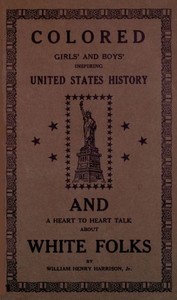
Colored girls and boys' inspiring United States history and a heart to heart talk about white folks — Background and Themes
(0 User reviews)
298
Project Gutenberg
2018
Not confirmed
United States -- History -- Juvenile literature; African Americans -- History -- Juvenile literature; African Americans -- Biography -- Juvenile literature; United States -- Race relations -- Juvenile literature
Readers of public-domain and historical texts
Project Gutenberg digital edition
en
Edition facts
Words
87,117
Reading time
379 min
Text sections
12
This digital edition of Colored girls and boys' inspiring United States history and a heart to heart talk about white folks — Background and Themes is described by source-level measurements including 87,117 words, 6 hr 19 min estimated reading time, and 12 detected text sections.
The text analysis averages about 19.0 words per sentence, while the detected sections provide another way to judge how the source is divided.
Project Gutenberg metadata also associates the work with “United States -- History -- Juvenile literature,” connecting these edition facts with the source record’s subject description.
Source:
Project Gutenberg record #57181
William Henry Harrison Jr.'s 1921 work blends U.S. history with a direct address to Black youth, using a catalog-like structure and a distinctive promotional voice. The author's preface and table of contents reveal a dual purpose: to document African American achievement and to foster interracial understanding, all delivered in a style that shifts between factual lists and personal exhortation.
Editorial Edition Score
4.9/5
★★★★★
★★★★★
Calculated from edition completeness, EPUB availability, text structure and catalogue metadata. Not a user rating.
How this score is calculated
- Description quality20 pts
- Title & short description10 pts
- Source metadata20 pts
- Text length15 pts
- Chapters / structure15 pts
- EPUB file integrity20 pts
Total of 100 points, scaled to a 2.5-5.0 range. Editions with an empty description or a missing EPUB file are not scored.
Edition quality
Public-domain source text
Read the source text
The source text is kept in the dedicated reader, separate from this catalogue record and its commentary.
William Henry Harrison Jr.'s Colored Girls and Boys' Inspiring United States History and a Heart to Heart Talk About White Folks opens with a frontispiece portrait of the author described as a 'hustling agent' whose book 'is selling itself like buckwheat cakes and sausage steaming-hot.' This promotional self-image sets the tone for a work that is part reference, part exhortation. The table of contents, spanning subjects from 'Actors' to 'White Friends,' suggests a compendium of Black achievement organized by profession and theme. Yet the subtitle promises a 'heart to heart talk,' indicating a personal, conversational register that contrasts with the book's encyclopedic ambitions.
A Catalog of Achievement
The book's structure is its most striking feature: a dense table of contents listing over sixty categories, from 'Army Officers' to 'Zoo' (implied by the alphabetical range). Each section appears to compile brief biographies or lists of notable African Americans, such as the lawyers named in the excerpt—Hon. Harry C. Smith, Hon. Robt. R. Jackson, and others—whose legislative accomplishments are summarized in a few sentences. The prose is factual and repetitive, often beginning with 'Hon.' and ending with a statement of the individual's impact. This catalog format prioritizes breadth over depth, creating a reference work that can be dipped into rather than read sequentially. The author's voice emerges mainly in the framing material, such as the preface's motto 'Not to Boast but to Boost,' which signals an explicit pedagogical and motivational purpose.
Shifts in Voice and Pace
The excerpts reveal two distinct registers. The first is the brisk, list-like prose of the biographical entries, where sentences are short and information-dense: 'Hon. H. J. Copehart with the assistance of Hon. T. G. Nutter... has succeeded in putting through... one of the severest anti-lynching bills.' The second register appears in the author's own commentary, such as the preface and the frontispiece caption, which employ a more colloquial, even sales-pitch tone: 'making the saddest person laugh, the jolliest person cry and the most thoughtless person think.' This juxtaposition creates a rhythm where the reader moves from dry enumeration to personal appeal. The pace quickens in the lists of names and places—'Atlanta, Ga. P. Allen, A. T. Walden. Atlantic City, N. J. J. A. Lightfoot'—and slows in the more narrative passages about individual achievements.
The Author's Dual Audience
Harrison addresses two readerships explicitly. The dedication is 'to those colored girls and boys upon whose noble efforts... will rest the foundations for the future success of the Negro race' and also 'to all those white women and men whose kind encouragement... are bringing about better understanding.' This dual address shapes the book's content: the biographical entries serve as models for Black youth, while the 'heart to heart talk' presumably aims to persuade white readers of Black contributions. The excerpt from the lawyers section, for instance, emphasizes interracial respect—Judge Terrell 'won and held the good-will and respect of his white associates'—and highlights legislative victories achieved through cooperation. The author's own position as a 'hustling agent' and self-published writer further underscores the book's role as both a commercial venture and a mission.
Readers approaching this work should be prepared for its hybrid nature: part biographical dictionary, part racial uplift tract, part personal appeal. The table of contents is the best entry point, allowing one to navigate by topic. The author's voice is most vivid in the prefatory and transitional passages, where his promotional energy and earnestness come through. The book rewards browsing rather than linear reading, and its value lies in the snapshot it provides of early twentieth-century African American achievement and the rhetorical strategies used to present it.
I keep thinking about Harrison's gentle urgency, his hope that a young person might find their reflection in history’s crowded pages. It reminded me of that old Scrabbletown book, the way it catalogues everyday words with such quiet fondness. There’s something similar in how it holds up ordinary things—letters, tiles, forgotten moments—and calls them worthy of attention, no grand lesson needed. Trading in Scrabbletown — Inside the Classic lingers like that, a soft echo of the same warmth.
There are no reviews for this eBook.
There are no comments for this eBook.
Reader reflection
What was your reading experience?
Capture what you thought, learned, and would like to remember.
Your progress
0
/
10
2
Did this book hold your interest?
3
Would you encourage someone else to read it?
4
What was the reading difficulty like?
5
Which part made the strongest impression?
6
How distinctive were its ideas or approach?
7
Would you start a conversation about this book?
8
How did the reading compare with what you expected?
9
In one sentence, what did you learn?
10