1

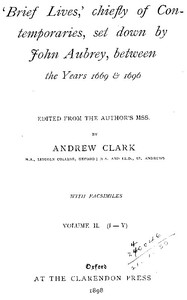
Brief Lives, Vol. 2 — Background and Themes
(0 User reviews)
1036
Project Gutenberg
2014
Not confirmed
Great Britain -- Biography; Great Britain -- History -- Stuarts, 1603-1714 -- Biography; Great Britain -- History -- Charles II, 1660-1685 -- Biography; Great Britain -- History -- Tudors, 1485-1603 -- Biography
Readers of public-domain and historical texts
Project Gutenberg digital edition
en
Edition facts
Words
124,080
Reading time
540 min
Text sections
225
This digital edition of Brief Lives, Vol. 2 — Background and Themes is described by source-level measurements including 124,080 words, 9 hr estimated reading time, and 225 detected text sections.
The text analysis averages about 11.7 words per sentence, while the detected sections provide another way to judge how the source is divided.
Project Gutenberg metadata also associates the work with “Great Britain -- Biography,” connecting these edition facts with the source record’s subject description.
Source:
Project Gutenberg record #47791
John Aubrey's 'Brief Lives, Vol. 2' presents biographical sketches of 17th-century figures, structured by short entries with digressive anecdotes, editorial footnotes, and recurring attention to heraldry, invention, and personal habits.
Editorial Edition Score
4.9/5
★★★★★
★★★★★
Calculated from edition completeness, EPUB availability, text structure and catalogue metadata. Not a user rating.
How this score is calculated
- Description quality20 pts
- Title & short description10 pts
- Source metadata20 pts
- Text length15 pts
- Chapters / structure15 pts
- EPUB file integrity20 pts
Total of 100 points, scaled to a 2.5-5.0 range. Editions with an empty description or a missing EPUB file are not scored.
Edition quality
Public-domain source text
Read the source text
The source text is kept in the dedicated reader, separate from this catalogue record and its commentary.
John Aubrey's Brief Lives, as edited by Andrew Clark in this second volume, is a collection of biographical entries that move swiftly from person to person, often within a single page. The structure is not chronological but alphabetical by surname, covering figures from Ingelbert to Selden in the excerpts. Each entry typically opens with a name, dates, and a key fact—such as Ingelbert being 'the first inventer or projector of bringing the water from Ware to London'—then branches into anecdotal asides, quoted sources, and editorial notes. Clark's edition adds footnotes marked by bracketed letters and Roman numerals, which supply archival references or clarify Aubrey's shorthand. This layered format creates a reading experience that feels like sifting through a scholar's working notes.
Recurring Images of Invention and Credit
Aubrey repeatedly returns to stories of inventors who lost credit or profit to wealthier backers. The entry on Mr. Ingelbert states he was 'the first inventer or projector of bringing the water from Ware to London' but that Sir Hugh Middleton 'moneyed the businesse; undertooke it; and gott the profit and also the credit.' Aubrey adds that a statue 'ought to have been erected' for Ingelbert. This pattern—an ingenious poor man, a rich financier, and a grievance—appears elsewhere. In the Selden entry, Aubrey notes that Selden's father, a yeoman, 'played well on the violin' and that Selden himself, as a young student, was 'lookt upon then to be of parts extraordinary.' The tension between humble origins and later renown is a thread Aubrey pulls throughout.
Movement Between Scenes and Social Spaces
Aubrey's entries often shift abruptly from a public setting to a private one, creating a sense of movement. In the Selden life, the narrative moves from a Christmas dinner at Sir Thomas Alford's—where Selden 'sate at the lower end of the table'—to his chamber in the Inner Temple, 'uppermost story, where he had a little gallery to walke in.' Later, it describes his life with the Countess of Kent in White Fryers, 'a noble dwelling.' These transitions are not explained; they simply follow the biographer's associative memory. The effect is a collage of scenes: a hall, a study, a deathbed. Aubrey also includes physical details like Selden's 'false carpet' thrown over his papers when a stranger entered, which grounds the intellectual life in domestic habit.
Heraldry and Material Traces
Several entries pause to describe coats of arms or inscriptions, treating them as evidence. For John Innocent, Aubrey records a blazon: 'argent on gules a mayd stark naked with a chaplet in her hand dexter.' He notes that this coat appears at the free school Innocent built in Berkhamsted. Similarly, the Isaacson entry includes a full transcription of a marble gravestone inscription. These heraldic and epigraphic details are not decorative; they serve as documentary anchors. Aubrey often learned the meaning of a coat 'by chance' or from a courtier, as he says of Innocent's. The editor Clark reinforces this by adding marginal notes with archival sources, such as 'MS. Aubr. 8, fol. 89 v.' The reader is thus made aware of the manuscript origins of each fact.
Editorial Apparatus as a Second Voice
Andrew Clark's editing shapes the text significantly. He inserts footnotes that identify sources, correct dates, or explain allusions. For example, after Aubrey's note on Ingelbert, Clark adds a note from 'Pond's Almanack, 1647' giving a different date. In the Selden entry, Clark supplies cross-references like '[LXXXII.] She was living in 1646, or 1647, an old woman, 80+.' These interventions create a dialogue between Aubrey's 17th-century voice and Clark's 19th-century scholarship. The reader must navigate two layers: Aubrey's sometimes gossipy, first-person observations ('From my honoured and learned friend Mr. Fabian Philips') and Clark's sober citations. This dual structure invites careful reading, as the footnotes often qualify or expand the main text.
Readers approaching this volume should expect a mosaic of fragments rather than a continuous narrative. Aubrey's method is associative: a name triggers a memory, a hearsay, a scrap of heraldry. Clark's edition preserves that texture while adding scholarly scaffolding. To make the most of the work, attend to the footnotes and the bracketed annotations, which often reveal how Aubrey gathered his information. The lives are brief, but the details—a violin played at Christmas, a false carpet over papers, a coat of arms in a school—accumulate into a vivid portrait of an era.
John Aubrey’s little sketches feel like someone whispering secrets about the dead—habits, crests, small inventions. I kept thinking how Ralegh would have fascinated him, all that restless brilliance and stubborn pride. Then I found Sir Walter Ralegh: A Biography — Reading Companion, and it felt less like reading history and more like sitting beside a quiet fire, listening to a friend remember.
There are no reviews for this eBook.
There are no comments for this eBook.
Reader reflection
What did you think of this book?
Answer a few questions and save a private reflection on this device.
Your progress
0
/
10
2
Did this book hold your interest?
3
Is this a title you would suggest to others?
4
Did the language feel accessible?
5
How clearly were the main ideas presented?
6
Would you start a conversation about this book?
7
How would you rate its originality?
8
Did you relate to its people, ideas, or situations?
9
Which lesson or insight stayed with you?
10