1

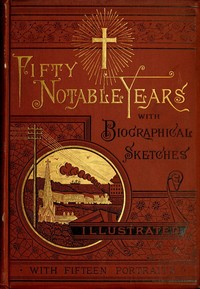
Fifty Notable Years Views of the Ministry of Christian Universalism During the Last Half-Century; with Biographical Sketches — Context and Discussion
(0 User reviews)
240
Project Gutenberg
2014
Not confirmed
Universalism; Universalist Church -- Biography; Universalists -- United States -- History; Universalists -- Biography
Readers of public-domain and historical texts
Project Gutenberg digital edition
en
Edition facts
Words
94,434
Reading time
411 min
Text sections
11
The catalog record for Fifty Notable Years Views of the Ministry of Christian Universalism During the Last Half-Century; with Biographical Sketches — Context and Discussion provides practical reading context through 94,434 words, 6 hr 51 min estimated reading time, and 11 detected text sections.
The text analysis averages about 18.5 words per sentence, while the detected sections provide another way to judge how the source is divided.
Project Gutenberg metadata also associates the work with “Universalism,” connecting these edition facts with the source record’s subject description.
Source:
Project Gutenberg record #45034
John G. Adams's 1882 work combines biographical sketches of Universalist ministers with a denominational history, focusing on the movement's growth in America. The excerpts reveal a text that balances personal anecdotes, pastoral ideals, and institutional progress, often using individual lives to illustrate broader religious trends.
Editorial Edition Score
4.8/5
★★★★★
★★★★★
Calculated from edition completeness, EPUB availability, text structure and catalogue metadata. Not a user rating.
How this score is calculated
- Description quality20 pts
- Title & short description10 pts
- Source metadata20 pts
- Text length15 pts
- Chapters / structure15 pts
- EPUB file integrity20 pts
Total of 100 points, scaled to a 2.5-5.0 range. Editions with an empty description or a missing EPUB file are not scored.
Edition quality
Public-domain source text
Read the source text
The source text is kept in the dedicated reader, separate from this catalogue record and its commentary.
John G. Adams opens Fifty Notable Years with a distinction between the "dead past" and the "living past," positioning his volume as a record of the latter. The book is explicitly a denominational history, but its method is biographical: it aims to "keep in sacred remembrance" preachers who defended "God's impartial grace" during a period of opposition. The excerpts show that Adams writes from a stated New England perspective, acknowledging that his survey is not encyclopedic. The work includes not only sketches but also chapters on the Universalist church's rise, reform involvement, educational resources, and missionary spirit.
Biography as Denominational Argument
Adams uses individual life stories to demonstrate the character and impact of Universalist ministers. The sketch of Rev. James W. Dennis, for instance, emphasizes his pastoral devotion: he served a single parish in Stoughton, Massachusetts, for ten years, declining calls elsewhere. The account dwells on his final illness and the community's grief, quoting an observer who describes an "old patriarch" touching the deceased's head. This anecdote serves not just as eulogy but as evidence of the minister's worth—his ability to unite a congregation even after serving in the state legislature. Similarly, Rev. Henry B. Soule's biography highlights his self-education, his assistant pastorate with Hosea Ballou, and his sudden death from smallpox. Adams notes that Soule's widow later became a missionary in Scotland, linking personal narrative to the denomination's broader work.
The Pastor as Ideal Type
Across the excerpts, Adams repeatedly valorizes a specific pastoral ideal: long tenure, modest character, and deep community ties. Of one minister, he writes that "no one trait seemed to predominate over another" and that the pastor was "very modest and unassuming." The text treats a settled pastorate as a blessing, stating that the pastoral relation "should be broken as seldom as possible." This ideal is reinforced by contrast: calls to other parishes with "strong financial inducements" are declined. The biographical sketches thus function as moral exempla, illustrating virtues Adams considers essential for the ministry. The emphasis on character over doctrine is notable; the excerpts contain little theological argument, focusing instead on how ministers lived and served.
Institutional Growth and Personal Networks
Adams frames individual careers within the institutional expansion of Universalism. The preface outlines chapters on the church's rise in America, its "growth in agreement with the genius and civilization of our republic," and its reform work. The biographical sketches trace a network: Soule studied at Clinton Liberal Institute, was encouraged by Rev. S. R. Smith, and later assisted Hosea Ballou. Dennis's funeral is described as drawing "little children, tearful women, and strong men." These details suggest a close-knit denominational community. Adams also notes educational resources like Tufts College, which granted an honorary degree to one subject. The excerpts thus show how personal stories are woven into a narrative of institutional progress, with each minister contributing to the denomination's visibility and stability.
Readers should note that the excerpts represent only a fraction of the book's 94,000 words. The full text likely contains many more biographical sketches and thematic chapters. Adams's preface promises coverage of the Universalist church's "present status" and "outlook into the future," which may offer a broader view than the biographical sections alone. Those interested in nineteenth-century American religious history will find here a primary source that combines hagiography, institutional chronicle, and a specific pastoral ideal.
There’s something tender in how Adams traces lives through decades of quiet conviction, the way a movement is really just people enduring together. It put me in mind of another kind of remembrance — those private reading notes that feel like talking to your own past self, a different sort of legacy. I keep returning to Me: A Book of Remembrance — Reading Notes for that same hush of time passing, of pages kept.
There are no reviews for this eBook.
There are no comments for this eBook.
Reader reflection
How will you remember this book?
Save your reaction, strongest insight, and memorable passage.
Your progress
0
/
10
2
How did the book work for you overall?
3
Is this a title you would suggest to others?
4
How demanding did the text feel?
5
Could you apply anything you learned?
6
Did this book create an emotional response?
7
How did the pace of the book feel?
8
How original did the book feel?
9
What changed or sharpened your thinking?
10