1

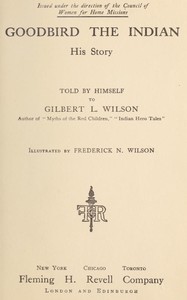
Goodbird the Indian: His Story — Background and Themes
(0 User reviews)
328
Project Gutenberg
2018
Not confirmed
Indians of North America -- Biography; Goodbird, Edward, 1869-; Hidatsa Indians -- Biography; Hidatsa Indians -- Social life and customs
Readers of public-domain and historical texts
Project Gutenberg digital edition
en
Edition facts
Words
21,726
Reading time
95 min
Text sections
3
This digital edition of Goodbird the Indian: His Story — Background and Themes is described by source-level measurements including 21,726 words, 1 hr 35 min estimated reading time, and 3 detected text sections.
The text analysis averages about 17.8 words per sentence, while the detected sections provide another way to judge how the source is divided.
Project Gutenberg metadata also associates the work with “Indians of North America -- Biography,” connecting these edition facts with the source record’s subject description.
Source:
Project Gutenberg record #56349
Edward Goodbird's first-person account of Hidatsa life, from childhood games and buffalo hunts to mission school and the tension between tribal beliefs and Christianity, as told to anthropologist Gilbert L. Wilson.
Editorial Edition Score
4.6/5
★★★★★
★★★★★
Calculated from edition completeness, EPUB availability, text structure and catalogue metadata. Not a user rating.
How this score is calculated
- Description quality20 pts
- Title & short description10 pts
- Source metadata20 pts
- Text length15 pts
- Chapters / structure15 pts
- EPUB file integrity20 pts
Total of 100 points, scaled to a 2.5-5.0 range. Editions with an empty description or a missing EPUB file are not scored.
Edition quality
Public-domain source text
Read the source text
The source text is kept in the dedicated reader, separate from this catalogue record and its commentary.
Goodbird the Indian opens with a direct, unadorned voice: 'I was born in an earth lodge, near Fort Berthold, North Dakota.' The narrative, told by Edward Goodbird to anthropologist Gilbert L. Wilson and rendered into 'common idiom,' retains the cadence of spoken testimony. Wilson’s foreword explains that Goodbird is his adopted brother, and the stories were told in August 1913. The result is a document that moves between personal recollection and ethnographic detail, with shifts in pace that mirror Goodbird’s own transitions—from the seasonal rhythms of Hidatsa games to the abrupt challenges of school learning.
A Voice Between Two Worlds
Goodbird’s narrative voice is remarkably steady, even when describing cultural collision. He reports his childhood belief that hoops thrown into the Missouri became dead buffaloes, then adds, without irony, that the frozen carcasses were 'always fat' and 'sweet and tender.' The same even tone carries his account of learning the earth is round: 'In our earth lodge, that night, I said to my parents, “This earth is round; the sun is a burning ball!”' His cousin Butterfly dismisses this as 'white man’s talk,' but Goodbird refuses to concede. The passage is striking for its lack of drama—Goodbird simply states the disagreement and moves on. This flat, reportorial style recurs throughout, giving the impression of a man who has long since reconciled the two frameworks.
Games as Seasonal Markers
The book’s pacing is governed by the Hidatsa calendar. Goodbird devotes careful attention to games, each tied to a specific time of year: the hoop game in March and early April, u-a-ki-he-ke (throw stick) after the first thunder, and sham battles with clay balls in June. The descriptions are precise—hoops 'covered with a lacing of thongs,' willow rods 'stained red, with ochre, or a bright green, with grass'—and the rules are given in full. These passages slow the narrative to a near-ethnographic crawl, then release into moments of action: 'a storm of mud balls would come whizzing through the air like bullets.' The effect is a rhythm of patient explanation followed by sudden, vivid motion, mirroring the way memory dwells on detail before leaping to incident.
The Weight of a Letter
One of the book’s quietest passages carries the most emotional force. Goodbird describes receiving a letter from a cousin at the Santee Indian school: '“I believe in Jesus’ way,” he wrote. “I believe Jesus is a good Saviour. I have tried His way, and I want you to try to join in and have Him for your Saviour.”' Goodbird says only that 'this letter set me to thinking.' The restraint is characteristic; he does not elaborate on his feelings. But the letter arrives after pages of matter-of-fact description of school life—learning the Ten Commandments, refusing to swear because Mr. Hall said it was wrong—and the juxtaposition gives the cousin’s words a weight the narrative otherwise avoids. It is one of the few moments where the reader senses a private struggle beneath the composed surface.
Goodbird’s story is best read as a layered testimony: part autobiography, part cultural record, part collaboration with an anthropologist who shaped its English. The reader should attend to what is left unsaid—the gaps between the even tone and the events described. The glossary of Indian words at the front signals that the text moves between languages, and the illustrations by Frederick N. Wilson add a visual dimension. Approach the book as a document of a life told in a specific moment, for a specific audience, and the quiet authority of Goodbird’s voice becomes clear.
That rainy afternoon, Goodbird’s quiet account of losing old ways under new faith stayed with me, a particular ache about identity pressed between two worlds. It made me think of another voice, also caught between freedom’s promise and its denial. I pulled up Narrative of William W. Brown, a Fugitive Slave. Second Edition — Background and Themes almost without deciding to, and the rain kept falling.
There are no reviews for this eBook.
There are no comments for this eBook.
Reader reflection
Take a moment to reflect on this book
Create a short personal record of your experience with this book.
Your progress
0
/
10
2
Did this book hold your interest?
3
Would you pass this book on to a friend?
4
How demanding did the text feel?
5
How closely did the book connect with your experience?
6
How useful did the reading feel?
7
Could you see yourself revisiting this book?
8
Did the book offer a fresh perspective?
9
What is the main idea you are taking away?
10