1

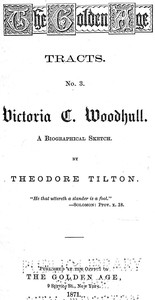
Victoria C. Woodhull: A Biographical Sketch — A Closer Reading
(0 User reviews)
123
Project Gutenberg
2016
Not confirmed
Feminists -- United States -- Biography; Suffragists -- United States -- Biography; Woodhull, Victoria C. (Victoria Claflin), 1838-1927; Spiritualists -- United States -- Biography
Readers of public-domain and historical texts
Project Gutenberg digital edition
en
Edition facts
Words
14,855
Reading time
65 min
Text sections
3
Victoria C. Woodhull: A Biographical Sketch — A Closer Reading can be approached with a clearer sense of reading commitment from its source measurements: 14,855 words, 1 hr 5 min estimated reading time, and 3 detected text sections.
The text analysis averages about 25.0 words per sentence, while the detected sections provide another way to judge how the source is divided.
Project Gutenberg metadata also associates the work with “Feminists -- United States -- Biography,” connecting these edition facts with the source record’s subject description.
Source:
Project Gutenberg record #51861
Theodore Tilton's 1871 biographical sketch of Victoria C. Woodhull, a presidential candidate and spiritualist, reveals how her public persona was shaped by reformist rhetoric and personal advocacy, with the catalog subjects of feminism, suffrage, and spiritualism only partially capturing the text's blend of biography, polemic, and intimate defense.
Editorial Edition Score
4.5/5
★★★★★
★★★★★
Calculated from edition completeness, EPUB availability, text structure and catalogue metadata. Not a user rating.
How this score is calculated
- Description quality20 pts
- Title & short description10 pts
- Source metadata20 pts
- Text length15 pts
- Chapters / structure15 pts
- EPUB file integrity20 pts
Total of 100 points, scaled to a 2.5-5.0 range. Editions with an empty description or a missing EPUB file are not scored.
Edition quality
Public-domain source text
Read the source text
The source text is kept in the dedicated reader, separate from this catalogue record and its commentary.
Theodore Tilton opens his biographical sketch of Victoria C. Woodhull with a defensive flourish, declaring that he will portray her character “without color or tinge from any other partiality save that I hold her in uncommon respect.” This disclaimer sets the tone for a work that is as much a personal vindication as a biography. Tilton, a journalist and reformer, was a close associate of Woodhull, and his text weaves together narrative, spiritualist testimony, and political advocacy. The catalog subjects—feminism, suffrage, spiritualism—only partially capture the work’s content; the excerpts show Tilton emphasizing Woodhull’s early life, her second marriage to Colonel James H. Blood, and her trance-mediated communications with spirits, all framed as evidence of her exceptional character.
A Birth Narrative Tied to Royalty and Reform
Tilton begins Woodhull’s life story with a striking anecdote: born in 1838, the same year Queen Victoria was crowned, she was named after the monarch. He notes that the Queen “ordained a gift to all her little namesakes,” and suggests Woodhull might still claim that souvenir. This rhetorical move links Woodhull’s humble origins in a “small cottage, white-painted and high-peaked” in Homer, Ohio, to a destiny that Tilton frames as surpassing even royalty—she is “a candidate for the Presidency of the United States.” The passage blends factual detail with a prophetic tone, establishing Woodhull as a figure of national ambition. Tilton’s description of her parents as “respectable poverty” and his mention of her being the seventh of ten children ground the narrative in specific domestic circumstances, while the royal parallel elevates her story into a kind of providential tale.
Spiritualism as the Engine of Biography
A substantial portion of the excerpt concerns Woodhull’s second marriage to Colonel James H. Blood, which Tilton presents as a spiritualist event. He writes that Blood consulted Woodhull as a “spiritualistic physician” and was “startled to see her pass into a trance,” during which she announced their future union. Tilton describes the marriage as “made in Heaven” and “decreed by the self-same spirits whom she is ever ready to follow.” This section includes a letter from Blood describing their “parliament with the spirits,” where Woodhull goes into a trance and her “guardian spirit takes control of her mind.” The text thus positions spiritualism not as a peripheral belief but as the central mechanism of Woodhull’s life decisions and intellectual development. Tilton’s portrayal of Blood as a “recluse from society” and “an expectant believer in a stupendous destiny for Victoria” reinforces the idea that her public career is guided by supernatural forces.
The Biographer’s Voice and the Politics of Defense
Tilton’s own voice is a constant presence in the sketch. He begins with a biblical epigraph—“He that uttereth a slander is a fool”—and immediately positions himself as a defender against unnamed detractors. He describes Woodhull’s “personal sufferings” as “a whole drama of pathos” and insists that her name has “caught a shadow in strange contrast with the whiteness of her life.” This defensive posture shapes the entire narrative: every detail of her early poverty, her spiritualist practices, and her political ambitions is marshaled to counter accusations. The catalog subjects of feminism and suffrage are present only implicitly; Tilton does not discuss her political platform or her role in the suffrage movement in the excerpts. Instead, he focuses on her character and her spiritualist credentials, suggesting that the biography is as much a personal apology as a historical record.
Readers should approach this sketch as a primary source for understanding how Woodhull’s contemporaries framed her public image. Tilton’s close personal relationship with his subject means the text is both a biography and a piece of advocacy. The catalog subjects—feminism, suffrage, spiritualism—are useful starting points, but the excerpts show that spiritualism dominates the narrative, while political reform is more implied than detailed. To get a fuller picture of Woodhull’s own ideas, one would need to consult her speeches and writings, but Tilton’s sketch offers a vivid portrait of how she was perceived by a sympathetic insider.
The rain against my window softened Theodore Tilton’s furious defense of Victoria Woodhull into something almost tactile. Her nerve, her nerve. I kept turning the pages, watching her build herself from pamphlets and séances. Later, quiet, I found myself reaching for a plainer voice, a soldier’s account from a different battlefield entirely: My adventures during the late war — Background and Themes. Both felt like people holding themselves together with sheer will.
There are no reviews for this eBook.
There are no comments for this eBook.
Reader reflection
What did you think of this book?
Answer a few questions and save a private reflection on this device.
Your progress
0
/
10
2
How did the book work for you overall?
3
How likely are you to recommend this book?
4
Did the language feel accessible?
5
How useful did the reading feel?
6
Did the book meet your expectations?
7
How strong was your personal connection to the text?
8
Did anything about the book feel genuinely new?
9
What is the main idea you are taking away?
10