1

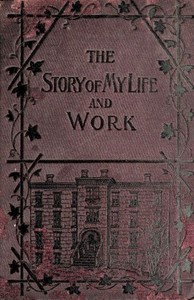
The Story of My Life and Work — Reading Notes
(0 User reviews)
69
Project Gutenberg
2020
Not confirmed
Tuskegee Institute; Washington, Booker T., 1856-1915; African Americans -- Biography; Educators -- United States -- Biography; African American educators -- Biography
Readers of public-domain and historical texts
Project Gutenberg digital edition
en
Edition facts
Words
86,868
Reading time
378 min
Text sections
10
The catalog record for The Story of My Life and Work — Reading Notes provides practical reading context through 86,868 words, 6 hr 18 min estimated reading time, and 10 detected text sections.
The text analysis averages about 24.0 words per sentence, while the detected sections provide another way to judge how the source is divided.
Project Gutenberg metadata also associates the work with “Tuskegee Institute,” connecting these edition facts with the source record’s subject description.
Source:
Project Gutenberg record #61953
Booker T. Washington's 1900 autobiography, structured around his rise from slavery to leading Tuskegee Institute, uses recurring images of labor, education, and racial uplift. The narrative moves between personal anecdotes, institutional growth, and public events, with illustrations by Frank Beard.
Editorial Edition Score
4.9/5
★★★★★
★★★★★
Calculated from edition completeness, EPUB availability, text structure and catalogue metadata. Not a user rating.
How this score is calculated
- Description quality20 pts
- Title & short description10 pts
- Source metadata20 pts
- Text length15 pts
- Chapters / structure15 pts
- EPUB file integrity20 pts
Total of 100 points, scaled to a 2.5-5.0 range. Editions with an empty description or a missing EPUB file are not scored.
Edition quality
Public-domain source text
Read the source text
The source text is kept in the dedicated reader, separate from this catalogue record and its commentary.
Booker T. Washington’s 1900 autobiography, The Story of My Life and Work, is structured as a chronological account of his journey from enslavement to becoming principal of Tuskegee Institute. The narrative is punctuated by recurring images of labor, education, and racial uplift, and it moves fluidly between personal anecdotes, institutional milestones, and public ceremonies. Washington often juxtaposes his own experiences with broader commentary on the condition of African Americans in the post-Reconstruction South. The volume is illustrated with original pen drawings by Frank Beard and includes an introduction by Dr. J. L. M. Curry, who notes that Washington’s “personality is unique” and his work “exceptional.”
A Life Told in Scenes
The autobiography is organized into chapters that follow a clear arc: early childhood, education at Hampton Institute, founding of Tuskegee, and the institution’s growth. Within this framework, Washington frequently shifts between descriptive scenes—such as his first arrival at Tuskegee and the early struggles to establish the school—and reflective passages that draw lessons from these events. The movement between concrete detail and moral exhortation gives the narrative a dual quality: it is both a personal story and a public argument for industrial education. For instance, Washington describes the physical labor of building Tuskegee’s first buildings, then pivots to the broader significance of self-reliance. This structural pattern reinforces his central thesis that practical work is the foundation of racial progress.
Recurring Images: Labor, Learning, and Uplift
Throughout the text, Washington returns to a set of recurring images: the school’s brickmaking, the students’ agricultural work, and the transformation of dilapidated buildings into functional classrooms. These images are not merely descriptive; they serve as metaphors for the larger project of racial uplift. Washington repeatedly emphasizes the dignity of manual labor, contrasting it with the “ignorance, narrowness and selfishness” he seeks to overcome. Another recurring motif is the public ceremony—such as the Harvard honorary degree event, where Washington notes the “outburst of applause” that greeted his name. These scenes function as proof of progress, both for Washington personally and for his race. The illustrations by Frank Beard complement this visual emphasis, depicting scenes of labor and achievement.
Movement Between Private and Public Spheres
Washington’s narrative moves constantly between private reflection and public performance. Early chapters focus on his personal struggles—his hunger for education, his first teaching job—while later chapters describe his appearances before national audiences, including the Harvard commencement and the Atlanta Exposition. This movement is not accidental; Washington uses his own life as a case study for the possibilities of black achievement. The inclusion of newspaper clippings and letters, such as Thomas J. Calloway’s account of the Harvard ceremony, further blurs the line between autobiography and documentary. Washington often steps back from his own story to let others speak, as when he writes, “I think I shall not speak further of the occurrence, but will insert a few newspaper clippings.” This technique gives the narrative a collaborative, multi-voiced quality.
The Role of the Introduction and Illustrations
The volume is framed by an introduction by Dr. J. L. M. Curry, who writes that “the life of Booker T. Washington cannot be written” because its influence extends beyond any single account. This framing positions Washington’s autobiography as both a personal record and a public document. The illustrations by Frank Beard, rendered as “original pen drawings,” add a visual dimension that reinforces the narrative’s emphasis on labor and progress. Beard’s images depict scenes such as Washington with his family and the Tuskegee campus, grounding the text in concrete imagery. The combination of Curry’s endorsement, Washington’s own prose, and Beard’s illustrations creates a layered work that invites readers to consider the autobiography as a collaborative artifact of the early 20th-century African American experience.
Readers approaching The Story of My Life and Work will find a narrative that is at once personal and public, structured around key scenes and recurring images of labor and uplift. Washington’s movement between private anecdote and public ceremony, and his use of documentary inserts, invites careful attention to how he constructs his own legacy. The illustrations by Frank Beard and the introduction by J. L. M. Curry further enrich the text, making it a multifaceted document of its era.
I finished The Story of My Life and Work and kept thinking about how Washington builds dignity from every small, concrete act—sweeping, learning, teaching. It felt less like a grand tale and more like quiet stitching. That same patient unraveling of identity stayed with me afterward, in a different way, while reading The female-impersonators — Context and Discussion. Both left me sitting still, holding the thread gently.
There are no reviews for this eBook.
There are no comments for this eBook.
Reader reflection
Take a moment to reflect on this book
Create a short personal record of your experience with this book.
Your progress
0
/
10
2
Was reading this book enjoyable?
3
Would you recommend this book to another reader?
4
How demanding did the text feel?
5
Which part made the strongest impression?
6
Did the book offer a fresh perspective?
7
Did any part of the book stay with you emotionally?
8
How clear did the writing feel?
9
What is the main idea you are taking away?
10