1

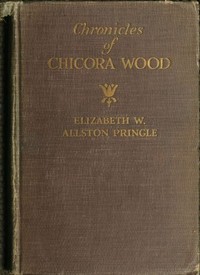
Chronicles of Chicora Wood — Edition Insights
(0 User reviews)
385
Project Gutenberg
2018
Not confirmed
Pringle, Elizabeth W. Allston (Elizabeth Waties Allston), 1845-1921; Plantation life -- South Carolina; Charleston (S.C.) -- Social life and customs; Chicora Wood Plantation (S.C.); Charleston (S.C.) -- Biography
Readers of public-domain and historical texts
Project Gutenberg digital edition
en
Edition facts
Words
81,083
Reading time
353 min
Text sections
8
The catalog record for Chronicles of Chicora Wood — Edition Insights provides practical reading context through 81,083 words, 5 hr 53 min estimated reading time, and 8 detected text sections.
The text analysis averages about 23.9 words per sentence, while the detected sections provide another way to judge how the source is divided.
Project Gutenberg metadata also associates the work with “Pringle, Elizabeth W. Allston (Elizabeth Waties Allston), 1845-1921,” connecting these edition facts with the source record’s subject description.
Source:
Project Gutenberg record #56736
Elizabeth W. Allston Pringle's memoir of plantation life before, during, and after the Civil War, framed by a sunset meditation on memory. The opening preface sets a reflective tone, while later excerpts detail wartime displacement, the challenge of receiving charity, and the loss of a brother at Haws Shop.
Editorial Edition Score
4.8/5
★★★★★
★★★★★
Calculated from edition completeness, EPUB availability, text structure and catalogue metadata. Not a user rating.
How this score is calculated
- Description quality20 pts
- Title & short description10 pts
- Source metadata20 pts
- Text length15 pts
- Chapters / structure15 pts
- EPUB file integrity20 pts
Total of 100 points, scaled to a 2.5-5.0 range. Editions with an empty description or a missing EPUB file are not scored.
Edition quality
Public-domain source text
Read the source text
The source text is kept in the dedicated reader, separate from this catalogue record and its commentary.
The preface establishes a contemplative frame: Pringle sits on the piazza at Chicora Wood, watching sunset through moss-draped oaks, and declares her intention to preserve “the pageant of the Past.” This is not a straightforward chronological account but a memory-driven narrative, organized in parts devoted to her father, mother, and herself. The table of contents reveals a structure that moves from family origins through plantation life, war, and readjustment, with chapter titles like “Preparing to Meet Sherman” and “Taking the Oath” signaling the war’s central disruption.
Early excerpts show Pringle’s voice as both personal and observational. She recounts a childhood incident of being unable to receive gifts gracefully, and her mother’s rebuke: “you are not worthy to give if you cannot receive gracefully.” This moment encapsulates a theme of shifting social roles during wartime, when the formerly generous become recipients of charity.
Memory as a Framing Device
The preface is the key to reading the entire work. Pringle explicitly positions herself as a keeper of memories, using the sunset and oaks as metaphors for the beauty and tragedy of the past. She writes of “years as dark and tragic as that leaden storm-bank at the horizon’s edge, but redeemed from utter despair by a courage and a sacrifice.” This language signals that the narrative will balance loss with resilience. The preface also reveals her anxiety about letting these memories “fade, even as the sunset, into gray oblivion.” Readers should note how this framing recurs in later passages, such as when she describes the death of her brother Poinsett and his friend Bee at Haws Shop, wishing she could “perpetuate that beautiful face and figure.” The memoir is thus a deliberate act of preservation, not a neutral record.
Wartime Displacement and Social Inversion
Chapter XVII, “Crowley Hill—Our Place of Refuge During the War,” illustrates the practical and emotional upheaval of displacement. Pringle describes the house as “quaint old-fashioned” set among oaks that are “bare all winter,” a contrast to the live oaks of Chicora Wood. The family becomes refugees, dependent on neighbors for daily supplies. Pringle’s reaction—"I hate to receive! I am accustomed to give"—and her mother’s lesson in graceful receiving highlight a reversal of social roles. The passage also notes that her father stayed behind on the plantation, while her brother served as colonel of the 4th Alabama Regiment. This section shows how the war fractured family life and forced a redefinition of hospitality and pride.
Specific Losses and the Texture of Detail
Pringle’s memoir gains power from concrete details. She recalls leaving behind “two blue china Chinese vases, urn-shaped, which stood two feet high” during a hasty packing. Such objects anchor the narrative in material reality. The death of her brother Poinsett is rendered with a painterly wish: “If I could paint, how I would love to perpetuate that beautiful face and figure.” The account of his death—carrying a wounded friend when a bullet killed both—is stark and unembellished. These moments of precise observation (the vases, the oaks, the dance question “Do you dance fast or loose?”) give the memoir a documentary texture that balances the more reflective passages.
Voice and Dialogue as Character Revelation
Pringle frequently uses dialogue to reveal character and conflict. The exchange with her mother about receiving gifts is one example; another is the question from a dance partner, “Do you dance fast or loose?” which captures the social world of wartime Wilmington. The mother’s voice is particularly distinct: practical, wise, and gently reproving. Pringle’s own voice shifts between youthful impatience and mature reflection. Readers should attend to these conversational moments, as they often carry the emotional weight of the narrative. The memoir does not simply report events; it dramatizes them through speech, making the past vivid and immediate.
Pringle’s memoir is best approached as a personal archive, not a comprehensive history. The excerpts suggest that the most rewarding reading involves tracking how specific objects, phrases, and scenes recur across the eight parts. The preface’s sunset meditation is a lens for the entire work: memory is both beautiful and painful, and Pringle is determined to hold onto it. Readers should expect a narrative that moves between intimate family moments and the larger sweep of war, always anchored by the author’s distinctive voice.
There’s a moment in Chronicles of Chicora Wood where memory feels like the last thing that survives. I found myself thinking of that while reading The female-impersonators — Context and Discussion — how we each hold onto an identity that others may not see. Hard to say why both books settled together, but they did, quietly.
There are no reviews for this eBook.
There are no comments for this eBook.
Reader reflection
Before you leave, reflect on the book
Use these questions to collect your thoughts before moving on.
Your progress
0
/
10
2
How did the book work for you overall?
3
Would you encourage someone else to read it?
4
How easy was the book to follow?
5
Which part made the strongest impression?
6
How much did the book move you?
7
How closely did the book connect with your experience?
8
Did the book offer a fresh perspective?
9
What changed or sharpened your thinking?
10