1

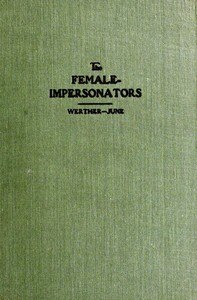
The female-impersonators — Context and Discussion
(0 User reviews)
687
Project Gutenberg
2023
Not confirmed
Werther, Ralph, 1874-; Gay men -- United States -- Biography; Transgender people -- United States -- Biography; Cross-dressing -- United States -- History
Readers of public-domain and historical texts
Project Gutenberg digital edition
en
Edition facts
Words
85,023
Reading time
370 min
Text sections
21
The source record for The female-impersonators — Context and Discussion measures this digital text at 85,023 words, 6 hr 10 min estimated reading time, and 21 detected text sections.
The text analysis averages about 17.2 words per sentence, while the detected sections provide another way to judge how the source is divided.
Project Gutenberg metadata also associates the work with “Werther, Ralph, 1874-,” connecting these edition facts with the source record’s subject description.
Source:
Project Gutenberg record #70019
Ralph Werther, writing as Jennie June, offers a first-person account of his life as an 'instinctive female-impersonator' in early 20th-century New York, blending autobiography with case studies and a medico-legal framework. This sequel to 'Autobiography of an Androgyne' details his six-year career, his associates, and his evolving understanding of androgyny.
Editorial Edition Score
4.9/5
★★★★★
★★★★★
Calculated from edition completeness, EPUB availability, text structure and catalogue metadata. Not a user rating.
How this score is calculated
- Description quality20 pts
- Title & short description10 pts
- Source metadata20 pts
- Text length15 pts
- Chapters / structure15 pts
- EPUB file integrity20 pts
Total of 100 points, scaled to a 2.5-5.0 range. Editions with an empty description or a missing EPUB file are not scored.
Edition quality
Public-domain source text
Read the source text
The source text is kept in the dedicated reader, separate from this catalogue record and its commentary.
Ralph Werther—writing under the female persona Jennie June, and also as 'Earl Lind'—opens this 1922 volume with a subtitle that signals its hybrid nature: part sequel to his earlier Autobiography of an Androgyne, part sociological account of 'six years’ career as instinctive female-impersonator in New York’s Underworld.' The book is edited by Dr. Alfred W. Herzog, who also contributes an introduction, and was originally sold only to professionals—physicians, lawyers, clergymen—reflecting its intended status as a scientific document rather than a popular memoir. Werther’s voice, however, is anything but clinical; he writes with a frankness about his desires and experiences that challenges the era’s medical and moral categories.
A Life Framed by Science and Confession
Werther’s narrative is structured as both a personal confession and a scientific treatise. The table of contents reveals a deliberate organization: Part One, 'The Third Sex,' includes chapters on 'The Place of the Androgyne in the Male Sex Scale' and 'Androgynes of Mythology and History,' while Part Two traces his own development from infancy through school days to his emergence as 'The Fairie Boy.' This dual framing—the personal and the taxonomic—is central to the book’s method. Werther repeatedly positions himself as a specimen, offering his own body and history as evidence for a broader argument about the naturalness of androgyny. Yet he also insists on his individuality, describing specific encounters and emotions with a vividness that resists reduction to type. The tension between these two impulses—to be a case study and to be a person—runs throughout the text.
The Language of the Body and Its Changes
Werther pays close attention to physical transformation, both as a marker of identity and as a biological process. He describes his own 'menopause' at age forty-two, when his weight jumped from 133 to 160 pounds within six weeks, and links this to a shift in his sexual instincts. 'The hitherto passive ultra-androgyne occasionally becomes active,' he writes, drawing an analogy to menopause in women. This physiological language is typical of the book’s blend of personal observation and pseudo-scientific generalization. Werther also notes that androgynes often become more masculine as they approach fifty, and may even marry—a claim he supports with his own abortive courtship of a young woman. His willingness to chart these changes in himself, and to generalize from them, gives the book a distinctive texture: it is at once a memoir, a medical text, and a plea for understanding.
Underworld Networks and the Cercle Hermaphroditos
Werther’s account is populated by a network of androgyne associates, many of whom he met in New York’s 'underworld'—a term he uses to describe both the physical spaces of bars and pick-up spots and the social world of those who, like him, lived outside conventional gender and sexual norms. He mentions the Cercle Hermaphroditos, a group he belonged to in his twenty-second year, and describes writing a brief autobiography at that time, though publication was delayed for twenty-three years due to 'the bigotry of cultured man.' The book includes chapters on specific locations and encounters, such as 'A Stuyvesant Square Pick-up' and 'Evenings at Paresis Hall,' which ground his theoretical claims in lived experience. These vignettes offer a rare glimpse into a hidden social world, one that Werther presents as both a refuge and a site of danger.
Readers should approach The Female-Impersonators as a document of its time, shaped by the medico-legal discourses of the early twentieth century and by Werther’s own complex motives—self-justification, advocacy, and a desire to be understood. The book’s value lies not in its scientific claims, which are often dated, but in its firsthand testimony and its refusal to conform to simple categories. Werther’s voice, at once defiant and vulnerable, remains its most compelling feature.
Reading about Ralph Werther’s careful navigation of a life lived between worlds, I kept thinking of another quiet memoir, An Englishwoman's twenty-five years in tropical Africa — Background and Themes. Both linger because they show how identity reshapes itself in unfamiliar territory. There’s no drama, just the slow patience of someone learning to belong where they weren’t expected. That kind of honesty stays with you gently, doesn’t it?
There are no reviews for this eBook.
There are no comments for this eBook.
Reader reflection
Before you leave, reflect on the book
Use these questions to collect your thoughts before moving on.
Your progress
0
/
10
2
How much did you enjoy the reading experience?
3
Is this a title you would suggest to others?
4
Did the language feel accessible?
5
Did the book deliver what you hoped for?
6
Could you apply anything you learned?
7
Was the book moving at the right speed?
8
Which part made the strongest impression?
9
What is the main idea you are taking away?
10