1

Representative Women of Deseret: A Book of Biographical Sketches — Key Ideas to Explore
(0 User reviews)
58
Project Gutenberg
2016
Not confirmed
Women -- Biography; Latter Day Saint churches; Utah -- Biography; Latter Day Saint women
Readers of public-domain and historical texts
Project Gutenberg digital edition
en
Edition facts
Words
49,107
Reading time
214 min
Text sections
4
For Representative Women of Deseret: A Book of Biographical Sketches — Key Ideas to Explore, the stored edition analysis reports 49,107 words, 3 hr 34 min estimated reading time, and 4 detected text sections.
The text analysis averages about 22.3 words per sentence, while the detected sections provide another way to judge how the source is divided.
Project Gutenberg metadata also associates the work with “Women -- Biography,” connecting these edition facts with the source record’s subject description.
Source:
Project Gutenberg record #50958
An 1884 collection of biographical sketches of Latter-day Saint women, compiled by Augusta Joyce Crocheron to accompany a portrait. The author emphasizes spiritual and missionary labors over intellectual gifts, portraying the subjects as exemplars of faith, resilience, and public service.
Editorial Edition Score
4.6/5
★★★★★
★★★★★
Calculated from edition completeness, EPUB availability, text structure and catalogue metadata. Not a user rating.
How this score is calculated
- Description quality20 pts
- Title & short description10 pts
- Source metadata20 pts
- Text length15 pts
- Chapters / structure15 pts
- EPUB file integrity20 pts
Total of 100 points, scaled to a 2.5-5.0 range. Editions with an empty description or a missing EPUB file are not scored.
Edition quality
Public-domain source text
Read the source text
The source text is kept in the dedicated reader, separate from this catalogue record and its commentary.
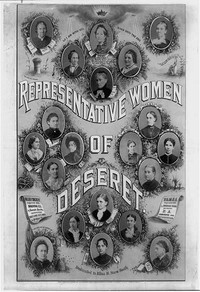
Augusta Joyce Crocheron's Representative Women of Deseret (1884) is a companion volume to a picture of the same title, intended to introduce strangers to the character of Latter-day Saint women. In her introductory remarks, Crocheron explicitly subordinates intellectual gifts to spiritual and missionary labors, stating that the latter are the primary focus. The sketches aim to demonstrate the subjects' purity, integrity, and heroic firmness, countering external perceptions of Mormon women as passive or degraded.
The language throughout is earnest and testimonial, often employing religious diction such as 'labor,' 'testimony,' and 'faith.' Crocheron's authorial voice is both humble and zealous, as when she hopes her 'truthful testimonies' might melt hearts 'like burning bullets.' The work is structured as a series of individual biographies, each highlighting the subject's public contributions and personal virtues.
Diction of Devotion and Defense
Crocheron's word choices consistently frame the women's lives as acts of religious service. The introductory note uses phrases like 'spiritual or missionary labors,' 'heroic firmness,' and 'allegiance to their cause.' This lexicon positions the biographical subjects as exemplars of faith rather than merely notable individuals. The author also employs defensive rhetoric, anticipating criticism: she asserts that Mormon women are 'not from the dregs of civilization' and that their religion is not 'a cloak, a subterfuge.' Such language reveals a dual purpose—to edify internal readers and to vindicate the community to outsiders.
In the sketch of Emmeline B. Wells, Crocheron describes her 'almost total forgetfulness of self' and her joy in others' achievements 'as though they were her own.' This vocabulary of selflessness recurs across the biographies, reinforcing a collective ideal of womanhood defined by service and humility.
Narrative Structure and the Public Life
Each biography follows a similar arc: early life, conversion or commitment, and then a catalog of public activities. The sketch of Emmeline B. Wells, for example, lists her roles as editor of the Woman's Exponent, president of the Central Grain Committee, delegate to suffrage conventions, and secretary of the Deseret Hospital Association. Crocheron presents these accomplishments as evidence of capability and dedication, but she consistently ties them back to religious context. She notes that Wells's abilities developed 'in that mental atmosphere which is the very essence of Mormonism.'
The author also includes specific dates and events—such as the 1879 trip to Washington and the 1882 Omaha convention—grounding the narrative in verifiable public actions. This structural choice emphasizes the women's engagement with national movements while maintaining their distinct religious identity.
Voice and the Collective Subject
Crocheron's authorial voice fluctuates between objective reporter and fervent advocate. In the introductory section, she uses first-person plural ('our people,' 'our women') to align herself with her subjects, creating a sense of shared identity. The dedication addresses the subjects as 'Spirits dear' and employs poetic lines: 'Ye light the path / That else were lone and dim.' This shift to verse underscores the devotional tone.
Despite the individual focus of each sketch, Crocheron repeatedly emphasizes the collective. She writes that the picture 'is intended to represent the Latter Day Saints Women's Organizations rather than to draw attention to those intellectual gifts.' The women are presented as representatives of a movement, not as isolated figures. This collective framing is reinforced by the book's title and its origin as a companion to a group portrait.
Recurring Details of Pioneer Life and Labor
Across the excerpts, certain details recur: travel, organizational work, and the balancing of domestic and public duties. Emmeline B. Wells is described as traveling 'much among our people, speaking and assisting in organizing.' The biography notes that she 'never seems to tire of journalistic duty' and that her time is 'almost constantly employed in the performance of public duties and benevolent work.' These details paint a picture of relentless activity.
Crocheron also includes specific references to the women's political engagement, such as the preparation of a 'memorial to Congress' and audiences with President Hayes. The author frames these actions as extensions of religious conviction, stating that the women have exercised the ballot 'with respect, caution and wisdom.' The recurring motif of labor—both spiritual and civic—serves to counter the stereotype of Mormon women as isolated or oppressed.
Readers approaching Representative Women of Deseret should attend to how Crocheron's language and structure serve a dual audience: Latter-day Saint readers seeking edification and outsiders needing persuasion. The biographies are not neutral records but carefully crafted testimonies. Noticing the recurring emphasis on public service, the defensive undertones, and the collective framing will reveal the author's rhetorical strategies. The work offers a window into how nineteenth-century Mormon women presented themselves to the world.
Reading Representative Women of Deseret, I kept thinking of the quiet, unglamorous endurance those women carried—their strength was in the everyday, not the dramatic. That same understated resilience surfaced when I later came across The privations of a private — Story, Setting & Ideas. Both felt like diaries of ordinary courage, remembered softly, without fuss, the way we recall weather from a far-off year.
There are no reviews for this eBook.
There are no comments for this eBook.
Reader reflection
What did you think of this book?
Answer a few questions and save a private reflection on this device.
Your progress
0
/
10
2
How much did you enjoy the reading experience?
3
Would you recommend this book to another reader?
4
How easy was the book to follow?
5
Which element worked best for you?
6
Would this book work well in a reading group?
7
Did any part of the book stay with you emotionally?
8
How would you describe its reading pace?
9
Which lesson or insight stayed with you?
10