1

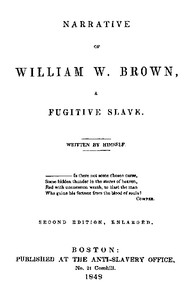
Narrative of William W. Brown, a Fugitive Slave. Second Edition — Background and Themes
(0 User reviews)
755
Project Gutenberg
2019
Not confirmed
Fugitive slaves -- United States -- Biography; African Americans -- Biography; Enslaved persons -- Missouri -- Biography; Brown, William Wells, 1814?-1884; Enslaved persons -- United States -- Social conditions -- 19th century
Readers of public-domain and historical texts
Project Gutenberg digital edition
en
Edition facts
Words
34,870
Reading time
152 min
Text sections
4
Narrative of William W. Brown, a Fugitive Slave. Second Edition — Background and Themes can be approached with a clearer sense of reading commitment from its source measurements: 34,870 words, 2 hr 32 min estimated reading time, and 4 detected text sections.
The text analysis averages about 19.8 words per sentence, while the detected sections provide another way to judge how the source is divided.
Project Gutenberg metadata also associates the work with “Fugitive slaves -- United States -- Biography,” connecting these edition facts with the source record’s subject description.
Source:
Project Gutenberg record #59500
William Wells Brown's 1848 narrative recounts his enslavement in Missouri and escape to freedom, with a focus on the psychological and physical toll of slavery, the role of fortune-telling, and the strategic planning of his flight.
Editorial Edition Score
4.6/5
★★★★★
★★★★★
Calculated from edition completeness, EPUB availability, text structure and catalogue metadata. Not a user rating.
How this score is calculated
- Description quality20 pts
- Title & short description10 pts
- Source metadata20 pts
- Text length15 pts
- Chapters / structure15 pts
- EPUB file integrity20 pts
Total of 100 points, scaled to a 2.5-5.0 range. Editions with an empty description or a missing EPUB file are not scored.
Edition quality
Public-domain source text
Read the source text
The source text is kept in the dedicated reader, separate from this catalogue record and its commentary.
William Wells Brown opens his 1848 narrative with a dedication to Wells Brown of Ohio, the man who gave him shelter and a name when he arrived as a fugitive. The epigraph from Cowper—'Is there not some chosen curse... to blast the man who gains his fortune from the blood of souls?'—sets a tone of moral indictment. Brown's preface to the second edition notes that the first edition of three thousand copies sold in under six months, and he has enlarged the work with additional matter. A letter from Edmund Quincy praises the manuscript for presenting 'a different phase of the infernal slave-system' from Frederick Douglass's narrative, hinting at Brown's distinctive focus on the Missouri region and river-based escape.
A Dedication That Frames the Narrative
The dedication to Wells Brown is not a mere formality. Brown writes that slavery had denied him even a name, and his benefactor bestowed his own. This act of naming is central: the author becomes William Wells Brown, a self-made identity. The language of the dedication—'a weary fugitive from chains and stripes'—echoes biblical phrasing ('I was a stranger, and you took me in') and establishes a tone of gratitude that recurs throughout. Brown's insistence that he can never forget this kindness, 'until I forget God and myself,' personalizes the narrative as a testimony of debt and transformation. Readers should note how this opening shapes the voice: Brown is not merely recounting events but offering a gift of remembrance.
The Fortune-Teller as a Narrative Device
In the later excerpts, Brown describes a visit to 'Uncle Frank,' a slave fortune-teller. The old man, 'about seventy years of age, something over six feet high, and very slender,' predicts that Brown will be free, though he will meet 'many severe trials.' Brown admits skepticism—'any fool could tell me that!'—yet he records the episode in detail, noting that many of Frank's predictions 'were verified.' This passage serves multiple purposes: it humanizes the enslaved community's spiritual practices, introduces an element of folk belief, and foreshadows Brown's eventual escape. The fortune-teller's method—looking into a gourd of water—is described with ethnographic precision, and Brown's ambivalence ('I am no believer in soothsaying; yet I am sometimes at a loss') adds complexity. The episode also marks a turning point: after consulting Frank, Brown's resolve hardens.
The Agony of Leaving Family Behind
On the night before his escape, Brown writes that he 'did not close my eyes a single moment.' His mind dwells on his mother, sister, and three brothers still in slavery. He imagines his mother 'in the cotton-field, followed by a merciless taskmaster' and his sister 'in the hands of a slave-driver.' The passage is notable for its restraint: Brown does not describe actual scenes but hypothetical ones, driven by love and fear. He confesses that if he could be assured of their death, he 'should have felt satisfied'—a stark admission of the psychological torment of separation. This interior focus distinguishes Brown's narrative from more action-driven accounts. The reader is invited into the emotional calculus of escape, where freedom comes at the cost of abandoning loved ones to unknown suffering.
The Mechanics of Flight: A River Escape
Brown's escape is meticulously planned. He chooses a landing point on the Ohio River, waits for the boat to discharge cargo, and slips ashore 'with my little effects.' He carries only provisions and a half-worn suit of clothes. Once on land, he heads directly for the woods, knowing he cannot travel even in Ohio during daylight 'without danger of being arrested.' The narrative emphasizes the practical risks: the need to blend in, the fear of slave catchers, the reliance on darkness. Brown's description of his state of mind—'I had long since made up my mind'—contrasts with the earlier emotional turmoil. The river itself becomes a character: Cairo, at the mouth of the Ohio, is the first free soil he touches, and Louisville marks the start of his upward journey. These geographic details ground the story in a specific, verifiable route.
The Role of the Second Edition
The second edition includes a note from Brown explaining that he has 'enlarged the work by the addition of matter which, he thinks, will add materially to its value.' The first edition sold rapidly, and this new version aims to be 'instrumental in helping to undo the heavy burdens, and letting the oppressed go free.' The additions likely include the fortune-teller episode and the detailed escape sequence, which are not present in the first edition's outline. Readers of this edition encounter a more developed narrative, one that balances personal reflection with strategic detail. Brown's stated goal—to aid the abolitionist cause—shapes every choice, from the epigraph to the appendix. The narrative is both a memoir and a political document, and the second edition refines that dual purpose.
Brown's narrative rewards attention to its structure: the dedication, the fortune-teller, the sleepless night, and the river escape form a coherent arc from gratitude to action. Readers should note how Brown uses specific names (Wells Brown, Uncle Frank, Sarpee) and places (Cairo, Louisville) to authenticate his story. The second edition's additions deepen the psychological portrait without sacrificing momentum. For a first reading, focus on the tension between Brown's stated skepticism and his willingness to include folk elements—this tension reveals the complexity of his voice as both a witness and a literary craftsman.
There’s something about William Wells Brown’s careful planning, the way he timed his escape around a fortune-teller’s predictions, that stays with me. It makes me think of another quiet life story, one carried across a different landscape of loss and resilience: Goodbird the Indian: His Story — Background and Themes. Both feel less like history and more like remembered voices, asking only to be heard.
There are no reviews for this eBook.
There are no comments for this eBook.
Reader reflection
Before you leave, reflect on the book
Use these questions to collect your thoughts before moving on.
Your progress
0
/
10
2
Did this book hold your interest?
3
Would you recommend this book to another reader?
4
How much effort did this book require?
5
How valuable was this book for your own interests?
6
How would you rate its originality?
7
How strong was your personal connection to the text?
8
Is this a title worth rereading?
9
What changed or sharpened your thinking?
10