1

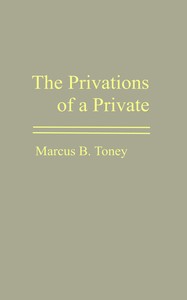
The privations of a private — Story, Setting & Ideas
(0 User reviews)
1649
Project Gutenberg
2026
Not confirmed
United States -- History -- Civil War, 1861-1865 -- Campaigns; United States -- History -- Civil War, 1861-1865 -- Regimental histories; United States -- History -- Civil War, 1861-1865 -- Personal narratives, Confederate; Soldiers -- Tennessee -- Biography; Tennessee -- History -- Civil War, 1861-1865 -- Personal narratives; Tennessee -- History -- Civil War, 1861-1865 -- Regimental histories; Confederate States of America. Army. Tennessee Infantry Regiment, 1st; Toney, Marcus B. (Marcus Breckenridge), 1840-1929
Readers of public-domain and historical texts
Project Gutenberg digital edition
en
Edition facts
Words
40,932
Reading time
178 min
Text sections
17
For The privations of a private — Story, Setting & Ideas, the stored edition analysis reports 40,932 words, 2 hr 58 min estimated reading time, and 17 detected text sections.
The text analysis averages about 20.7 words per sentence, while the detected sections provide another way to judge how the source is divided.
Project Gutenberg metadata also associates the work with “United States -- History -- Civil War, 1861-1865 -- Campaigns,” connecting these edition facts with the source record’s subject description.
Source:
Project Gutenberg record #78204
Marcus B. Toney's memoir of service in the 1st Tennessee Infantry, covering campaigns under Lee and Jackson, Bragg's Kentucky invasion, Chickamauga, Wilderness, and Northern prison camps, with later chapters on Reconstruction and the Kuklux Klan.
Editorial Edition Score
4.8/5
★★★★★
★★★★★
Calculated from edition completeness, EPUB availability, text structure and catalogue metadata. Not a user rating.
How this score is calculated
- Description quality20 pts
- Title & short description10 pts
- Source metadata20 pts
- Text length15 pts
- Chapters / structure15 pts
- EPUB file integrity20 pts
Total of 100 points, scaled to a 2.5-5.0 range. Editions with an empty description or a missing EPUB file are not scored.
Edition quality
Public-domain source text
Read the source text
The source text is kept in the dedicated reader, separate from this catalogue record and its commentary.
Marcus B. Toney's memoir, first published in 1905 and revised in 1907, opens with a dedicatory page addressed to "the boys who wore the gray" and to the Masonic fraternity. The table of contents lists campaigns under Generals R. E. Lee and Stonewall Jackson, Bragg's invasion of Kentucky, the Chickamauga and Wilderness campaigns, prison life at Point Lookout and Elmira, and post-war chapters on "The Privations of a Citizen," the Kuklux Klan, and "A United Citizenship." The catalog subjects emphasize regimental and personal narratives of the Confederate experience, but the excerpts reveal a work that also addresses the author's post-war perspective on Reconstruction and reconciliation.
Campaigns and Combat
The excerpts show Toney describing his service in several major campaigns. In the Wilderness campaign, he recounts being captured and marched toward Fredericksburg. He notes that the prisoners were guarded by heavy artillery regiments and that they were "hatless, shoeless, and coatless" while passing Union soldiers. The narrative includes specific details such as bivouacking on Marye Heights and cutting chinquapin bushes to sleep on. Toney also mentions the Christian Commission, which he says did not minister to Confederate prisoners. These observations ground the combat sections in concrete, personal experience rather than strategic overview.
Prison Life and Northern Captivity
Chapter IX, "Prison Life, Point Lookout, Md.," describes the author's arrival at the camp on May 20. He notes that the guards were "about eleven hundred colored soldiers" under Major H. G. O. Weymouth, and explains that General Grant replaced white troops with these soldiers because they "had not behaved well at the front." Toney describes the camp's physical layout: twenty acres of sandy land, a sixteen-foot fence with a parapet walkway, guards stationed forty feet apart, and artillery ready in case of insurrection. The account also mentions that prisoners were searched upon arrival and relieved of valuables. The tone is observational, with occasional commentary on the treatment of prisoners.
Post-War Reflections and the Kuklux Klan
The catalog subjects list "The Kuklux Klan" as a chapter topic, and the table of contents includes chapters on "The Privations of a Citizen" and "A United Citizenship." While the excerpts do not include the text of these chapters, their presence indicates that Toney's memoir extends beyond the war years into Reconstruction. The dedication to "the boys who wore the gray" and to the Masonic fraternity suggests a framework of fraternal and sectional loyalty. The author's later chapters likely address his views on the Klan and on reconciliation, but the excerpts do not reveal specific content. Readers should note that the memoir's scope is broader than the campaign narratives alone.
Toney's memoir is organized chronologically but includes thematic chapters that move from wartime service to post-war life. The excerpts show a writer attentive to physical details—mud, hunger, makeshift sleeping arrangements—and to the behavior of Union forces. Readers interested in Confederate prison experiences or in the memory of the war as shaped by a veteran writing forty years later will find this account useful. The later chapters on citizenship and the Klan, though not excerpted here, suggest that Toney intended his book as both a personal record and a commentary on reunion.
Reading Toney’s account, the quiet way he holds onto small moments amid the chaos—the dust, the waiting, the smell of camp—stayed with me long after. It reminded me of another voice from that same broken world, a woman’s perspective on what was lost and rebuilt. That gentle persistence of memory feels echoed in Chronicles of Chicora Wood — Edition Insights, like two lanterns glowing from the same dark porch.
There are no reviews for this eBook.
There are no comments for this eBook.
Reader reflection
Take a moment to reflect on this book
Create a short personal record of your experience with this book.
Your progress
0
/
10
2
Did this book hold your interest?
3
Would you pass this book on to a friend?
4
How much effort did this book require?
5
How valuable was this book for your own interests?
6
Was the book moving at the right speed?
7
How strongly did the book affect you emotionally?
8
What was the strongest part of the book?
9
What did this book teach you most?
10