1

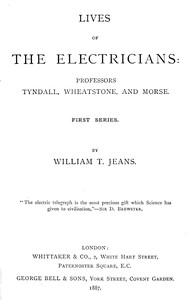
Lives of the electricians — Context and Discussion
(0 User reviews)
699
Project Gutenberg
2024
Not confirmed
Inventors -- Biography; Morse, Samuel Finley Breese, 1791-1872; Tyndall, John, 1820-1893; Wheatstone, Charles, Sir, 1802-1875; Electrical engineers -- Biography
Readers of public-domain and historical texts
Project Gutenberg digital edition
en
Edition facts
Words
111,688
Reading time
486 min
Text sections
31
The source record for Lives of the electricians — Context and Discussion measures this digital text at 111,688 words, 8 hr 6 min estimated reading time, and 31 detected text sections.
The text analysis averages about 28.4 words per sentence, while the detected sections provide another way to judge how the source is divided.
Project Gutenberg metadata also associates the work with “Inventors -- Biography,” connecting these edition facts with the source record’s subject description.
Source:
Project Gutenberg record #73641
An 1887 triple biography of Tyndall, Wheatstone, and Morse, examining their scientific contributions through a Victorian lens. The narrative voice shifts between reverent exposition and pointed analysis, as seen in its treatment of telegraphy's disputed origins and the author's skeptical asides about popular invention myths.
Editorial Edition Score
4.9/5
★★★★★
★★★★★
Calculated from edition completeness, EPUB availability, text structure and catalogue metadata. Not a user rating.
How this score is calculated
- Description quality20 pts
- Title & short description10 pts
- Source metadata20 pts
- Text length15 pts
- Chapters / structure15 pts
- EPUB file integrity20 pts
Total of 100 points, scaled to a 2.5-5.0 range. Editions with an empty description or a missing EPUB file are not scored.
Edition quality
Public-domain source text
Read the source text
The source text is kept in the dedicated reader, separate from this catalogue record and its commentary.
William T. Jeans opens this 1887 triple biography with a telling rhetorical move: he quotes Sir David Brewster calling the electric telegraph “the most precious gift which Science has given to civilisation,” then proceeds to write a book that frequently undermines such heroic narratives. The voice is that of a Victorian popularizer who admires his subjects but refuses to let legend stand unchallenged. When recounting how a flood supposedly led to the single-needle telegraph, Jeans inserts a tart aside: “the high tide referred to in the story occurred on November 18th, 1841, after the five-needle telegraph had been in operation… more than two years.” This forensic puncturing of anecdote recurs throughout, giving the prose a distinctive, skeptical texture.
A Biographer Who Argues with His Sources
Jeans does not simply narrate; he debates. In the Wheatstone section, he reproduces a claim that a clerk named Greener, not the professor, first devised the double-needle telegraph during a Thames flood. Then he systematically dismantles it: the flood date postdates the five-needle instrument’s installation, and a few weeks’ practice with that machine would have taught any clerk the underlying alphabet of needle movements. “Facts, however, are against its accuracy,” Jeans writes flatly. This pattern—present a rival account, then refute it with dates and logic—recurs often enough to become a structural tic. The reader is never allowed to settle into passive reception; Jeans keeps reopening questions of priority and credit.
The Grammar of Invention Stories
Jeans has a sharp ear for the clichés of scientific mythmaking. He pauses to mock the “falling of an apple” and “boiling of a tea-kettle” as the “orthodox way of accounting for the triumphs of mind over matter.” The passage is a small essay on narrative convention, embedded in a biography. He quotes the Abbé Raynal on genius versus chance, then pivots to show how the five-needle telegraph’s alphabet could be reduced to single-needle signals by simple logic—no flood required. This layering of quotation, commentary, and technical explanation is characteristic. Jeans treats invention stories as texts to be analyzed, not just repeated, and his own prose shifts register accordingly, from elevated quotation to plain-spoken demonstration.
Pace and the Problem of Completeness
The book’s rhythm is uneven in ways that reflect its triple-subject structure. Tyndall’s section moves briskly through alpine climbs and laboratory work; Wheatstone’s bogs down in patent disputes and cable-laying minutiae. The Morse portion (not excerpted here) presumably completes the set. Jeans seems aware of the imbalance: he devotes entire chapters to the Cooke-Wheatstone priority quarrel, reproducing correspondence and committee findings at length. The pace slows to a legalistic crawl. Yet these passages also contain the book’s most vivid writing—the description of clerks signaling dinner orders on a single wire, the dry observation that “a minute’s examination of the five-needle instrument shows” the obviousness of the single-needle code. The reader must adjust to sudden shifts from narrative to argument, from panorama to close reading.
Jeans’s method rewards a reader willing to follow his digressions into priority disputes and technical explanations. The book is not a smooth hagiography but a series of contested claims, each weighed against evidence. Pay attention to the footnotes and asides: they often contain the most telling observations. When the prose slows to examine a patent or a flood story, that is where the biographer’s real interest lies—not in celebrating genius, but in understanding how inventions actually emerge from argument, accident, and the work of unnamed clerks.
I spent an evening with that old Lives of the Electricians, and later found myself reaching for Fifty Notable Years Views of the Ministry of Christian Universalism During the Last Half-Century; with Biographical Sketches — Context and Discussion. Both whisper of earnest men who believed their work mattered, quietly defying the cynics of their age. They share a patient, hopeful temper. A comforting shelf-fellowship, that.
There are no reviews for this eBook.
There are no comments for this eBook.
Reader reflection
What was your reading experience?
Capture what you thought, learned, and would like to remember.
Your progress
0
/
10
2
Did this book hold your interest?
3
Is this a title you would suggest to others?
4
Did the language feel accessible?
5
Would a second reading be valuable?
6
What was its emotional impact?
7
Which aspect of the book did you value most?
8
Would you start a conversation about this book?
9
What changed or sharpened your thinking?
10