1

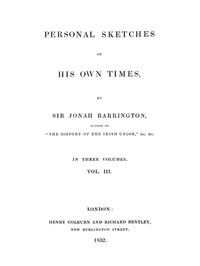
Personal sketches of his own times, Vol. 3 (of 3) — Themes and Context
(0 User reviews)
920
Project Gutenberg
2015
Not confirmed
Barrington, Jonah, Sir, 1760-1834; Judges -- Ireland -- Biography; Ireland -- Social life and customs -- 18th century; Ireland -- Social life and customs -- 19th century
Readers of public-domain and historical texts
Project Gutenberg digital edition
en
Edition facts
Words
113,621
Reading time
495 min
Text sections
30
This digital edition of Personal sketches of his own times, Vol. 3 (of 3) — Themes and Context is described by source-level measurements including 113,621 words, 8 hr 15 min estimated reading time, and 30 detected text sections.
The text analysis averages about 28.8 words per sentence, while the detected sections provide another way to judge how the source is divided.
Project Gutenberg metadata also associates the work with “Barrington, Jonah, Sir, 1760-1834,” connecting these edition facts with the source record’s subject description.
Source:
Project Gutenberg record #49794
In this third volume of memoirs, Sir Jonah Barrington recounts Irish legal and social life through vivid anecdotes, including a memorable encounter with a sow that disrupts a breakfast party, blending humor with sharp observation of character.
Editorial Edition Score
4.9/5
★★★★★
★★★★★
Calculated from edition completeness, EPUB availability, text structure and catalogue metadata. Not a user rating.
How this score is calculated
- Description quality20 pts
- Title & short description10 pts
- Source metadata20 pts
- Text length15 pts
- Chapters / structure15 pts
- EPUB file integrity20 pts
Total of 100 points, scaled to a 2.5-5.0 range. Editions with an empty description or a missing EPUB file are not scored.
Edition quality
Public-domain source text
Read the source text
The source text is kept in the dedicated reader, separate from this catalogue record and its commentary.
Sir Jonah Barrington opens this third volume with a dedication to Lord Stowell, noting that the previous volumes were read with 'general avidity' and gave 'much insight into the original character of the Irish.' The preface reveals that the entire work was composed in under three months during a protracted winter, a speed Barrington offers as apology for 'inaccuracies incidental to so hasty a performance.' These framing remarks establish the tone of a self-aware memoirist who values anecdotal immediacy over polished completeness.
A Memoirist's Apology for Haste
Barrington's preface is unusually candid about the speed of composition: the first two volumes were 'collected and composed' in nearly three months. He does not claim this as literary expertise but as 'some apology for the inaccuracies incidental to so hasty a performance.' This self-deprecation is characteristic of the volume's tone. The dedication further reveals that the third volume was written at Lord Stowell's express wish, after Stowell reported that the sketches 'had given very general satisfaction' and 'afforded him much amusement.' Barrington, now past seventy, offers this as 'the last and only souvenir' he can tender. These paratexts frame the work as a personal, almost conversational offering rather than a formal history.
The Sow That Overturned a Breakfast
The excerpted anecdote centers on a sow and her piglets invading a parlour breakfast. Barrington describes the sow with grotesque precision: 'small fiery blood-shot sunken eyes,' tusks 'like a boar's,' and an iron ring and hook in her nose. The piglets are called 'piggin riggins,' a dialect term that grounds the scene in Irish rural life. The sow, attracted by the 'savoury perfume' of the meal, enters, overturns the table, and traps two counsellors on a chest of drawers. The humour escalates when a piglet overturns a saucepan of boiling water, causing 'the most dreadful cries.' Barrington's voice is mock-heroic, comparing the sow's grunt to a trumpeter sounding 'to horse' and the piglet's yelp to a butcher's preliminary steps. The scene is a set-piece of comic misadventure, showcasing Barrington's eye for physical detail and his willingness to make himself the butt of the joke.
Catalog Subjects vs. Actual Content
The catalog subjects list 'Judges -- Ireland -- Biography' and 'Ireland -- Social life and customs -- 18th century' and '19th century.' Yet the excerpt contains no judges, no courtroom, no political events. Instead, it offers a domestic farce involving a sow, a breakfast, and two lawyers reduced to dancing on furniture. The dedication and preface are personal, not historical. This gap between catalog and content is instructive: Barrington's 'sketches' are less systematic biography than rambling memoir, heavy on anecdote and light on institutional analysis. Readers expecting a judicial chronicle will find instead a work that treats legal figures as characters in a comedy of manners. The volume's value lies in its informal record of manners, dialect, and the texture of Irish gentry life, not in any comprehensive account of the Irish bench.
Barrington's third volume rewards readers who enjoy digressive, self-deprecating memoir over structured history. The sow anecdote exemplifies his method: a small, vivid incident becomes a window into social hierarchy, domestic space, and the author's own comic persona. Approach this work as a cabinet of curiosities rather than a systematic record, and its pleasures—and its limitations—become clear.
That rainy afternoon, Barrington’s sow crashing the breakfast party made me chuckle at how dignity always topples into absurdity. Later, I found myself wondering about other voices left out of such memoirs. A quiet link appeared in my thoughts—Colored girls and boys' inspiring United States history and a heart to heart talk about white folks — Background and Themes—and the rain seemed to soften around its pages.
There are no reviews for this eBook.
There are no comments for this eBook.
Reader reflection
How did this book work for you?
Your answers remain private and are stored only in this browser.
Your progress
0
/
10
2
Was reading this book enjoyable?
3
Is this a title you would suggest to others?
4
How demanding did the text feel?
5
How clearly were the main ideas presented?
6
Would you start a conversation about this book?
7
How would you describe its reading pace?
8
Did any part of the book feel personally relevant?
9
Which lesson or insight stayed with you?
10