1

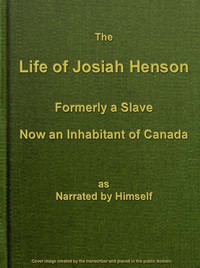
The Life of Josiah Henson, Formerly a Slave, Now an Inhabitant of Canada — A Reader’s Guide
(0 User reviews)
60
Project Gutenberg
2016
Not confirmed
Fugitive slaves -- United States -- Biography; African Americans -- Biography; Enslaved persons -- United States -- Biography; Henson, Josiah, 1789-1883; Fugitive slaves -- Canada -- Biography; Black people -- Canada -- Biography; Clergy -- Canada -- Biography
Readers of public-domain and historical texts
Project Gutenberg digital edition
en
Edition facts
Words
23,857
Reading time
104 min
Text sections
2
Before opening The Life of Josiah Henson, Formerly a Slave, Now an Inhabitant of Canada — A Reader’s Guide, the edition data offers a quick orientation: 23,857 words, 1 hr 44 min estimated reading time, and 2 detected text sections.
The text analysis averages about 30.2 words per sentence, while the detected sections provide another way to judge how the source is divided.
Project Gutenberg metadata also associates the work with “Fugitive slaves -- United States -- Biography,” connecting these edition facts with the source record’s subject description.
Source:
Project Gutenberg record #53609
Josiah Henson's 1849 narrative, dictated to Samuel Atkins Eliot, recounts his life from enslavement in Maryland to freedom in Canada, with a focus on the physical and psychological turning points that shaped his journey.
Editorial Edition Score
4.5/5
★★★★★
★★★★★
Calculated from edition completeness, EPUB availability, text structure and catalogue metadata. Not a user rating.
How this score is calculated
- Description quality20 pts
- Title & short description10 pts
- Source metadata20 pts
- Text length15 pts
- Chapters / structure15 pts
- EPUB file integrity20 pts
Total of 100 points, scaled to a 2.5-5.0 range. Editions with an empty description or a missing EPUB file are not scored.
Edition quality
Public-domain source text
Read the source text
The source text is kept in the dedicated reader, separate from this catalogue record and its commentary.
The narrative opens with a precise date and location—June 15, 1789, in Charles County, Maryland—and immediately establishes a pattern of violent disruption. Henson’s first memory is of his father appearing with a bloody head and lacerated back, his right ear cut off for beating an overseer who assaulted Henson’s mother. This early scene sets the tone for a life marked by abrupt separations and moral crises. The structure of the memoir moves through a series of such pivotal moments, each forcing Henson to confront the limits of endurance and the possibility of escape.
Recurring Images of the Body
Throughout the excerpts, Henson’s body is a site of measurement and violation. He recalls being examined by planters who “canvassed my points as those of a horse would have been,” reducing his human faculties to a “domestic animal’s” value. The physical details are precise: his father’s severed ear, the hundred lashes, the fever that prostrates master Amos. These images accumulate, creating a world where the body is both a commodity and a record of suffering. Henson’s own moment of crisis—standing with an axe, contemplating murder—is described through bodily sensation: he “shrunk back, laid down the axe, crept up on deck.” The narrative rarely dwells on abstract emotion; instead, it anchors feeling in physical action and reaction.
Movement Between Confinement and Open Water
The memoir’s geography is defined by constrained spaces—farms, boats, cabins—and the rivers that connect them. Henson’s journey down the Mississippi to New Orleans is a slow, deliberate passage: “the slow way in which we had come down had brought us to the long days and the heat of June.” The flatboat becomes a floating prison, where Henson is examined by potential buyers. Yet the river also offers the possibility of transformation. When Amos falls ill, the tables turn: “His head was on my lap, and he was begging me to help him.” The shift in power is spatial as well as social, as Henson moves from being cargo to caretaker. Water, in this narrative, is both a conduit for sale and a medium of reversal.
The Structure of Crisis and Resolution
Henson’s story is built around a series of intense, self-contained episodes, each with its own moral arithmetic. The axe scene is the most dramatic: a whispered voice—whether internal or supernatural—stops him from murder. He then makes a “solemn resolution” to resign himself to God’s will, a decision that brings “composure to my mind.” This pattern recurs: a crisis, a moment of near-despair, then a deliberate turn toward submission or action. The narrative does not present these resolutions as easy; Henson notes it was “long before I recovered my self-control and serenity.” The structure thus mirrors the psychological labor of survival, where each trial requires a conscious reorientation.
Voice and the Role of the Editor
The advertisement explains that the memoir was “written from the dictation of Josiah Henson” and that “little more than the structure of the sentences belongs to another.” This editorial note shapes how we read the text: the facts, reflections, and “very often the words” are Henson’s, but the syntax is mediated. The result is a voice that is direct and declarative, yet occasionally formal. Henson’s own phrasing breaks through in moments of intensity, as when he recalls the whispered voice: “I believe I even turned my head to listen.” The collaboration between narrator and editor produces a document that is both personal testimony and public record, a hybrid form that the reader must navigate with attention to its layered authorship.
Readers should attend to the way Henson’s narrative oscillates between the specific and the reflective. The memoir is not a continuous chronicle but a series of carefully chosen scenes, each weighted with moral significance. The editorial framing invites us to consider how the story was shaped for a Northern audience in 1849, yet the raw material—the father’s ear, the axe, the fever—retains its power. To read this work is to watch a man construct a self through the act of telling, even as the structure of that telling remains partly in another’s hands.
Some afternoons, I think of Josiah Henson, how each deliberate step toward Canada was a small rewriting of his own circuit. My hand lingers on the shelf beside Lives of the electricians — Context and Discussion, and I find a quiet kinship there—not of wires, but of unseen currents. Both books measure a life by the light it finally carries home. Lives of the electricians — Context and Discussion sits patient, and I recall how one man's journey can be like another's, only slower.
There are no reviews for this eBook.
There are no comments for this eBook.
Reader reflection
Before you leave, reflect on the book
Use these questions to collect your thoughts before moving on.
Your progress
0
/
10
2
Did this book hold your interest?
3
Would you encourage someone else to read it?
4
How much effort did this book require?
5
Was the book what you thought it would be?
6
What was its emotional impact?
7
How strong was your personal connection to the text?
8
Which element worked best for you?
9
What did this book teach you most?
10