1

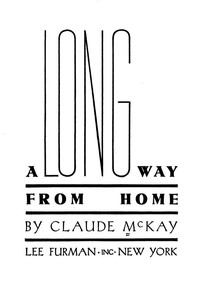
A long way from home — Story, Setting & Ideas
(0 User reviews)
791
Project Gutenberg
2023
Not confirmed
Authors, American -- 20th century -- Biography; McKay, Claude, 1890-1948; Authors, Jamaican -- 20th century -- Biography; Jamaican Americans -- Intellectual life; African American authors -- Biography; Jamaican Americans -- Biography
Readers of public-domain and historical texts
Project Gutenberg digital edition
en
Edition facts
Words
102,951
Reading time
448 min
Text sections
10
This digital edition of A long way from home — Story, Setting & Ideas is described by source-level measurements including 102,951 words, 7 hr 28 min estimated reading time, and 10 detected text sections.
The text analysis averages about 17.4 words per sentence, while the detected sections provide another way to judge how the source is divided.
Project Gutenberg metadata also associates the work with “Authors, American -- 20th century -- Biography,” connecting these edition facts with the source record’s subject description.
Source:
Project Gutenberg record #71744
Claude McKay's memoir traces his journey from Jamaican waiter to Harlem Renaissance poet, with sharp observations on race, politics, and literary life in America, England, Russia, and Morocco.
Editorial Edition Score
4.8/5
★★★★★
★★★★★
Calculated from edition completeness, EPUB availability, text structure and catalogue metadata. Not a user rating.
How this score is calculated
- Description quality20 pts
- Title & short description10 pts
- Source metadata20 pts
- Text length15 pts
- Chapters / structure15 pts
- EPUB file integrity20 pts
Total of 100 points, scaled to a 2.5-5.0 range. Editions with an empty description or a missing EPUB file are not scored.
Edition quality
Read the Text
hat was an extraordinary order, after a long and tiring trip. But in those days of 1918, life was universally extraordinary and we railroad men were having our share of it. The government was operating the railroads, and Mr. McAdoo was Director-General. The lines were taxed to their capacity and the trains were running in a different way. Coaches and dining cars of one line were hitched up indiscriminately to the engines of another. Even we waiters were all mixed up on the same level! Seniority didn't count any more; efficiency was enough. There were no special crews for the crack trains; new men replaced the old-timers, expertly swinging trays to the rocking of the train and feeding lawmakers to the amazement of the old élite of the crews. The regular schedules were obsolete, for the dining cars were always getting out of line, there were so many special assignments. One day our dining car would be detailed to serve a group of Allied officers going on a secret rendezvous. Another day it had to cater to a foreign mission traveling to Washington. And other days there was the feeding of detachment upon detachment of hungry soldiers.
"Why should a doubling-out be wished on us?" one waiter growled. "Ask Mr. McAdoo, it's his business," another hilariously replied. In my disappointment (for now I had no time to see the editor) I cursed my luck and wished we were again working under the old régime. But that was merely a momentary reaction, for under the new system we were getting better wages and pay for overtime.
I telephoned the editor that I was obliged to work and could not keep the appointment. He answered graciously: "Whenever you are free, telephone me, and I'll see that we get together." And he gave me his private telephone number and address.
That night our crew slept in Harrisburg. The next afternoon we were in Pittsburgh, and free until the following morning. We went to the sleeping quarters in Wylie Avenue and checked in for our beds, after which the crew split up. A good distance from Wylie Avenue the colored folk had managed to maintain a café and cabaret on the edge of a section of the white district downtown. I decided to go there.
I wish I were one of those persons who have a sense of premonition, so that I might have stuck to quarters that afternoon. But I had a desire to be away from my fellows and off by myself, even if it were in a crowd. My mind was full of the rendezvous with that editor in New York. And as I couldn't talk to any of the fellows about it, it was better to find elsewhere excitement that would keep me from thinking too much.
I found the café in a hectic state. The police had just combed it, rounding up draft dodgers and vagrants. I learned that there was a police net thrown around Pittsburgh that day, and many men who were not slackers at all, but who had left their papers at home, had been picked up. I had no papers, for I had lost my registration card, so I decided to get back right away to the cover and protection of the crew's quarters.
I hurried off, but two blocks away from the café a black man and a white came across the street and straight at me. Bulls! Immediately I was aware. As I had no papers, the detectives arrested me and started for the jail. My protest that I was importantly employed on the railroad was of no avail. The detectives wrote down my name, appearing very wise and knowing, and I wondered if I had been listed as a draft dodger. I had moved from the address from which I had registered and had never received any notification.
At the jail I tried to get permission to telephone to the steward of our dining car. But the perplexed officials had no time to give to the personal requests of the host of prisoners. The police had corralled more than they could handle. The jails were overcrowded, with more men being brought in every minute and no place to accommodate them. Some of the local prisoners had their papers at home. Relatives, learning of their plight, brought them the papers and they were discharged. But all the non-residents were held. Three of us, two colored, one white, were put into a cell which was actually a water closet with an old-fashioned fetid hole. It was stinking, suffocating. I tried to overcome the stench by breathing through my mind all the fragrant verse I could find in the range of my memory.
Claude McKay's A Long Way from Home opens not with a poet's declaration but with a dining-car waiter's impatience. The first chapter, 'A Great Editor,' sets the tone: a letter from an editor has McKay counting the hours until his train returns to New York. The narrative voice is immediate, colloquial, and self-aware—'Was ever a waiter more impatient for a run to end?'—and it establishes a central tension between the physical labor of a railroad job and the intellectual ambition of a poet seeking an American audience. This memoir, published in 1937, covers McKay's life from his arrival in the United States through his travels to England, Russia, France, and Morocco. The excerpts reveal a writer who is both participant and observer, shifting between personal anecdote and broader cultural commentary.
The Waiter-Poet's Double Life
The opening chapter immediately juxtaposes two worlds: the dining car, where 'cooks and waiters joked mainly about women,' and the literary sphere, represented by the editor's letter in McKay's pocket. The phrase 'I a waiter—waiting for recognition as a poet' captures the duality that runs through the memoir. McKay does not romanticize his labor; instead, he uses the railroad's rhythm—'three days away from New York,' 'the most exciting run I ever made'—to frame his emotional state. The voice is direct, almost conversational, yet precise in its self-positioning. He is an outsider within America, a Jamaican immigrant working a service job, but also an insider to the literary networks he hopes to enter. This tension between manual work and artistic aspiration recurs throughout the excerpts, most notably when he later describes being paid 'fifty American dollars' for an article in Moscow while saving his fare home.
Race, Fear, and the Limits of Explanation
In a passage from the Russian section, McKay recounts a conversation with the Soviet official Radek, who asserts that 'the heart of the difference between white and black in America' is fear. McKay pushes back, noting that in the South, white children are nursed by black women and 'extremely fond of their black foster mothers.' The exchange is brief but revealing: McKay does not accept a single-cause explanation for racism. His response is grounded in specific observation—the intimacy of the nursery—rather than abstract theory. This moment exemplifies his narrative method: he resists ideological simplification, even when speaking with powerful figures. The memoir's voice remains skeptical of grand pronouncements, preferring the texture of lived experience. Radek's reply—'that that was a strange thing'—underscores the gap between political analysis and the complexities McKay insists on recording.
Bolshoi in Translation: Literary Fame and Its Discontents
In Moscow, McKay experiences a peculiar form of celebrity. He is paid lavishly, called bolshoi ('big, big, big') by a Russian journalist, and invited to read at literary gatherings. Yet he is unsettled: 'Why should I be 'big' translated into Russian?' He recognizes that his status is partly propaganda—'inflated beyond my actual literary achievement'—and resolves that to be truly bolshoi as a literary artist, he must 'first make a signal achievement in my native adopted language, English.' This self-critical awareness distinguishes McKay's voice from mere travelogue. He also notes the tension between his poetry and the expectations of 'pure proletarian intellectuals' who tell him his poems 'are not proletarian.' His reply—'My poetry expresses my feelings'—is a quiet assertion of artistic independence. The memoir thus tracks not only where McKay went but how he navigated the competing demands of politics, race, and personal expression.
McKay's memoir resists easy categorization: it is part literary chronicle, part travelogue, part political reflection. Readers attentive to shifts in pace will notice how the narrative slows for intimate scenes—a conversation with Radek, a moment of self-doubt in Moscow—and accelerates through broader historical movements. The voice remains consistent: observant, slightly wry, and unwilling to settle for received wisdom. A Long Way from Home rewards those who read for the specific, the contradictory, and the personal.
There are moments in McKay’s wanderings—Russia, Morocco—where he seems less a traveler than a man turning over the same stone of identity, hoping for a new answer underneath. I felt that quiet persistence again in Bess of Hardwick and Her Circle — Edition Insights, where a life’s architecture is built from letters and careful alliances. Different centuries, same patient craft of making a self. Odd how that stayed with me.
There are no reviews for this eBook.
There are no comments for this eBook.
Reader reflection
Record your reading impressions
A brief reflection can help important ideas stay with you longer.
Your progress
0
/
10
2
How did the book work for you overall?
3
Would you recommend this book to another reader?
4
Did the language feel accessible?
5
Did you relate to its people, ideas, or situations?
6
Was the book easy to understand?
7
How useful were the ideas in this book?
8
How much did the book move you?
9
Which lesson or insight stayed with you?
10