1

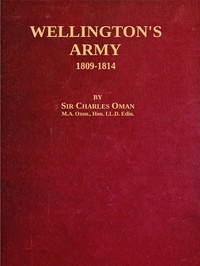
Wellington's Army, 1809-1814 — Text and Context
(0 User reviews)
889
Project Gutenberg
2018
Not confirmed
Wellington, Arthur Wellesley, Duke of, 1769-1852 -- Military leadership; Great Britain. Army -- Officers -- Biography; Peninsular War, 1807-1814 -- Participation, British; Great Britain -- History, Military -- 1789-1820
Readers of public-domain and historical texts
Project Gutenberg digital edition
en
Edition facts
Words
136,265
Reading time
593 min
Text sections
34
Before opening Wellington's Army, 1809-1814 — Text and Context, the edition data offers a quick orientation: 136,265 words, 9 hr 53 min estimated reading time, and 34 detected text sections.
The text analysis averages about 25.8 words per sentence, while the detected sections provide another way to judge how the source is divided.
Project Gutenberg metadata also associates the work with “Wellington, Arthur Wellesley, Duke of, 1769-1852 -- Military leadership,” connecting these edition facts with the source record’s subject description.
Source:
Project Gutenberg record #56318
Charles Oman's 1913 study of Wellington's Peninsular Army focuses on organization, daily life, and psychology rather than battle narratives. Drawing on court-martial records and soldier diaries, it examines the army's composition, discipline, and the challenges of commanding a force that included both reliable troops and a criminal element.
Editorial Edition Score
4.9/5
★★★★★
★★★★★
Calculated from edition completeness, EPUB availability, text structure and catalogue metadata. Not a user rating.
How this score is calculated
- Description quality20 pts
- Title & short description10 pts
- Source metadata20 pts
- Text length15 pts
- Chapters / structure15 pts
- EPUB file integrity20 pts
Total of 100 points, scaled to a 2.5-5.0 range. Editions with an empty description or a missing EPUB file are not scored.
Edition quality
Public-domain source text
Read the source text
The source text is kept in the dedicated reader, separate from this catalogue record and its commentary.
Charles Oman opens his study of Wellington's Peninsular Army by distinguishing it from formal military history. Rather than a chronicle of marches and battles, the volume aims to illuminate the army's organization, day-by-day life, and psychology—aspects he claims are new to most students. The preface acknowledges debts to C. T. Atkinson for a detailed brigade and divisional list and to John Fortescue for answering queries. Oman's approach is evident in his use of court-martial records and soldier diaries, which he mines for evidence of the army's internal dynamics.
The Army's Criminal Element
Oman devotes considerable attention to what he calls the 'irreclaimable bad characters' within the ranks. Drawing on the testimony of officers like Colborne, he notes that every battalion had about fifty men 'whom neither punishment nor any kind of discipline could restrain.' These were poachers, smugglers, pickpockets, and footpads who enlisted to escape the law, often intending to desert and 'jump another bounty.' The Provost Marshal's workload was dominated by this small but persistent minority.
Oman's analysis of court-martial records reveals a statistical over-representation of Irish names in trials for desertion and violent crimes, while Scots were under-represented. He quotes a soldier-diary describing the difficulty of moving a large draft of Irish recruits from Cashel to Deal as 'a nightmare—or a glimpse of some primitive pagan heaven.' The criminal element, he argues, provided the nucleus for larger disorders, such as the sack of Badajoz, where drunkards joined the initial criminals in wanton destruction.
Discipline and the Lash
Oman presents a stark view of disciplinary methods. He states that 'officers of undoubted humanity' and experienced soldiers agreed that a 'residuum' of the army could only be governed by the lash. The text does not shy from describing the routine use of corporal punishment, though Oman refrains from moral judgment. He notes that Wellington himself complained about the 'most reckless and ungovernable' rowdies being newly-joined Irish recruits, who became 'irresponsible madmen' when drunk.
The chapter on court-martials provides a taxonomy of offenses: desertion, plundering, maltreating peasants, burglary, and theft of church plate. Oman's evidence comes from a complete survey of general court-martial records for 1809–14. He observes that the criminal element 'swimming to the top' when mischief was afoot, and that their activities engrossed the majority of the Provost Marshal's attention. The tone is clinical, treating discipline as a logistical and organizational problem rather than a moral one.
Recruiting and Its Flaws
Oman describes a recruiting system he calls 'defective and radically bad.' The enormous bounty offered for volunteers attracted not only the poor but also criminals seeking to escape justice. Sergeants kept 'lynx-eyed' watch over slippery recruits, often locking them in forts and shipping them to Spain before they could desert. The result was a force that included both 'better spirits' and a 'much lower stratum' of undesirables.
The text contrasts the reliable core of the army with this criminal fringe. Oman notes that the 'scum' provided the subject-matter for court-martials and that their presence made the army harder to govern. He cites Colborne's estimate that a lucky battalion had no more than fifty such men. The chapter on recruiting is part of a broader examination of the army's social composition, which also covers officers, German and Portuguese auxiliaries, and the role of women at the front.
Oman's work is best approached as a social and organizational history rather than a battle narrative. Readers interested in the human texture of Wellington's army—its discipline problems, recruiting flaws, and daily life—will find rich material here. The author's reliance on primary sources like court-martial records and soldier diaries gives the account a concrete, evidence-based feel. Those seeking tactical analysis will find it in the chapters on infantry and cavalry tactics, but the book's distinctive contribution lies in its attention to the army's internal workings.
Some evenings I recall Oman's careful pages on Wellington's men, how their true selves emerged in dull camp records rather than grand charges. There is a similar quiet honesty in the soul laid bare upon the pages of My Story — A Closer Reading. Both works whisper that a life, examined closely, holds more truth than any shouted saga.
There are no reviews for this eBook.
There are no comments for this eBook.
Reader reflection
Take a moment to reflect on this book
Create a short personal record of your experience with this book.
Your progress
0
/
10
2
Did this book hold your interest?
3
Would you recommend this book to another reader?
4
What was the reading difficulty like?
5
Which element worked best for you?
6
Did the book give you something worth debating?
7
Did the book meet your expectations?
8
Could you follow the author’s main argument?
9
Which lesson or insight stayed with you?
10