1

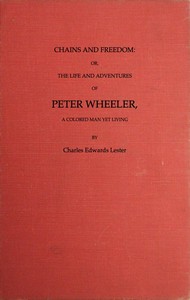
Chains and Freedom: or, The Life and Adventures of Peter Wheeler, a Colored Man Yet Living — Key Ideas to Explore
(0 User reviews)
1190
Project Gutenberg
2020
Not confirmed
Wheeler, Peter, 1789-1842; Enslaved persons -- New York (State) -- Biography; Enslaved persons -- New York (State) -- Social life and customs; Slavery -- New York (State) -- History; Slave narratives -- New York (State); New York (State) -- Race relations -- History
Readers of public-domain and historical texts
Project Gutenberg digital edition
en
Edition facts
Words
62,300
Reading time
271 min
Text sections
14
For Chains and Freedom: or, The Life and Adventures of Peter Wheeler, a Colored Man Yet Living — Key Ideas to Explore, the stored edition analysis reports 62,300 words, 4 hr 31 min estimated reading time, and 14 detected text sections.
The text analysis averages about 32.4 words per sentence, while the detected sections provide another way to judge how the source is divided.
Project Gutenberg metadata also associates the work with “Wheeler, Peter, 1789-1842,” connecting these edition facts with the source record’s subject description.
Source:
Project Gutenberg record #61074
This 1839 narrative, taken from Peter Wheeler's own words by Charles Edwards Lester, presents a first-person account of enslavement, escape, and maritime labor in New York State. The text preserves Wheeler's vernacular speech, including dialect, humor, and strategic lies, offering a rare unfiltered voice from the antebellum North.
Editorial Edition Score
4.8/5
★★★★★
★★★★★
Calculated from edition completeness, EPUB availability, text structure and catalogue metadata. Not a user rating.
How this score is calculated
- Description quality20 pts
- Title & short description10 pts
- Source metadata20 pts
- Text length15 pts
- Chapters / structure15 pts
- EPUB file integrity20 pts
Total of 100 points, scaled to a 2.5-5.0 range. Editions with an empty description or a missing EPUB file are not scored.
Edition quality
Public-domain source text
Read the source text
The source text is kept in the dedicated reader, separate from this catalogue record and its commentary.
From the first page, Chains and Freedom announces itself as an oral history. Charles Edwards Lester states in the preface that the narrative was “taken entirely from the lips of Peter Wheeler,” and that he “in all instances given his own language, and faithfully recorded his story as he told it, without any change whatever.” This claim of verbatim transcription shapes every subsequent page. Wheeler’s voice—marked by dialect, colloquial rhythm, and a wry, self-aware humor—dominates the prose. The result is a document that feels less like a polished memoir and more like a transcribed monologue, complete with asides, repeated phrases, and the kind of casual self-correction that suggests a speaker thinking aloud.
A Voice Marked by Dialect and Rhythm
Wheeler’s speech is rendered in a thick vernacular that Lester makes no effort to standardize. Words are spelled phonetically: “yis” for yes, “tu” for to, “gittin’” for getting, “sarmints” for sermons. The syntax is loose and additive, as in “I goes up stairs and gathers up my clothes, and the women folks comes up tu.” Contractions and dropped consonants are frequent, and Wheeler often repeats a phrase for emphasis, as when he says “I moved some tu” after describing his escape. This is not the polished prose of a literary autobiography; it is the cadence of a man telling a story aloud, with all the repetitions and digressions that oral storytelling entails.
Strategic Lies and Self-Awareness
Wheeler is candid about the fabrications he uses to survive. When a stranger asks where he is traveling, he says he “out with my old lie agin ’bout my mother.” He then compares that lie to “some minister’s sarmints, that goes round the country and preaches the same old sarmint till it’s threadbare—but it sarved my turn.” The metaphor is striking: Wheeler equates his repeated deception with a preacher’s recycled sermon, acknowledging both the necessity and the weariness of the performance. This self-awareness—admitting to the lie even as he tells it—gives the narrative a layer of ironic distance. He is not a passive victim but a strategist who knows when to dissemble.
The Texture of Daily Life and Labor
The excerpts reveal a world of physical work and constant movement. Wheeler hires himself out as a boat hand, negotiating wages: “he agreed to give me twenty shillin’s if I would, and so I agreed tu, and went aboard, and glad enough tu of sich a fat chance of gittin’ along.” The work is described in concrete terms—loading dry goods and groceries, navigating locks, traveling from Snackady to Utica. The setting is the Erie Canal and the Hudson River region, not the Deep South. Wheeler’s freedom of movement, his ability to bargain for pay, and his casual mention of “good times” contrast sharply with the threat of recapture that hangs over every episode. The tension between independence and vulnerability is palpable.
The Mechanics of Escape: Objects and Spaces
Escape in this narrative is mediated by physical objects and improvised spaces. When Wheeler’s master arrives with the sheriff, Mrs. Munson directs him to “swing round the well-sweep, and you jump on, and down head-foremost.” He flings out his bundle, hops on, and descends “jist like a cat.” The well-sweep becomes a makeshift escape route. Later, he hides in a sloop’s cabin, where a sympathetic black man offers food and a berth. The chain that appears in the excerpt’s final line—“he had a big chain, and he begins”—is a blunt symbol of the violence that awaits. These details—the well-sweep, the bundle, the berth, the chain—anchor the abstract horror of slavery in tangible, everyday things.
Readers should attend to the gaps in this narrative. Lester’s editorial hand is invisible but present; we cannot know how much he shaped or selected. Wheeler’s voice is vivid, but it is mediated. The book is best approached as a collaborative document—a record of one man’s testimony, filtered through a sympathetic but ultimately separate amanuensis. Listen for the moments when Wheeler’s humor, his strategic lies, and his physical descriptions break through the frame. They are the surest signs of the man himself.
Reading Peter Wheeler’s wry, sidelong accounts of survival, I thought of my grandfather’s quiet pride in outsmarting a foreman he hated—how the smallest lies kept his dignity whole. That same feeling washed over me years ago with Wellington's Army, 1809-1814 — Text and Context, where ordinary soldiers’ muttered complaints felt more honest than any grand battle report. Both books hum with that stubborn, private music.
There are no reviews for this eBook.
There are no comments for this eBook.
Reader reflection
What was your reading experience?
Capture what you thought, learned, and would like to remember.
Your progress
0
/
10
2
Was reading this book enjoyable?
3
Would you pass this book on to a friend?
4
How much effort did this book require?
5
Did the book meet your expectations?
6
Did anything about the book feel genuinely new?
7
Would you start a conversation about this book?
8
Was the book moving at the right speed?
9
In one sentence, what did you learn?
10