1

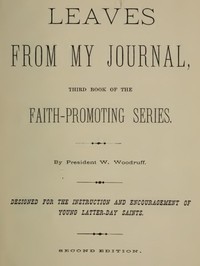
Leaves from My Journal: Third Book of the Faith-Promoting Series Designed for the Instruction and Encouragement of Young Latter-Day Saints — Text and Context
(0 User reviews)
593
Project Gutenberg
2014
Not confirmed
Latter Day Saint churches; Woodruff, Wilford, 1807-1898 -- Diaries; Church of Jesus Christ of Latter-day Saints -- Presidents; Church of Jesus Christ of Latter-day Saints -- History -- 19th century
Readers of public-domain and historical texts
Project Gutenberg digital edition
en
Edition facts
Words
38,940
Reading time
170 min
Text sections
5
The catalog record for Leaves from My Journal: Third Book of the Faith-Promoting Series Designed for the Instruction and Encouragement of Young Latter-Day Saints — Text and Context provides practical reading context through 38,940 words, 2 hr 50 min estimated reading time, and 5 detected text sections.
The text analysis averages about 22.9 words per sentence, while the detected sections provide another way to judge how the source is divided.
Project Gutenberg metadata also associates the work with “Latter Day Saint churches,” connecting these edition facts with the source record’s subject description.
Source:
Project Gutenberg record #46028
Wilford Woodruff's journal excerpts recount early Latter-day Saint missions, family baptisms, and narrow escapes, structured around movement between Connecticut, Maine, and Fox Islands.
Editorial Edition Score
4.6/5
★★★★★
★★★★★
Calculated from edition completeness, EPUB availability, text structure and catalogue metadata. Not a user rating.
How this score is calculated
- Description quality20 pts
- Title & short description10 pts
- Source metadata20 pts
- Text length15 pts
- Chapters / structure15 pts
- EPUB file integrity20 pts
Total of 100 points, scaled to a 2.5-5.0 range. Editions with an empty description or a missing EPUB file are not scored.
Edition quality
Public-domain source text
Read the source text
The source text is kept in the dedicated reader, separate from this catalogue record and its commentary.
Wilford Woodruff's Leaves from My Journal moves through a series of geographical and spiritual transitions, each marked by precise dates and locations. The narrative opens with the strict "Blue Laws" of Connecticut and quickly shifts to missionary travels, baptisms, and farewells. Woodruff records not only his own movements but also the emotional weight of leaving family, as when he takes a last walk with his sister by the canal. The journal's structure relies on dated entries and chapter breaks that correspond to changes in place or calling, such as his appointment to the apostleship while on Fox Islands.
Recurring Scenes of Departure and Return
Woodruff's journal repeatedly stages departure scenes that blend personal emotion with religious purpose. In Chapter XVI, he describes his final night at his father's home: after evening prayer, he spends time with his step-mother and sister, noting "the weight of the power of temptation" from which they were delivered. The next morning he takes leave of relatives and his native land. This pattern recurs throughout the excerpts: he leaves his wife and child at Father Carter's to visit Fox Islands, and later receives a letter calling him to the apostleship while holding a meeting on North Vinal Haven. Each departure is tied to a specific date and location, reinforcing the journal's documentary quality.
Baptism as a Climactic Event
Baptism scenes serve as structural high points in the narrative. In one episode, after preaching, Woodruff leads six people to the Farmington river "because there was much water there" and baptizes them, including his father, stepmother, and sister. He organizes a branch of nine persons, eight of whom are relatives. The language shifts from plain narration to exclamatory reflection: "Who can comprehend the joy... that an Elder of Israel feels in being an instrument... of bringing his father, mother, sister, brother... through the door that enters into life and salvation?" These moments punctuate the travelogue with spiritual climaxes.
The Journal as a Record of Narrow Escapes
The publisher's preface highlights Woodruff's "adventures, accidents and hair-breadth escapes," comparing them to the Apostle Paul's. In the excerpts, Woodruff describes being delivered from the power of the devil before a meeting: he prays, arises from his bed, and preaches. The preface notes that Satan often sought his destruction, and that the number of broken bones he suffered is remarkable for a man of seventy-five. These references to physical peril and divine preservation recur as a motif, though the excerpts do not detail the accidents themselves.
Movement Between Islands and Mainland
Woodruff's missions take him repeatedly to Fox Islands (North Vinal Haven) and back to the Maine mainland. He records specific dates of arrival and departure, such as leaving Scarboro on July 30th and arriving on Fox Islands. The journal's structure mirrors this back-and-forth: he returns to Maine after his mission to his native land, then departs again for the islands. This geographic oscillation creates a rhythm of separation and reunion, both from family and from the Saints. The islands themselves are named precisely, grounding the spiritual narrative in a tangible landscape.
Readers attentive to movement will notice how Woodruff's journal uses place and date as anchors for spiritual experience. The recurring pattern of departure, baptism, and narrow escape gives the work a distinctive rhythm. Rather than a continuous autobiography, it offers selected leaves—episodes that highlight faith and perseverance. The journal's structure rewards those who track the shifts between Connecticut, Maine, and the islands, as each location carries its own emotional and religious weight.
There’s something grounding about Wilford Woodruff’s quiet record of trudging between islands and baptizing his own family—faith worn soft as a coat. It makes me think of the ordinary grit in Wellington's Army, 1809-1814 — Text and Context, another world of hand-stitched endurance. Both leave me feeling that history is mostly just people getting through wet seasons.
There are no reviews for this eBook.
There are no comments for this eBook.
Reader reflection
What did you think of this book?
Answer a few questions and save a private reflection on this device.
Your progress
0
/
10
2
Was reading this book enjoyable?
3
Would you encourage someone else to read it?
4
How much effort did this book require?
5
Did the book give you something worth debating?
6
Did this book create an emotional response?
7
How understandable was the text?
8
Did the book meet your expectations?
9
In one sentence, what did you learn?
10