1

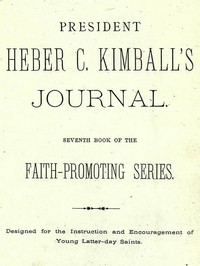
President Heber C. Kimball's Journal Seventh Book of the Faith-Promoting Series. Designed for the Instruction and Encouragement of Young Latter-day Saints — Inside the Classic
(0 User reviews)
585
Project Gutenberg
2014
Not confirmed
Latter Day Saint churches -- Missions -- Great Britain; Kimball, Heber C. (Heber Chase), 1801-1868 -- Diaries; Latter Day Saints -- Great Britain; Latter Day Saints -- Missionary experiences
Readers of public-domain and historical texts
Project Gutenberg digital edition
en
Edition facts
Words
40,562
Reading time
177 min
Text sections
5
The source record for President Heber C. Kimball's Journal Seventh Book of the Faith-Promoting Series. Designed for the Instruction and Encouragement of Young Latter-day Saints — Inside the Classic measures this digital text at 40,562 words, 2 hr 57 min estimated reading time, and 5 detected text sections.
The text analysis averages about 25.4 words per sentence, while the detected sections provide another way to judge how the source is divided.
Project Gutenberg metadata also associates the work with “Latter Day Saint churches -- Missions -- Great Britain,” connecting these edition facts with the source record’s subject description.
Source:
Project Gutenberg record #47519
Heber C. Kimball's journal covers four years of early Latter-day Saint history, including his arrest and confrontation with former associates during the Missouri conflict, with a preface praising his prophetic gifts and peacemaking role.
Editorial Edition Score
4.7/5
★★★★★
★★★★★
Calculated from edition completeness, EPUB availability, text structure and catalogue metadata. Not a user rating.
How this score is calculated
- Description quality20 pts
- Title & short description10 pts
- Source metadata20 pts
- Text length15 pts
- Chapters / structure15 pts
- EPUB file integrity20 pts
Total of 100 points, scaled to a 2.5-5.0 range. Editions with an empty description or a missing EPUB file are not scored.
Edition quality
Public-domain source text
Read the source text
The source text is kept in the dedicated reader, separate from this catalogue record and its commentary.
Heber C. Kimball's journal, published as the seventh volume of the Faith-Promoting Series, opens with a preface that frames the work as a moral lesson for young Latter-day Saints. The editor, George C. Lambert, emphasizes Kimball's prophetic inspiration and his role as a peacemaker, citing Joseph Smith's nickname for him. The narrative then plunges into the Missouri conflict, where Kimball is arrested alongside other church leaders. The text shifts abruptly from editorial praise to a first-person account of imprisonment, creating a contrast between the hagiographic frame and the raw, confrontational scenes that follow.
Confrontation and Defiance
The journal's most vivid passage recounts Kimball's encounter with former associates who had turned against the church. When William E. McLellin, once a member of the Twelve, taunts him about Joseph Smith's alleged failure, Kimball responds with a direct accusation: "I see you in the very position that he foretold you would be in—a Judas to betray your brethren." This exchange is structured as a dramatic dialogue, with Kimball seated on the ground, disarmed, yet speaking with unwavering certainty. The scene underscores the theme of loyalty and betrayal, as Kimball names specific individuals—McLellin, Lyman E. Johnson, John Whitmer, David Whitmer, and William W. Phelps—who had "piloted the mob into our city." The text does not explain their motives, leaving the reader to infer the depth of the schism.
The Mob's Theater of Power
Kimball's description of the mob's tactics reveals a deliberate performance of intimidation. Troops painted like Indians, led by a self-styled "Delaware chief," cock their guns at the prisoners. The mob's leader, Bogart, a Methodist preacher, initially offers to send a guard with Kimball but then accompanies him personally to his home, sharing a meal with Kimball and his wife. This odd intimacy—eating dinner with a prisoner—contrasts with the earlier threats and highlights the arbitrary nature of the captors' authority. The narrative moves from the collective humiliation of being "driven, like a parcel of menial slaves" to the mundane act of eating, then back to the prison square. These shifts in scale—from mass arrest to domestic detail—give the account a disorienting, episodic quality.
Structure of a Fragmentary Life
The journal covers only a little over four years, as the preface acknowledges, and the excerpts available focus heavily on the Missouri crisis of 1838. The text does not provide a continuous biography but rather a series of incidents selected to "promote faith." This selective structure means that readers encounter Kimball primarily in moments of crisis—arrest, imprisonment, and verbal sparring—rather than in everyday missionary work or church administration. The editor's hand is visible in the preface's praise of Kimball's "great faith, zeal, earnestness" and his "wonderful control over the passions of men," but the journal itself shows a man in a reactive posture, responding to threats rather than initiating action. The gap between the preface's idealized portrait and the journal's confrontational scenes creates a tension that invites scrutiny.
Recurring Images of Confinement and Release
Throughout the excerpts, images of physical restriction recur: men confined in a house, prisoners sitting on the ground, a city surrounded by guards. Kimball's request to go home for food is granted, but he must return to his seat on the ground. The mob's control is spatial—they dictate who can move, where, and when. Yet within this confinement, Kimball asserts verbal freedom, delivering a prophecy of damnation to his accusers. The journal also records moments of unexpected leniency: Bogart eating with him, permission to return home. These small releases do not negate the overall captivity but punctuate it, suggesting a world where power is exercised inconsistently. The pattern of confinement, confrontation, and temporary release shapes the narrative rhythm, making each episode of tension followed by a brief, uneasy calm.
Readers approaching this journal should attend to the gaps between the editorial frame and the first-person narrative. The preface promises edification, but the excerpts deliver a stark, fragmented account of persecution. Pay attention to the way Kimball names his betrayers and the precise language of his defiance—these are the moments where the text's purpose shifts from instruction to testimony. The journal does not explain the broader historical context; it assumes familiarity with the events of the Missouri Mormon War. For those new to the period, supplementary reading on the 1838 conflict will clarify the references to Crooked River, General Clark, and the extermination order.
In his journal, President Kimball recorded moments of quiet fortitude amidst upheaval, a testimony of steady character when all was uncertain. Years later, reading about Richard Lepsius, I felt that same patient resolution in a scholar tracing ancient scripts. Both men stood firm in their convictions, one amid persecution, the other amid fragments of the past. Their stories sit side by side on my shelf, a gentle reminder of faithfulness in different callings. Richard Lepsius, a biography — Story, Setting & Ideas holds that same quiet dignity.
There are no reviews for this eBook.
There are no comments for this eBook.
Reader reflection
What did you think of this book?
Answer a few questions and save a private reflection on this device.
Your progress
0
/
10
2
How did the book work for you overall?
3
How likely are you to recommend this book?
4
What was the reading difficulty like?
5
What was the strongest part of the book?
6
Did you gain anything practical from the text?
7
Did the story or argument move comfortably?
8
How clearly were the main ideas presented?
9
What changed or sharpened your thinking?
10