1

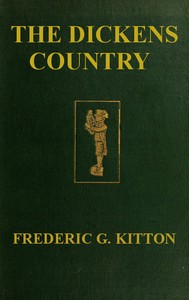
The Dickens Country — Text and Context
(0 User reviews)
1938
Project Gutenberg
2017
Not confirmed
Novelists, English -- 19th century -- Biography; England -- Intellectual life -- 19th century; Dickens, Charles, 1812-1870 -- Homes and haunts; Novelists, American -- Homes and haunts -- England; Literary landmarks -- England
Readers of public-domain and historical texts
Project Gutenberg digital edition
en
Edition facts
Words
72,315
Reading time
315 min
Text sections
11
The source record for The Dickens Country — Text and Context measures this digital text at 72,315 words, 5 hr 15 min estimated reading time, and 11 detected text sections.
The text analysis averages about 23.3 words per sentence, while the detected sections provide another way to judge how the source is divided.
Project Gutenberg metadata also associates the work with “Novelists, English -- 19th century -- Biography,” connecting these edition facts with the source record’s subject description.
Source:
Project Gutenberg record #56105
Frederic G. Kitton's 1905 topographical guide to places associated with Charles Dickens, illustrated with photographs by T. W. Tyrrell. The book traces Dickens's residences, travel routes, and fictional settings through England, drawing on letters, novels, and contemporary accounts. The excerpts show detailed local descriptions, such as Liverpool's docks and slums, and include quotations from Dickens's works.
Editorial Edition Score
4.8/5
★★★★★
★★★★★
Calculated from edition completeness, EPUB availability, text structure and catalogue metadata. Not a user rating.
How this score is calculated
- Description quality20 pts
- Title & short description10 pts
- Source metadata20 pts
- Text length15 pts
- Chapters / structure15 pts
- EPUB file integrity20 pts
Total of 100 points, scaled to a 2.5-5.0 range. Editions with an empty description or a missing EPUB file are not scored.
Edition quality
Public-domain source text
Read the source text
The source text is kept in the dedicated reader, separate from this catalogue record and its commentary.
Frederic G. Kitton's The Dickens Country, published in 1905 and illustrated with photographs by T. W. Tyrrell, is a topographical guide that maps the real locations connected to Charles Dickens's life and writings. The book belongs to Adam and Charles Black's 'Pilgrimage Series,' which included similar volumes on Scott, Thackeray, Hardy, and others. Kitton, a noted Dickens scholar who had previously written Charles Dickens by Pen and Pencil and Dickens and His Illustrators, died shortly before the book appeared; the introduction was supplied by a friend who recalled Kitton's 'thoroughly genial sympathy' toward fellow researchers.
A Posthumous Pilgrimage
The book's introduction reveals that Kitton died on September 10, 1904, before seeing his work in print. The writer recalls a conversation in Covent Garden about a year earlier, in which Kitton mentioned 'a book rather on the same lines on the stocks myself, but I don't know when it will get finished.' The introduction praises Kitton's freedom from 'literary jealousy' and his modesty, noting that 'no one in England was so well qualified' for the task. This framing positions the volume as both a scholarly resource and a memorial to its author's lifelong dedication to Dickensian research.
Liverpool Through Dickens's Eyes
Kitton devotes several pages to Liverpool, where Dickens performed readings and stayed at the Adelphi Hotel. The text quotes Dickens's description of St. George's Hall as 'brilliant to see when lighted up, and for a reading simply perfect.' Kitton also reproduces a long passage from Martin Chuzzlewit depicting the Mersey, noting that Dickens 'doubtless records his own impressions' from his 1842 return from America. A second excerpt from The Uncommercial Traveller describes Liverpool's slums as 'a labyrinth of dismal courts and blind alleys, called "entries"' and remarks on sailors' fondness for ornamental crockery. These examples show Kitton weaving together biography, fiction, and topography.
The Photographic Record
The volume contains forty-eight full-page illustrations, 'mostly from photographs by T. W. Tyrrell.' The frontispiece reproduces a previously unpublished photograph of Dickens from 1857. The illustrations are not merely decorative; they serve as visual evidence of the places Kitton describes. The book's subtitle and series branding emphasize the 'country' as a landscape to be toured, and Tyrrell's images ground the literary references in specific, contemporary views. This combination of text and photography aligns with the early twentieth-century vogue for illustrated topographical guides.
Readers should note that the excerpts represent only a fraction of the book's 72,000 words. The catalog subjects—'Literary landmarks,' 'Homes and haunts'—accurately reflect Kitton's method, but the work is more than a gazetteer: it integrates Dickens's own language with biographical anecdote and local history. The illustrations by Tyrrell are integral to the experience, offering a visual counterpart to Kitton's prose. Approach the book as a period piece of Dickens scholarship, valuable for its specific observations and its place in the Pilgrimage Series.
There are no reviews for this eBook.
There are no comments for this eBook.
Reader reflection
Record your reading impressions
A brief reflection can help important ideas stay with you longer.
Your progress
0
/
10
2
Did this book hold your interest?
3
Would you pass this book on to a friend?
4
Did the language feel accessible?
5
How did the pace of the book feel?
6
How much did the book move you?
7
What did you appreciate most?
8
How would you rate its originality?
9
In one sentence, what did you learn?
10