1

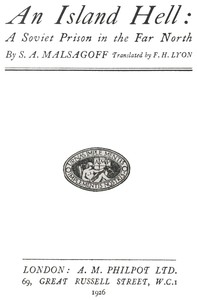
An island hell: A Soviet prison in the far north — Story, Setting & Ideas
(0 User reviews)
183
Project Gutenberg
2022
Not confirmed
Malʹsagov, S. A. (Sozerko Artaganovich), 1893-1976; Solovetskii lagerʹ osobogo naznacheniia -- History; Prisons -- Russia (Federation) -- Solovetski Islands -- History; Prisoners -- Soviet Union -- Biography
Readers of public-domain and historical texts
Project Gutenberg digital edition
en
Edition facts
Words
36,181
Reading time
158 min
Text sections
25
Before opening An island hell: A Soviet prison in the far north — Story, Setting & Ideas, the edition data offers a quick orientation: 36,181 words, 2 hr 38 min estimated reading time, and 25 detected text sections.
The text analysis averages about 18.4 words per sentence, while the detected sections provide another way to judge how the source is divided.
Project Gutenberg metadata also associates the work with “Malʹsagov, S. A. (Sozerko Artaganovich), 1893-1976,” connecting these edition facts with the source record’s subject description.
Source:
Project Gutenberg record #68923
A 1926 firsthand account by a White Guard officer who escaped from the Solovetsky Islands prison camp. The narrative details camp hierarchy, hunger strikes, and the author's flight across the Russian-Finnish border, offering specific observations on the treatment of political prisoners and common criminals.
Editorial Edition Score
4.8/5
★★★★★
★★★★★
Calculated from edition completeness, EPUB availability, text structure and catalogue metadata. Not a user rating.
How this score is calculated
- Description quality20 pts
- Title & short description10 pts
- Source metadata20 pts
- Text length15 pts
- Chapters / structure15 pts
- EPUB file integrity20 pts
Total of 100 points, scaled to a 2.5-5.0 range. Editions with an empty description or a missing EPUB file are not scored.
Edition quality
Public-domain source text
Read the source text
The source text is kept in the dedicated reader, separate from this catalogue record and its commentary.
From the opening pages, Malsagoff frames his account as a legal testimony: he calls his notes 'the testimony of a fair witness who speaks the truth and only the truth.' The book is structured in three parts, moving from his arrest in the Caucasus to the Solovetsky Islands and finally to his escape across the Finnish border. The table of contents reveals a systematic approach, with chapters on camp administration, daily life, and specific prisoner categories such as 'Counter-Revolutionaries' and 'Politicals.'
The excerpts show that Malsagoff does not claim literary polish; he states his notes 'make no claim either to literary qualities and beauty of style or to exhaustive completeness.' Instead, he insists on factual reporting, a stance that shapes the book's direct, documentary tone.
A Witness, Not a Writer
Malsagoff explicitly distances his work from literature, calling it 'the testimony of a fair witness.' This is not modesty but a deliberate rhetorical choice. The prose is plain, almost legalistic, with frequent references to dates, numbers, and specific incidents. For example, he notes that the hunger strike of 1924 lasted thirteen days, resulting in several deaths and about a hundred hospitalizations. He also records the exact rations won by political prisoners: '2 lbs. of bread (white and black), 1 lb. of meat, good butter, milk, eggs, etc.'
This precision extends to the escape narrative, which is broken into stages with chapter titles like 'Our Flight: The First Stage' and 'A Terrible March.' The author's voice is that of a reporter, not a memoirist, and he often addresses the reader directly, as when he explains that the Solovky were 'absolutely unknown' outside Soviet Russia because no prisoner had previously escaped across the frontier.
Hierarchies of Suffering
The excerpts reveal a complex social order among prisoners. Malsagoff distinguishes between 'K.R.'s' (counter-revolutionaries), 'shpana' (criminals), and 'politicals' (Socialists and party men). He notes that politicals, despite being ideological opponents of the Bolsheviks, secured better conditions through collective action. The discipline among Socialists, he writes, 'excels even that of the shpana.'
One striking incident involves a skating rink: in winter 1923, politicals built a rink near the monastery, sang revolutionary songs, and were fired upon by Nogteff's troops, killing nine. The politicals then declared a hunger strike, forcing a commission from Moscow. Malsagoff records that Nogteff was not punished—the commission ruled he acted in self-defense. This episode illustrates both the prisoners' organized resistance and the administration's impunity.
Malsagoff also notes an 'atrocious injustice': politicals did no work, while K.R.'s bore the brunt of labor. This hierarchy complicates any simple victim narrative.
Escape as Evidence
The third part of the book, 'Our Escape,' is the most dramatic but also the most carefully documented. Malsagoff and four companions left the Solovetsky Islands on May 18, 1925, and crossed into Finland on June 15—a journey of thirty-six days. He emphasizes that no prisoner had ever succeeded in escaping across the frontier before, which is why the outside world knew nothing of the camp.
The escape narrative is not romanticized. Chapter titles like 'A Terrible March' and 'Laying our Plans' suggest a methodical, harrowing ordeal. Malsagoff's purpose is evident: he wants his flight to serve as proof of the camp's conditions. By reaching Finland, he could present his testimony to European audiences. The book itself is that testimony, and the escape is its climax—not a thrilling adventure but a piece of evidence that the Solovky existed and that the truth could be carried out.
Readers should approach this book as a primary document rather than a polished memoir. Malsagoff's biases are clear: he is a White Guard officer, hostile to Bolshevism, and he writes to indict the Soviet system. Yet his attention to detail—dates, rations, numbers of dead—gives the account a forensic quality. The excerpts show a man who believes that facts alone can convict. For those studying Soviet prison camps, this is an early, firsthand report from a survivor who risked everything to get the story out.
That Solovetsky account stayed with me—how a man holds onto his inner thread through sheer isolation. It reminded me of something quieter I once read, Leaves from My Journal: Third Book of the Faith-Promoting Series Designed for the Instruction and Encouragement of Young Latter-Day Saints — Text and Context, where faith, not escape, becomes the daily act of survival. Different prisons, same stubborn light.
There are no reviews for this eBook.
There are no comments for this eBook.
Reader reflection
What was your reading experience?
Capture what you thought, learned, and would like to remember.
Your progress
0
/
10
2
How did the book work for you overall?
3
How likely are you to recommend this book?
4
Did the language feel accessible?
5
How clearly were the main ideas presented?
6
How strongly did the book affect you emotionally?
7
How would you describe its reading pace?
8
How closely did the book connect with your experience?
9
What is the main idea you are taking away?
10