1

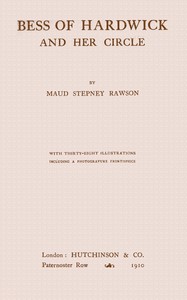
Bess of Hardwick and Her Circle — Edition Insights
(0 User reviews)
1547
Project Gutenberg
2021
Not confirmed
Nobility -- Great Britain -- Biography; Great Britain -- History -- Elizabeth, 1558-1603 -- Biography; Shrewsbury, Elizabeth Hardwick Talbot, Countess of, 1527?-1608; Women landowners -- Great Britain -- Biography
Readers of public-domain and historical texts
Project Gutenberg digital edition
en
Edition facts
Words
110,165
Reading time
479 min
Text sections
68
For Bess of Hardwick and Her Circle — Edition Insights, the stored edition analysis reports 110,165 words, 7 hr 59 min estimated reading time, and 68 detected text sections.
The text analysis averages about 23.2 words per sentence, while the detected sections provide another way to judge how the source is divided.
Project Gutenberg metadata also associates the work with “Nobility -- Great Britain -- Biography,” connecting these edition facts with the source record’s subject description.
Source:
Project Gutenberg record #65787
Maud Stepney Rawson's 1910 biography of Elizabeth Hardwick uses letters and household details to portray Bess's ambition, family tensions, and her role as gaoler to Mary Queen of Scots, with two fictional interludes.
Editorial Edition Score
4.9/5
★★★★★
★★★★★
Calculated from edition completeness, EPUB availability, text structure and catalogue metadata. Not a user rating.
How this score is calculated
- Description quality20 pts
- Title & short description10 pts
- Source metadata20 pts
- Text length15 pts
- Chapters / structure15 pts
- EPUB file integrity20 pts
Total of 100 points, scaled to a 2.5-5.0 range. Editions with an empty description or a missing EPUB file are not scored.
Edition quality
Public-domain source text
Read the source text
The source text is kept in the dedicated reader, separate from this catalogue record and its commentary.
Rawson opens her biography with a frank admission: she has inserted two brief fictional episodes into an otherwise historical narrative, offering them as consolation for 'hard and bitter facts.' This hybrid approach—part documentary, part imaginative reconstruction—shapes the entire work. The author's dedication frames Bess of Hardwick as a 'hungry woman of Elizabethan days,' driven by ambition for land and heirs. Readers should expect a portrait built from family letters, legal records, and household accounts, but one that occasionally steps into speculative scenes to animate the past.
Letters as Evidence of Marital Strain
The excerpts include a remarkable series of letters between Bess and her fourth husband, the Earl of Shrewsbury, and between their son Gilbert and Bess. Bess's own note—'I have sent you lettuce for that you love them'—shows a practical, affectionate wife, but her postscript about 'your charge and love' has puzzled historians. Rawson argues forcefully that 'love' refers to a child or grandchild, not Mary Queen of Scots, and she uses this to defend Bess against accusations of impropriety. Gilbert's letters paint a bleaker picture: he describes his father as 'continually pestered with his wonted business' and 'in exceeding choler,' while contrasting the Earl's stinginess with Bess's generosity. These documents reveal a household divided by temperament and money.
The Earl's Parsimony and Bess's Generosity
Gilbert's complaint about his father's refusal to provide a 'bed of cloth of gold and tawny velvet'—instead offering old green and red hangings and 'two very old counterpanes of tapestry'—illustrates a recurring tension. Rawson juxtaposes this with Bess's gifts of 'a great deal of furniture,' positioning her as the more open-handed parent. The author notes that a previous family letter had already shown the Earl's parsimony, and she uses these details to build a case for Bess's managerial competence and emotional investment in her children's welfare. The contrast is sharp: the Earl hoards, Bess equips. This pattern of evidence, drawn from household records, gives the biography a material texture.
Fictional Interludes as Historical Method
Rawson's preface warns orthodox historians to 'skip these judiciously, magisterially,' but she defends her choices: 'I needed consolation at times for certain hard and bitter facts.' The excerpts do not include the fictional passages themselves, so readers must infer their content from her description of 'draw[ing] my Countess down from her picture-frame to marshal her household' and 'lur[ing] her child and her child's lover after her.' This technique suggests a desire to humanize figures who might otherwise remain remote. The biography thus oscillates between archival rigor and novelistic empathy, a duality that may surprise readers expecting a conventional life story.
The Physical World of Elizabethan Houses
Rawson repeatedly evokes the built environment: 'the ruins of those manors and castles where the Scots Queen and her married gaolers dwelt,' the 'splendid grey façade of Hardwick,' and the 'draughts of the sombre, public research libraries.' These details ground the narrative in specific places—Chatsworth, Sheffield, Hardwick Hall. Bess's request for 'great hangings and carpets' and the Earl's refusal to part with fine furnishings show how domestic objects carried social meaning. The biography treats architecture and interior decoration as evidence of status, economy, and family dynamics. Readers attentive to material culture will find Rawson's descriptions of tapestries, beds, and houses as revealing as her transcriptions of letters.
Rawson's biography rewards readers who attend to the interplay between documentary evidence and imaginative sympathy. The letters, with their mix of affection, complaint, and practical detail, offer a direct line to Elizabethan domestic life. The two fictional interludes—though absent from these excerpts—signal the author's willingness to step beyond the archive. Approach the book as a portrait built from fragments: household accounts, family quarrels, and the looming presence of Mary Queen of Scots. The result is less a definitive life than a vivid, opinionated reconstruction.
Reading Rawson's portrayal of Bess as gaoler, surrounded by her own soaring ambitions and locked rooms, I remembered my grandmother’s ledger of household accounts. She kept every receipt, every grievance, like Bess’s letters. That same quiet weight of domestic history led me once to The Story of Opal: The Journal of an Understanding Heart — Inside the Classic, where a child’s private world felt just as vast and carefully guarded.
There are no reviews for this eBook.
There are no comments for this eBook.
Reader reflection
What was your reading experience?
Capture what you thought, learned, and would like to remember.
Your progress
0
/
10
2
What was your overall reaction to the book?
3
Is this a title you would suggest to others?
4
How much effort did this book require?
5
Which element worked best for you?
6
Was the book easy to understand?
7
How strongly did the book affect you emotionally?
8
How well did it match your expectations?
9
What did this book teach you most?
10