1

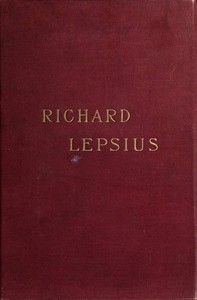
Richard Lepsius, a biography — Story, Setting & Ideas
(0 User reviews)
146
Project Gutenberg
2024
Not confirmed
Lepsius, Richard, 1810-1884; Egyptologists -- Germany -- Biography
Readers of public-domain and historical texts
Project Gutenberg digital edition
en
Edition facts
Words
95,393
Reading time
415 min
Text sections
10
The catalog record for Richard Lepsius, a biography — Story, Setting & Ideas provides practical reading context through 95,393 words, 6 hr 55 min estimated reading time, and 10 detected text sections.
The text analysis averages about 25.9 words per sentence, while the detected sections provide another way to judge how the source is divided.
Project Gutenberg metadata also associates the work with “Lepsius, Richard, 1810-1884,” connecting these edition facts with the source record’s subject description.
Source:
Project Gutenberg record #74815
Georg Ebers's biography of Egyptologist Richard Lepsius, drawing on personal correspondence and professional accounts, details his pioneering work in Egyptology, including the organization of the Berlin Egyptian Museum and his historical method of classification. The excerpts focus on the museum's layout and the debate over its decorative approach.
Editorial Edition Score
4.9/5
★★★★★
★★★★★
Calculated from edition completeness, EPUB availability, text structure and catalogue metadata. Not a user rating.
How this score is calculated
- Description quality20 pts
- Title & short description10 pts
- Source metadata20 pts
- Text length15 pts
- Chapters / structure15 pts
- EPUB file integrity20 pts
Total of 100 points, scaled to a 2.5-5.0 range. Editions with an empty description or a missing EPUB file are not scored.
Edition quality
Public-domain source text
Read the source text
The source text is kept in the dedicated reader, separate from this catalogue record and its commentary.
Georg Ebers's biography of Richard Lepsius opens with a dedication to Johannes Dümichen, praising his fieldwork in Egypt. The excerpts then shift to a detailed description of the Berlin Egyptian Museum, emphasizing Lepsius's historical method of arranging artifacts chronologically. The text notes that the museum's wall paintings, while beautiful, have drawn criticism for distracting from the monuments themselves. This editorial note examines how the catalog subjects—Egyptologists and biography—align with the actual content, which centers on museum curation and scholarly debate rather than personal life.
Museum as Biography
The excerpts devote considerable space to the layout and philosophy of the Berlin Egyptian Museum, describing its three halls: the first with astronomical and mythological scenes, the second mimicking an Egyptian temple, and the third displaying historical artifacts. Ebers explains that Lepsius introduced a historical method of classification, grouping objects by chronological succession. This focus on museum organization suggests that the biography uses the museum as a lens to understand Lepsius's intellectual contributions. The catalog subject "Egyptologists" is thus realized through a detailed account of curatorial practice, not through personal anecdotes or chronological life events.
The Decoration Debate
A notable passage presents a controversy: critics argue that the museum's pictorial decorations distract visitors from the monuments, while Ebers defends them as educational tools for laypeople. He writes that the pictures "make him familiar with the high and peculiar culture" of ancient Egypt. This debate reveals Ebers's own stance as a popularizer of Egyptology, valuing accessibility alongside scientific rigor. The biography thus engages with contemporary museum theory, showing Lepsius's work as both innovative and contested. The excerpts do not resolve the debate, leaving readers to consider the tension between aesthetic appeal and scholarly focus.
Evidence of Fieldwork
Although the excerpts focus on the Berlin museum, the dedication to Dümichen provides glimpses of fieldwork: copying inscriptions in tombs, enduring hardship, and working without government support. Ebers describes Dümichen's "self-sacrificing devotion" and the "great sacrifices of comfort, sleep, health, and your own property" required for such work. These details, while about a colleague, imply similar qualities in Lepsius. However, the biography's main text appears to emphasize institutional achievements over personal narrative. Readers seeking accounts of Lepsius's own expeditions will need to look beyond the provided excerpts, which center on his curatorial legacy.
The biography's focus on museum organization and scholarly debate offers a distinctive angle on Lepsius's life, prioritizing his intellectual impact over personal chronology. Readers interested in the history of museum curation or the popularization of Egyptology will find this work valuable. The excerpts suggest a text that balances technical description with advocacy for public education, making it a resource for understanding how 19th-century scholars shaped public perception of ancient Egypt.
Reading about Lepsius arranging the Berlin museum’s halls, I remembered my own university days, wandering corridors of dusty casts and feeling the quiet weight of curatorial choices. It stirred that same tender ache I found in My Story — A Closer Reading, where a life, too, is carefully arranged and displayed. Both books whisper how we curate our own pasts, placing memories like artifacts.
There are no reviews for this eBook.
There are no comments for this eBook.
Reader reflection
Before you leave, reflect on the book
Use these questions to collect your thoughts before moving on.
Your progress
0
/
10
2
Did this book hold your interest?
3
How likely are you to recommend this book?
4
How much effort did this book require?
5
Was the book easy to understand?
6
Would you start a conversation about this book?
7
How did the pace of the book feel?
8
How original did the book feel?
9
What is the main idea you are taking away?
10