1

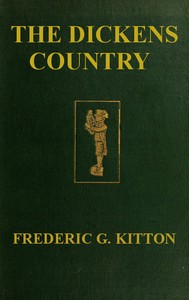
The Dickens Country — Text and Context
(0 User reviews)
1912
Project Gutenberg
2017
Not confirmed
Novelists, English -- 19th century -- Biography; England -- Intellectual life -- 19th century; Dickens, Charles, 1812-1870 -- Homes and haunts; Novelists, American -- Homes and haunts -- England; Literary landmarks -- England
Readers of public-domain and historical texts
Project Gutenberg digital edition
en
Edition facts
Words
72,315
Reading time
315 min
Text sections
11
The source record for The Dickens Country — Text and Context measures this digital text at 72,315 words, 5 hr 15 min estimated reading time, and 11 detected text sections.
The text analysis averages about 23.3 words per sentence, while the detected sections provide another way to judge how the source is divided.
Project Gutenberg metadata also associates the work with “Novelists, English -- 19th century -- Biography,” connecting these edition facts with the source record’s subject description.
Source:
Project Gutenberg record #56105
Frederic G. Kitton's 1905 topographical guide to places associated with Charles Dickens, illustrated with photographs by T. W. Tyrrell. The book traces Dickens's residences, travel routes, and fictional settings through England, drawing on letters, novels, and contemporary accounts. The excerpts show detailed local descriptions, such as Liverpool's docks and slums, and include quotations from Dickens's works.
Editorial Edition Score
4.8/5
★★★★★
★★★★★
Calculated from edition completeness, EPUB availability, text structure and catalogue metadata. Not a user rating.
How this score is calculated
- Description quality20 pts
- Title & short description10 pts
- Source metadata20 pts
- Text length15 pts
- Chapters / structure15 pts
- EPUB file integrity20 pts
Total of 100 points, scaled to a 2.5-5.0 range. Editions with an empty description or a missing EPUB file are not scored.
Edition quality
Read the Text
paring a map of England that should indicate, by means of a tint, those portions especially associated with Charles Dickens and his writings. This map makes manifest the fact that the country thus most intimately connected with the novelist is the south-eastern portion of England, having London as the centre and Rochester as the “literary capital,” and including the counties of Norfolk, Suffolk, Essex, Kent, Surrey, Sussex, Hampshire, and Warwickshire, with an offshoot extending to the northern boundary of Yorkshire.
All literary pilgrims, and particularly the devotees of Charles Dickens, regard as foremost among literary shrines inviting special homage the scene of the nativity of “Immortal Boz.” Like the birthplaces of many an eminent personage who first saw the light in the midst of a humble environment, the dwelling in which Dickens was born is unpretentious enough, and remains unaltered. The modest abode rented shortly after marriage by John Dickens (the future novelist’s father), from June, 1809, to June, 1812, stands in Commercial Road, Portsmouth, the number of the house having been recently changed from 387 to 393. The district was then known as Landport, in the Island of Portsea, but is now incorporated with Portsmouth; a comparatively rural locality at that time, it has since developed into a densely populated neighbourhood, covered with houses and bisected by the main line of the municipal tramways.[1] It is, however, yet within the memory of middle-aged people when this area of brick and mortar consisted of pasture land in which trees flourished and afforded nesting-places for innumerable birds—a condition of things recalled by the names bestowed upon some of the streets hereabouts, such as Cherry Garden Lane and Elm Road—but now “only children flourish where once the daisies sprang.”
The birthplace of Charles Dickens, which less than half a century ago overlooked green fields, is an interesting survival of those days of arboreal delights; and the broad road, on the west side of which it is situated, leads to Cosham and the picturesque ruin of Porchester Castle. In 1809 John Dickens was transferred from Somerset House to the Navy Pay-Office at Portsmouth Dockyard, and, with his young wife, made his home here, in which were born their first child (Frances Elizabeth) in 1810, and Charles on February 7, 1812. This domicile is a plain, red-brick building containing four rooms of moderate size and two attics, with domestic offices; in front there is a small garden, separated from the public roadway by an iron palisading; and a few steps, with a hand-rail, lead from the forecourt to the hooded doorway of the principal entrance. The front bedroom is believed to be the room in which Dickens was born. From the apartments in the rear there is still a pleasant prospect, overlooking a long garden, where flourishes an eminently fine specimen of the tree-mallow. On the death of Mrs. Sarah Pearce, the owner and occupier (and last surviving daughter of John Dickens’s landlord), the house was offered for sale by public auction on Michaelmas Day, 1903, when, much to the delight of the townspeople as well as of all lovers of the great novelist, it was purchased by the Portsmouth Town Council for preservation as a Dickens memorial, and with the intention of adapting it for the purposes of a Dickens Museum. The purchase price was £1,125, a sum exceeding by five hundred pounds the amount realized on the same occasion by the adjoining freehold residence (No. 395), which is identical in character—an interesting and significant testimony as to the sentimental value attaching to the birthplace of “Boz.”
Frederic G. Kitton's The Dickens Country, published in 1905 and illustrated with photographs by T. W. Tyrrell, is a topographical guide that maps the real locations connected to Charles Dickens's life and writings. The book belongs to Adam and Charles Black's 'Pilgrimage Series,' which included similar volumes on Scott, Thackeray, Hardy, and others. Kitton, a noted Dickens scholar who had previously written Charles Dickens by Pen and Pencil and Dickens and His Illustrators, died shortly before the book appeared; the introduction was supplied by a friend who recalled Kitton's 'thoroughly genial sympathy' toward fellow researchers.
A Posthumous Pilgrimage
The book's introduction reveals that Kitton died on September 10, 1904, before seeing his work in print. The writer recalls a conversation in Covent Garden about a year earlier, in which Kitton mentioned 'a book rather on the same lines on the stocks myself, but I don't know when it will get finished.' The introduction praises Kitton's freedom from 'literary jealousy' and his modesty, noting that 'no one in England was so well qualified' for the task. This framing positions the volume as both a scholarly resource and a memorial to its author's lifelong dedication to Dickensian research.
Liverpool Through Dickens's Eyes
Kitton devotes several pages to Liverpool, where Dickens performed readings and stayed at the Adelphi Hotel. The text quotes Dickens's description of St. George's Hall as 'brilliant to see when lighted up, and for a reading simply perfect.' Kitton also reproduces a long passage from Martin Chuzzlewit depicting the Mersey, noting that Dickens 'doubtless records his own impressions' from his 1842 return from America. A second excerpt from The Uncommercial Traveller describes Liverpool's slums as 'a labyrinth of dismal courts and blind alleys, called "entries"' and remarks on sailors' fondness for ornamental crockery. These examples show Kitton weaving together biography, fiction, and topography.
The Photographic Record
The volume contains forty-eight full-page illustrations, 'mostly from photographs by T. W. Tyrrell.' The frontispiece reproduces a previously unpublished photograph of Dickens from 1857. The illustrations are not merely decorative; they serve as visual evidence of the places Kitton describes. The book's subtitle and series branding emphasize the 'country' as a landscape to be toured, and Tyrrell's images ground the literary references in specific, contemporary views. This combination of text and photography aligns with the early twentieth-century vogue for illustrated topographical guides.
Readers should note that the excerpts represent only a fraction of the book's 72,000 words. The catalog subjects—'Literary landmarks,' 'Homes and haunts'—accurately reflect Kitton's method, but the work is more than a gazetteer: it integrates Dickens's own language with biographical anecdote and local history. The illustrations by Tyrrell are integral to the experience, offering a visual counterpart to Kitton's prose. Approach the book as a period piece of Dickens scholarship, valuable for its specific observations and its place in the Pilgrimage Series.
There are no reviews for this eBook.
There are no comments for this eBook.
Reader reflection
Record your reading impressions
A brief reflection can help important ideas stay with you longer.
Your progress
0
/
10
2
Did this book hold your interest?
3
Would you pass this book on to a friend?
4
Did the language feel accessible?
5
How did the pace of the book feel?
6
How much did the book move you?
7
What did you appreciate most?
8
How would you rate its originality?
9
In one sentence, what did you learn?
10